GoGeezer

Get up and GO, Geezer!

  • Hey all. What follows is another work of short fiction. This one originated in a very strange vivid dream I had recently. The people involved in this story aren’t real, of course. (I said it is fiction.) I did pull bits of personalities from friends and acquaintances. So, if you think I’m talking about you, I’m not.

    More generally, what’s going on is that I’m gearing up to start writing again. (I don’t consider this blog ‘writing’.) There have been several periods in my life when I longed to be a writer. I tried my hand at it whenever the desire overtook me. What I’ve discovered is that wanting to write and actually producing something worth reading are two vastly different things. My early efforts were HORRIBLE, but they did do one thing; they provided the outlet I needed, and the practice, to produce something that did not completely suck.

    During one of those periods when I was trying to write science fiction I attended a SciFi Convention. It hosted a bunch of well known writers, including Ben Bova, who wrote THX 1138, a movie that was directed by a pre-2001:A Space Odyssey Stanley Kubrick.

    Between lectures I went to get a drink at a nearby bar. As I sat at the bar mulling over whether I should continue my writing efforts, Ben Bova pulled up a stool next to me and ordered a drink. We started chatting and he asked me if I’ve written anything. I was embarrassed to tell him that, yes, I had tried to write, but nothing I’d written was any good. He said that there are a lot of people who call themselves writers who haven’t written so much as a single word, that I had written several stories was far more accomplished than many. Then he offered to read and critique one of my stories.

    I was floored at the opportunity, and nervous that someone of his caliber would see how amateurish my efforts were. Even so, I sent him a story and he reviewed it. He wrote encouraging comments throughout and said it was a good story that needed polishing.

    Back then, the only thing I knew how to polish was my car and my shoes. Still, I made the effort and sent the story into several publishers. No one liked it enough to publish it.

    Disheartened, I set my efforts aside, but the desire has always been there. So, I’m at it again.

    Many of you enjoyed my last short fiction titled ‘Grandpa’. Your responses to that story were so encouraging. Thank you! I hope you enjoy this one as well.

    Dead Meet

    “You? You’re dead meet!”

    I’m thinking that she’s supposed to be a friend, but what she was telling me kind of smacks me in the feels. “Why am I dead meat? I don’t remember doing anything to anybody worth killing me over?”

    “Not meat, like a steak, you dolt! Meet, like people getting together,” Amanda replied before she bit into her reuben. She chewed while appraising my reaction to her clarification. Satisfied that I was still flummoxed, she focused more intently on her sandwich.

    “I don’t get it. Dead Meet? What does that even mean? I meet someone, then I kill them? I’m a serial killer now?”

    Amanda swallowed and took a sip of her Chardonnay, smiling. She likes to keep me guessing, knowing it irritates me. At that instant, the thought of putting my butter knife through Amanda’s heart had a certain appeal. Fortunately for her, violence is not a big part of my nature, which is often the subject of her amateurish psychoanalysis.

    “No,” she said, “you don’t kill the people you meet, at least not that I’m aware of. You kill any potential for a relationship.” Her smile broadened while she eyed me with mock suspicion. “You haven’t killed anyone lately, have you?”

    My irritation was beyond her attempt at humor. “No, but there are still a few hours left before I call it a day. Stop screwing around and explain what you mean by ‘dead meet’.”

    My turkey club sat before me pretty much as the waitress had delivered it. I had nibbled on a potato chip and had tasted my merlot, but my appetite had left the scene, and my patience was packing up to follow.

    Amanda and I have known each other for years. I can confidently call her a friend because I know that if I needed help or an ear to chew on, she’d be there for me. And I believe she has the same confidence in my relationship with her. However, ours is a passive-aggressive relationship: I’m the passive one while she’s aggressive. When we get together for lunch, it is Amanda who usually dominates the conversation while I listen, smile, and nod when appropriate. I don’t mind; I’m not much of a talker. It’s not that I don’t have anything to say, it’s just that I don’t readily volunteer what I perceive as the more mundane aspects of my life, which, unfortunately, describes my entire existence. Amanda has never felt that way. Every action or thought, every social interaction, no matter how detailed, is fodder for stories to be espoused, with a heavy helping of literary license, between bites of food and sips of wine.

    When she’s not relating the minutiae of her social life, she, what I believe is a personal hobby of hers, picks apart what she thinks I’m doing wrong with my life. I think she means well, but it does tend to get more than a little annoying at times.

    This was one of those times. 

    For the most part, I’m satisfied with where I am in life. I have a decent job where my IT skills are appreciated, more often than not with monetary rewards. I have an eclectic group of friends whose social, political, and ideological values are similar, but not exactly the same as mine. And I’m in reasonably good shape for a 33-year-old Black man, though at five feet, eleven inches, I wish I was a bit taller.

    The only aspect of my life I’m not happy with is intimate companionship, or rather, the lack of it. I’ve had three girlfriends since high school. None of them stayed around longer than a year, and I think the only reason the one stayed that long was because sex was good (at least, it was for me). Contrary to what some guys will tell you, no intimate relationship survives on sex alone. And while I have indulged in casual sex, the encounters have always left me feeling unfulfilled. 

    Yeah, I know; guys aren’t supposed to be that in touch with their feelings, and outwardly I guess I appear as a typical guy in that regard, but being alone gives one lots of time for introspection. Identifying that part of me would probably win me kudos from a therapist, but it hasn’t helped me figure out how to fix my lack of companionship.

    I made the mistake of explaining that much to Amanda, who immediately decided to fix it in her own way. Hence, the label, ‘Dead Meet Guy’.

    Amanda’s great at identifying my problems, or so she thinks, but not so great at coming up with solutions.

    “What you need to do is shut up and listen more,” she told me while masticating a mouthful of rueben. 

    “Huh? You’re kidding, right? Are you saying I talk too much?” 

    Amanda swallowed and wiped her mouth with a napkin. She really appeared to be enjoying her sandwich as much as she’s enjoying aggravating me. “It isn’t how much you talk, it’s what you say when you do speak. You don’t pay attention to what’s being said, and when you do open your mouth, what comes out is wrong.”

    “I listen,” I insisted. “In fact, I consciously try my best to hear what women are saying to me.”

    Amanda took another sip of her Chardonnay and eyed me thoughtfully. “No,” she replied after a moment. “You may hear what’s being said, but you don’t listen to what’s being said. There’s a difference.”

    “OK,” I said, letting my irritation bleed into my reply. “I know I’m not the sharpest knife on the rack, but I think I know that hearing and listening is pretty much one and the same.”

    “And you’d be wrong,” Amanda said, suppressing a smirk.

    I nibbled at another chip, hoping it would help me suppress a more emotionally immature and somewhat caustic urge of my own. I don’t know why I let her get to me this way.  The thing is, somewhere rooting around in my subconscious, caged by a male ego that hasn’t matured past twelve years old, I know she’s right. I hear, but years of being my own counsel, which filters out much of what others say to me, I tend to miss where they intend for a conversation to go, and I strike out on my own, so my responses, my inputs don’t line up, giving me the appearance of being self-indulgent and not really paying attention. In reality, it’s a survival skill that gets me by without having to rely on or, more importantly, trust anyone. I hear, I listen, I may then dismiss or reduce the importance of the other person’s view because I don’t trust it. 

    So, I’m a man-child with trust issues. Therapists everywhere would likely cheer and give each other high-fives if I had said that out loud. 

    I took a long pull from my wine glass. I needed the alcoholic lubricant, wishing it was something stronger, to get me through this lunch without sounding or acting like an 180-pound twelve-year-old. “OK,” I said, “ if what you say is true, then what do I do about it?”

    As I’ve said before, Amanda is great at nitpicking my psyche, but not so great at providing fixes. She shrugged, swallowed, and replied, “I dunno. Listen better, maybe?” 

    “And how do I listen better?”

    Amanda picked up what was left of her rueben to finish it off, but then put the sandwich down, wiped her hands and reached across the table, right palm open as an invitation. 

    “What?” I asked.

    She remained silent, her eyes drilling into mine, making me uncomfortable. Her hand remained open, inviting. 

    Reluctantly, I placed my right hand into hers, and she immediately grabbed it tightly and yanked, surprising me and pulling me against the table. 

    “What the hell, Amanda!” I started to pull my hand away, but her grip was firm, and she pulled even more. 

    I looked down at my hand and then up at her. Any semblance of her usual playfulness was gone. The intensity of her gaze was immediately unsettling, and I started to look away. She pulled my hand again, insisting, without words, that I look at her.

    “Do I have your attention?” she asked. Her voice was low and even, serious. 

    When I didn’t respond, she gave my hand a yank and repeated, “Do I have your attention?”

    “Uh…, yeah!”

    “Your complete and undivided attention?”

    “Yes! What the Hell?”

    She relinquished her grip and sat back. “That’s how you listen,” she stated, then popped the remains of her rueben into her mouth.

    I sat back as well. Her grip hadn’t hurt, but I rubbed away the intensity of it. I took another drink from my wine glass as my mind assessed what she had done and said, picking it all apart, scrutinizing every aspect of the incident.  

    “So,” I began. “What you’re saying is that I need to be present when I listen, and focus on the other person, try to understand what she is saying.”

    Amanda nodded. 

    “And that will get me a relationship?”

    “It’s a start. I can’t fix everything for you, Dead Meet Boy!”

    I grimaced. “You need to stop calling me that.”

    Amanda chuckled. “I will when you stop killing your relationships.”

    Epilogue

    It’s been three months since that very odd, but very telling lunch with Amanda. During that time, I’ve been on two dates, and the last one might actually turn into something more. Her name is Rachel, and she says that I’m the first guy she’s met in a while that actually listens to her.  We’re going out again this Friday.

    Yeah, I’ve been practicing. I still have a ways to go, and I still have trust issues, but I’ve found that, initially at least, it isn’t about trust; it’s about learning, being open to the experiences of others. Trust comes in time, and time can only be had if the other person wants to stick around. And the other person will want to stick around if they believe you are into them. And they will know that you are into them if you really listen. 

    Huh! Who knew?

    Amanda did!

    Maybe it’s time I buy Amanda lunch to thank her. I understand that she really likes a good rueben.

    The end.

    Hope you enjoyed it. As I’d mentioned in the beginning, any semblance of the people in this little vignette to real folks is purely coincidental. I will admit to putting a bit of myself in the protagonist.

    Way before my hearing loss became an issue, hearing to others was something that I prided myself on. I had friends and stranger spilling their most intimate problems and secrets to me, confident that I would neither judge or use what they told me as gossip fodder.

    But as I look back on many of those conversations one thing became glaringly clear; while I heard what was being said to me, I seldom listened. And because I wasn’t listening I could not deduce what wasn’t being said. In other words, I couldn’t read (or hear, in this case) between the lines.

    Now that my hearing sucks, I find that I really, really want to listen and understand what’s being said to me.

    Life can be cruel!

    Stay tuned.
  • Preface: The following is a work of short fiction. While the description of my grandfather is fairly accurate, the story you are about to read never happened.

    The idea for the story came to me a few days ago and, for some reason I’ve yet to resolve, I could not forget it. So, I decided to write it out, and this is the result.

    I’d appreciate any comments or critiques.

    I hope you enjoy the story.

    Grandpa

    My grandpa was an enigmatic entity who had a “good job” working for the B&O Railroad. In what capacity, I never knew, but back then there were few jobs for Black men that wasn’t in the service sector. I assumed he was a conductor. He was always dressed in a black suit over a dark blue vest, which was over a starched white collared shirt, fastened to the top and completed with a dark blue necktie. He was an imposing figure, at least to my very young eyes, stern of countenance, dark-skinned, and clean-shaven. 

    Whenever I visited my grandparents’ house in South Baltimore on evenings and weekends, I would usually see Grandpa sitting in a large winged-backed chair next to the window in the living room of my grandparents’ row house. He didn’t say much, at least not to me or any of his many grandkids that I ever recall, but then, he didn’t have to. If us kids got too rambunctious, he would just give us a look, and we’d immediately get quiet and move our activities elsewhere. Hearing his voice, the rumble after the initial boom of thunder, was as rare as lightning in a snowstorm.

    But there was one time when grandpa spoke to me, directly.

    I was sitting on the marble steps of Grandpa’s house late one spring evening, staring up at what I thought were strange clouds. 

    “What are you looking at, boy?” My Grandpa had come home from work, and I hadn’t noticed his approach, so entrance I was with those clouds. He startled me speechless. I sat, eyes bugging up at him, mouth gapping like a fish out of water. He stood there, dark and as imposing as a thunderhead. A newspaper wedged into his right armpit. His stare was intense but unreadable.

    To this day, I don’t know if he ever knew my name.

    “You hear me, boy? I asked you a question!”

    “Um…, I,… um, I was just looking up at those clouds,” I stammered, pointing.

    Grandpa turned to glance up in the direction I had indicated. The peculiar cloud formations were straight lines crisscrossing the deepening blue sky. Grandpa returned his gaze to me. “You know what kind of clouds they are?”

    “Nno, sir. I’ve seen them before, but I thought they were just strange clouds.”

    Grandpa studied me for a moment, looked up at the door of the house as if trying to decide whether to climb the steps and take up his position in his chair beside the window, or do something else. What else? I had no clue.

    “Run up and fetch me my pipe and tobacco. They’re on the table next to my chair,” he commanded.

    “Yes, sir!” Without hesitation, I sprung up from the stoop to get his pipe. I was relieved and, oddly, the errand felt like a privilege. It was the first time Grandpa had ever asked me to do something for him. I’ve seen him ask some of my older cousins to do things like running down to the corner store to buy a Coke or a pack of tobacco, but I guess, at least until now, he must have thought I was too young for such tasks.

    As I opened the door to return with his pipe and tobacco, I saw that he had planted himself on the step that I had been sitting on. 

    This was new. Grandpa always sat by the window, even on balmy summer days. I immediately started to wonder if I’d done something wrong. Had I taken too long to get his pipe? Maybe he’d changed his mind about me being old enough to do stuff for him. 

    I softly closed the door and gingerly, but with cat-like silence, descended the stairs and presented him with his pipe and tobacco. He took them, glancing up at the clouds, then at me while he packed his pipe. He had sat on his newspaper, something I’ve seen other grownups do when they thought the steps were too dirty to sit on directly. Maybe that was the problem; he was going to tell me to scrub the steps.

    I hated scrubbing those marble steps. I don’t know of anyone who enjoyed it, but everyone on the block did it. It was a point of pride. Dirt from so much foot traffic was easy to see on white marble, and no one wanted their house to be singled out as being dirty. Scrubbing, with a wooden scrub brush and Ajax, was usually a Saturday morning ritual often assigned to younger family members, which often meant that my Saturday mornings were booked. I had to admit, that row of gleaming white marble steps was a sight to see, especially in the evening light where they seemed to have taken a bit of fire from the sun to shine from within.

    Grandpa lit his pipe, pulling air through red glowing embers in the bowl and puffing out small billows of white smoke. He glanced at me, then patted the step beside him, indicating that I should sit. 

    Next to him!

    This was definitely new.

    Bewildered, speechless, I sat.

    He pulled at his pipe a few more times, releasing small clouds of fragrant smoke that hung before him like a gathering fog. He then pointed up at the clouds and said, “Those are clouds there, those are angel farts.”

    What? Angel farts??? Really? I started to laugh, but I could see that he was serious, and you just didn’t laugh at Grandpa. Period.

    He glanced at me, a twinkle in his eye, but in a solemn tone, he then explained, “When people die, sometimes they are so full of sin that their souls are like great big balloons, just bulging with all the bad things they had done in life. As their soul leaves the body, all that sin is heavy and it pulls them down towards Hell. But sometimes, just like when you eat too much, you have to pass some gas to feel better. That’s what those souls do. They pass their sinful, foul-smelling gas, and it makes them lighter and they rise up. And if they can pass enough of it before the Pearly Gates close, they can get into Heaven.”

    He pointed at the line of clouds, “That’s the gas they pass as they rise up to heaven.”

    He became silent and continued to stare up at the clouds and puffing on his pipe, and I continued to stare up at him. I didn’t know what to say or do, what to even think. Was he pulling my leg? Was he telling me the truth?

    We sat there in silence for what seemed like an hour, him with his eyes on the clouds through a haze of pipe smoke, me looking down at the sidewalk in front of me, lost in thought.

    Then a noise pierced the quiet, sounding like a series of coughs or maybe blasts from a poorly blown trumpet. The newspaper Grandpa sat on rattled, then went still. I looked up at my grandpa as he stood. I believe he was smiling when he said, “It’s never too early to start relieving yourself of sin, boy.” 

    He tooted again as he climbed the steps and chuckled, “That one was for the cookies I stole from my momma’s jar and lying about it when I was your age.” 

    Grandpa stepped through the door, closing it behind him, then I saw him take up his spot in his chair by the window. He was laughing.

    I started to laughed too. Angel farts! 

    I later learned the lines of clouds I saw in the sky were not souls in route to Heaven, but contrails from jet aircraft. But I prefer my Grandpa’s explanation. 

    Stay tuned.

    Vern

  • My quest to give my home some smarts continues with the addition of a robot vacuum.

    I debated for quite a while about the virtues, or lack thereof, of having a robot vacuum running around my house. After all, I don’t live in a mansion; my house is a shade over 1400 square feet. One would think that keeping it clean does not require a lot of effort.

    And it doesn’t really, except for one thing…

    Everyone has a pet peeve, something that undeniably irks the heck out of them, maybe unreasonably so. My irksome peeve is dust bunnies, those little balls of dust, hair, and who knows what else that seemingly appear out of some mystical alternate reality. They hide under beds, in corners, behind sofas, and multiply like rabbits in heat. They look like weird alien tumbleweeds that gather and grow until they get big enough to match your body mass so they can replace you. They dodge dust mops and somehow manage to avoid regular vacuuming. For mindless bits of flotsam, they sure seem hellbent on surviving my cleaning days, most likely to fulfill some nefarious alien mission that involves copying my DNA by analyzing my fallen hair and dead skin flakes, perhaps looking for means to subvert my immune system and send me into a dust bunny induced hell.

    It’s no wonder I have trouble sleeping.

    They must be stopped!

    Enter Dirty Dirk.

    Some friends of mine have a robot vacuum cleaner that they set loose twice a week. I had dropped off a borrowed item and was surprised by the squat, outsized hockey puck that came crawling from under a couch. It ignored me, seemingly content to devour whatever bits of dust in its path. And realistically, I was just too big to bother with. I asked my friends about it, and they were delighted with their mechanized pet that they named Sharky. When I asked what they liked about it, they said, “It just works!” 

    That set my mind in motion. Maybe this was the answer to the question I didn’t know needed asking. To wit: how do I eradicate those evil dust bunnies? Well before the ink had dried from me signing for the deed to my new home, I had procured a robot vac of my own. And I dubbed it ‘Dirty Dirk’.

    Setting DD up was simple: take it out of its box, find a place in my house to put its ‘nest’ (charging station and debris repository), and let it map my home. That latter bit was kinda fun to watch. Dirk ambled about searching out every nook and cranny. It trundled under beds, sniffed out spaces between tables and chairs, and peeked its LIDAR eyes in places I wouldn’t normally think to look for dust. 

    Once the mapping was done, I told it to go hunting. It beeped and flashed a light to let me know it was executing my command. Then, at a leisurely pace and stealthily quiet, it set out to find and consume dust bunnies. 

    Watching how dedicated it was to complete its mission served as entertainment the first few times I launched it, especially when it encountered the metal-legged bench I have in one room. The bench has horizontal parts that are on the floor. Undeterred, Dirty Dirk tumbled, bumped, and pushed its way over and around that bench, sometimes making noises that made me think it had crashed and was lying upturned on the floor like some robot turtle, its wheels rolling uselessly in the air. But it ran the gauntlet of the bench legs unfazed.

    My dust bunny population has been dramatically reduced thanks to Dirty Dirk. Reduced, but not eliminated completely. DD can’t open or close doors, so it can’t get behind them or into closed closets. I’m sure those little alien tumbleweeds are hiding in the dark recesses of my closets and behind doors, plotting a course for world domination. So, once a month or so, I go scorched earth and take my regular vac into those places where Dirty Dirk can’t go. 

    There is no escape for dust bunnies in my house.

    None.

    Dirty Dirk on a mission

    The only problem I have with Dirty Dirk is that I can’t tell it, by voice command, to start a cleaning mission; I have to use an app. This is another issue that irks me: every ‘smart’ device has to have an associated app. I suppose it’s necessary so that you can perform firmware updates when needed; beyond that, the apps serve as a direct interface for the device in question and a platform for ads. In a perfect world, devices connect directly to Apple’s HomeKit (or the smart home system of your choice) via MATTER, and everything, including firmware updates, is handled through that. In this way, you won’t have to worry if some device maker decides that it’s not worth their time to maintain a device or its associated app and stops supporting it. 

    This does happen; just ask owners of Google’s first and second-generation thermostats. Google decided it will no longer support them and bricked them, making them unusable and leaving users in somewhat of a lurch. Google offers their latest generation Nest thermostats to owners of the newly unsupported models at a 50% discount, but it makes some folks hesitant to jump to smart thermostats and smart devices in general. After all, a dumb thermostat will continue working for decades, even if the maker goes out of business, and they’re a lot cheaper and less complicated to deal with.

    Seems like the smarter thing to do is to stick with dumb devices. But doing so may mean I’d lose my battle with dust bunnies. And, really, do I want to abandon Dirty Dirk?

    I have friends who insist that I need a pet, a cat maybe. They don’t realize that I have a great pet, one that eats those dastardly devilish dust bunnies. 

    Ditch Dirty Dirk for a cat that coughs up hairballs?

    Nope!

    Stay tuned.

    Vern

  • I’ve never been one for sports. I don’t religiously follow teams, though I will watch a game recap. I could never properly perform a basketball layup, throw or catch a football with any finesse, or hit a baseball no matter how hard I tried, so I was always the last one to get picked for a team.

    I was turned off from tennis when some bozo said he’d coach me for free, but it turned out he just wanted someone he could blast 200mph serves at. I had even bought a tennis racket with the intention of learning the basics. Besides, I figured women might take notice (more like pity) of a strapping young man trying to whack a fuzzy yellow ball across a net and failing miserably. And, sadly, no women took notice. 

    A friend of mine tried and failed to teach me the finer points of golf. While I enjoy smacking the hell out of those little white balls on a driving range, I absolutely suck at playing the game on a course. I figured that if I was going to spend that much time in sand traps, I may as well go to a beach instead.

    There are really only two activities that may loosely be considered sports that I am any good at: table tennis (ping pong) and darts.

    I picked up table tennis during my stint in the military while stationed in Thailand. I was looking for something to do that didn’t cost money and didn’t involve drinking. I started playing in the NCO (Non-Commissioned Officer) rec rooms on the bases wherever I was stationed, and I got to be fairly good, winning more matches than I lost.

    During my time at IBM, I had a manager who also enjoyed ping pong and was quite good at it, though he was half again my age at the time. We discovered that IBM had a table tennis setup in one of the lounges on site, and my manager and I would go and play during our lunch breaks. 

    We weren’t in the league of those world class players who stand ten feet away from the table and can make the ball move blindingly fast or seem to hover just above the net, but we had a lot of fun. 

    I don’t play anymore, though I’m sure I’ll pick it up again given the opportunity.

    I started playing darts after looking for something that my then-wife and I could do together after my daughter went off to college. I bought an electronic dart board. It wasn’t very good and broke not long after we started playing regularly. But we played enough that we were hooked, so I bought better one.

    While I got fairly decent at it, my ex got really good, beating me 3 out of 5 games almost every time we played. I think she practiced while I was at work, though she never would admit it. 

    She had a very unconventional way of throwing. She would swing her arms like a baseball pitcher winding up for a pitch, then throw the dart, not hard, but with uncanny accuracy. My throwing style at the time was copied from players I’d seen on the internet. They all threw basically the same way; using the forearm and wrist to kind of flick the dart. These guys were pros, but my mimicked throw produced mixed results. You can imagine my frustration at losing to a woman who threw darts like a Yankee pitcher trying for a no-hitter.

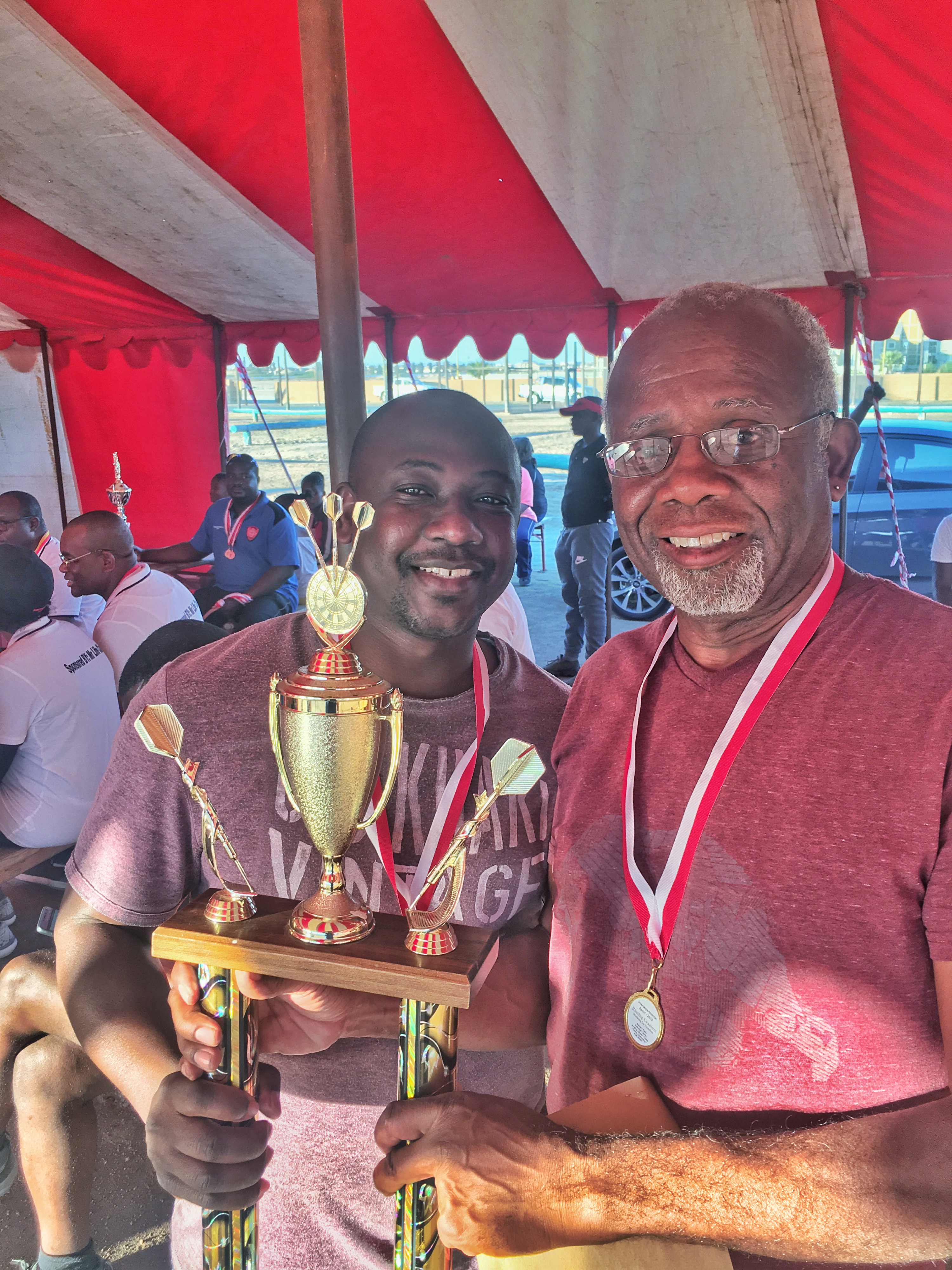
    Since that time, my dart throwing accuracy has improved. Back in 2019, the organization that hosted me while I was in Namibia, the Rössing Foundation, had put on a sporting event for its employees. Darts was among the activities, and I won the first-place trophy! The first time I’d ever won a trophy for anything!

    That’s my friend, Florian, on the left.

    While I was in Namibia, I found that the locals also enjoyed darts, and I would play them after work at a local bar. It was there, oddly enough, that I learned to associate beer with darts. An association that I enjoy to this day.

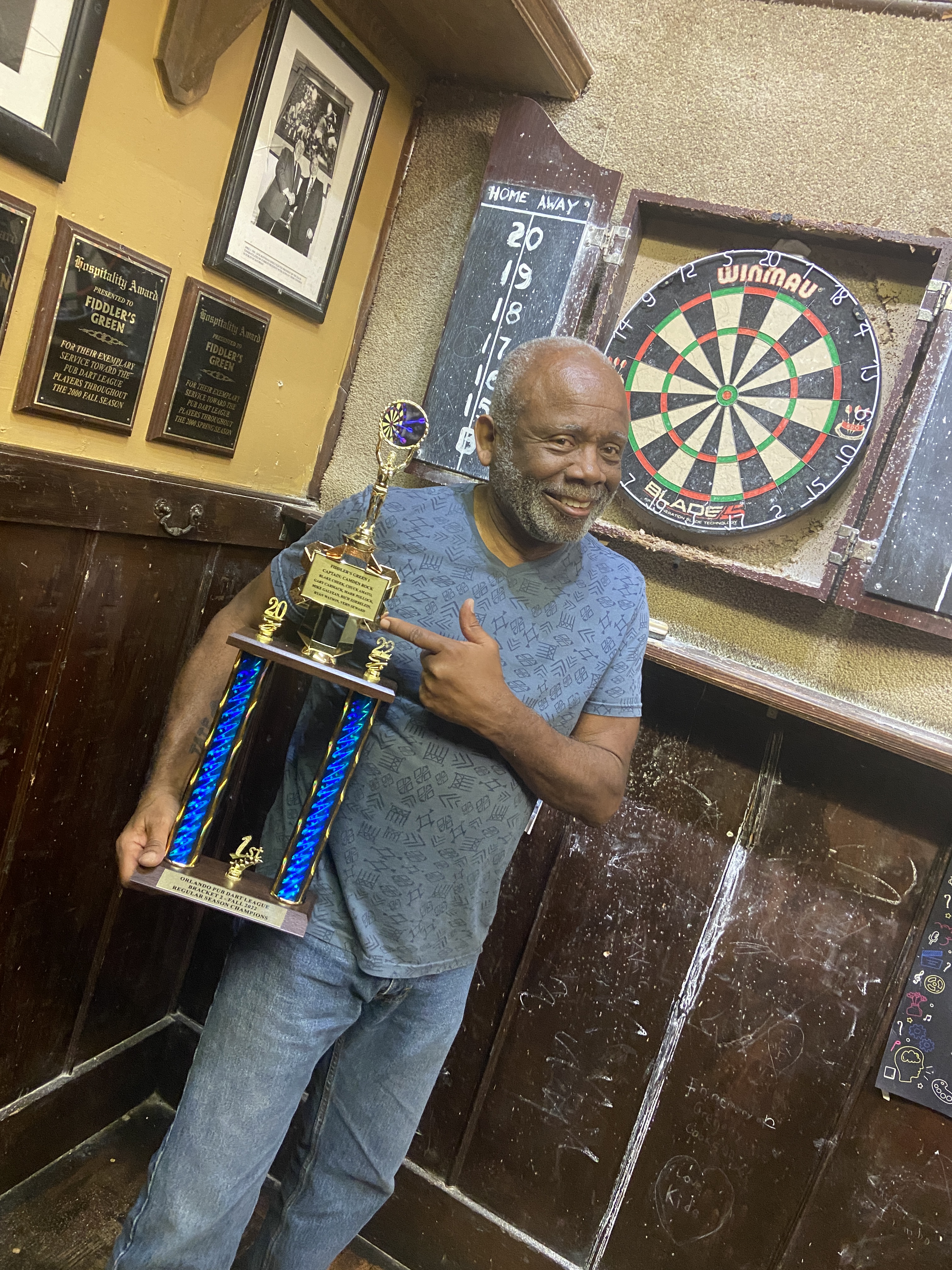
    My skills had improved since returning from Namibia (so did my beer drinking), enough so that I wound up on a team in the Orlando Darts League. We played out of Fiddler’s Green in Winter Park. I was there for 3 seasons, and the second season I was there, we were first in our division and got a trophy for our efforts!  Every game was enhanced by a pint or two of Guinness. 

    That’s my name I’m pointing to.

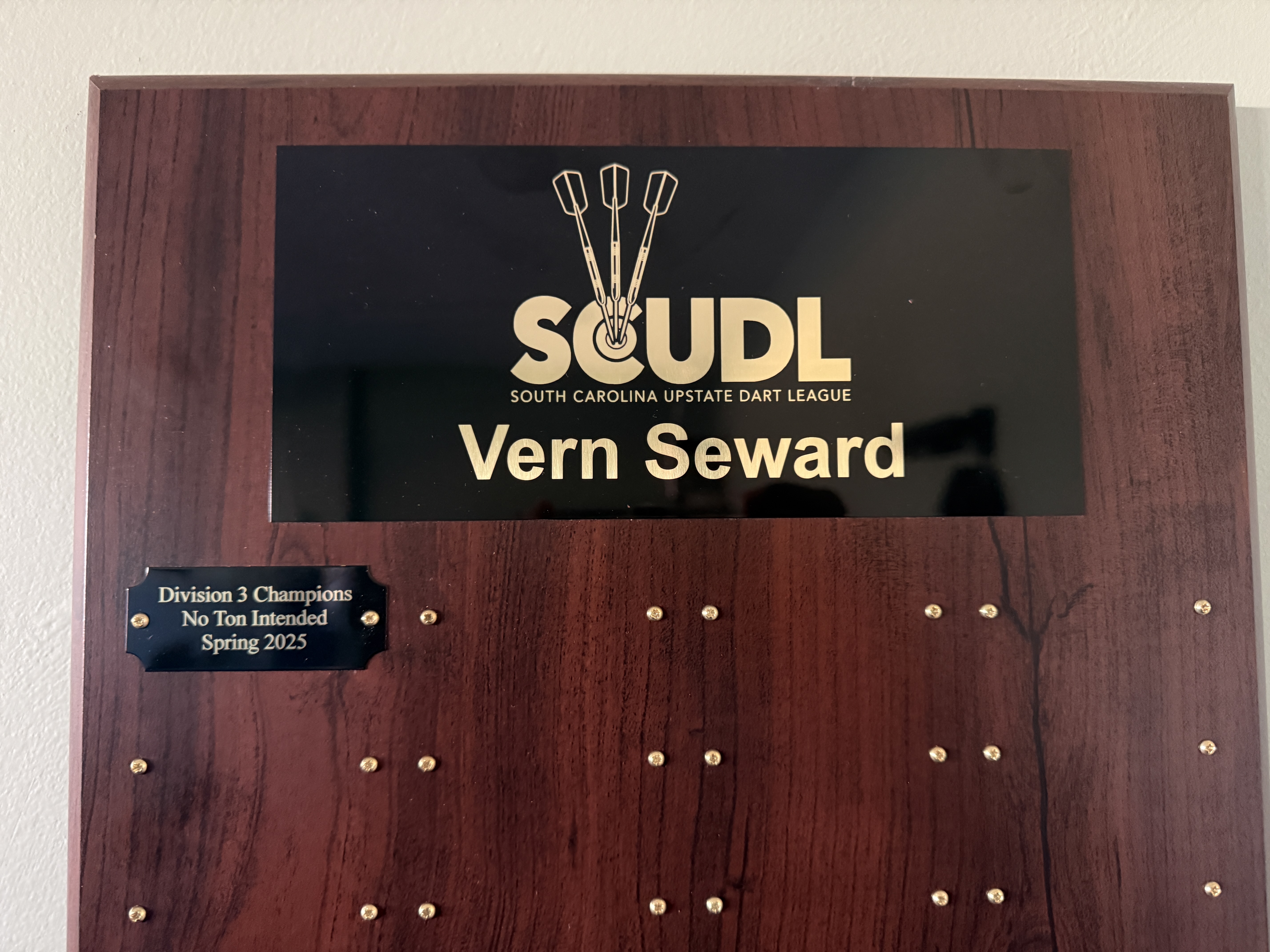
    Since moving to the Greenville, SC area, however, my dart throwing skills have declined dramatically. I was still good enough to get signed onto a team out of Doc’s Tavern in Greenville, and we actually won first place in our division last season, but we did so without much help from me. This season my team, called ‘No Ton Intended’, moved up to Division 2 and we are getting spanked soundly by nearly every team we’ve played so far. And I don’t think I’ve won a match yet this season, regardless of how many beers I drank.

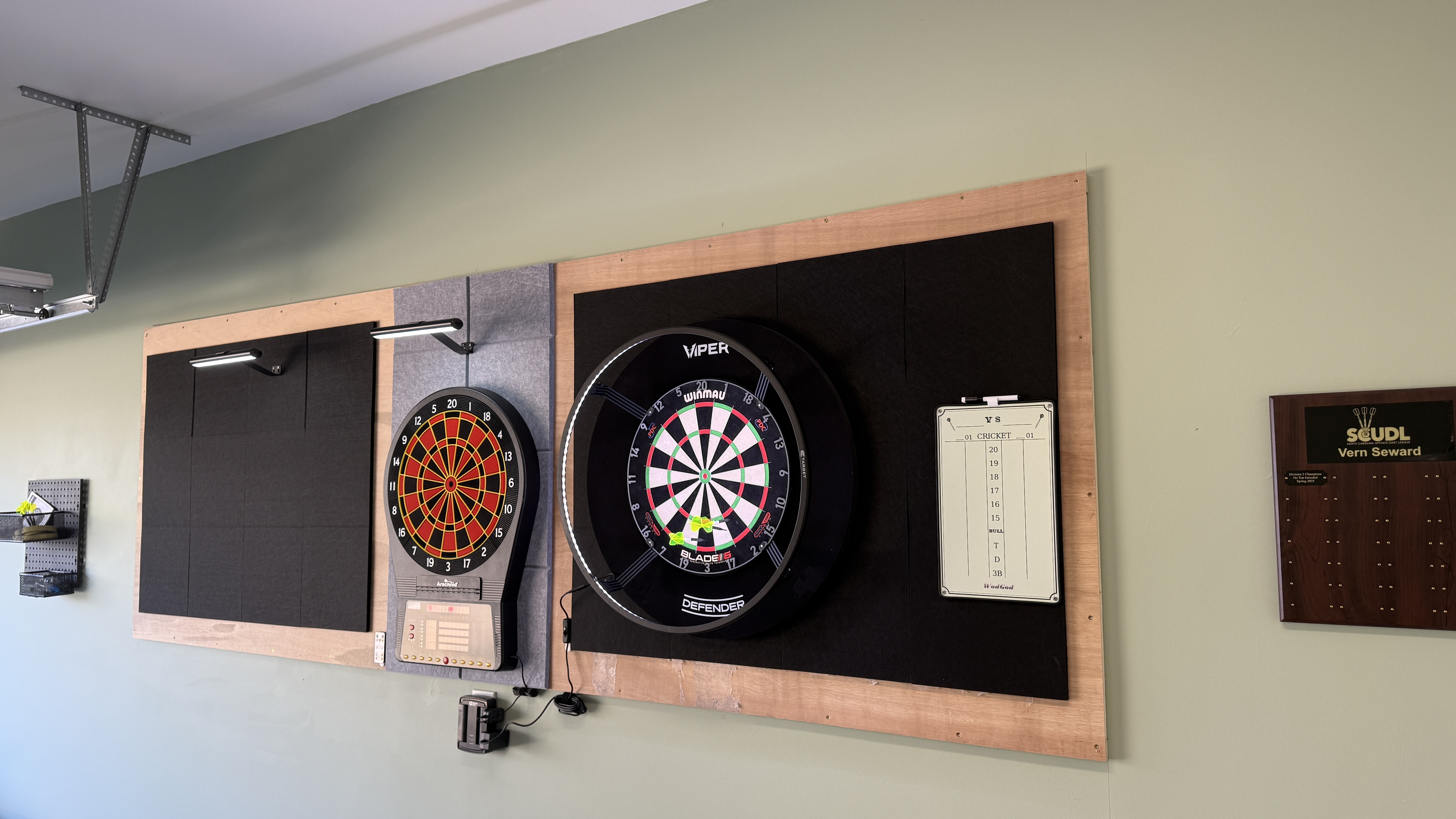
    The plaque was a surprise. Not sure how many of those empty spots I’ll fill in.

    I know what the problem is: practice, or rather, the lack of it. Like any skill, throwing a pointy bit of metal at a 1-inch diameter target about 8 feet away and hitting it consistently takes practice. Lots and lots of practice. 

    A quick search on the internet reveals that professional darters practice anywhere between 1 hour up to an astounding 12 hours a day!! I’m retired and I enjoy throwing, but 12 hours a day?? 

    Nope!

    Still, after reviewing my league performance so far this season, it’s obvious that I need to practice. A lot. The problem is that I have nothing to practice on. I’ve moved into my house about 4 months ago, and my focus has been on fitting up the house to make it feel like home. The apartment I had the year before I moved in was so small that I had to go outside to change my mind. (Old joke, but still makes me chuckle.) Places where I could go to practice were inconveniently far away for daily throws. What I need is a dart setup here, in my house somewhere. 

    Now, I’m on a mission!

    Other tasks around the house have been put on hold until I can establish a dart practice space. I can’t just throw a dartboard on a wall and have at it. A dartboard must be hung at a specific height (5 feet, 8 inches from floor to bullseye) and must be a specific distance from the throw line (7 feet, 8 and 3/4 inches). There must be proper lighting. There should be a backboard behind the dartboard that can catch errant throws without causing damage to the wall. And more. 

    An engineering challenge that is not outside the scope of my abilities.

    So, after careful consideration ( and a few beers), I’ve decided to build a dart practice setup consisting of, not 1, not 2, but 3 dart boards: a regulation board, a practice board where the high-point target areas are all reduced in size, and an electronic dart board.

    I’m going to go all out with this setup. I’m putting it in my garage. The walls will be painted. The floor will be epoxy-coated, and the garage will be kept neat and free of clutter and accumulated stuff. 

    That’s the goal anyway. Right now, the floor is bare concrete. The walls are painted, but there’s stuff everywhere. 

    I’m working on it!

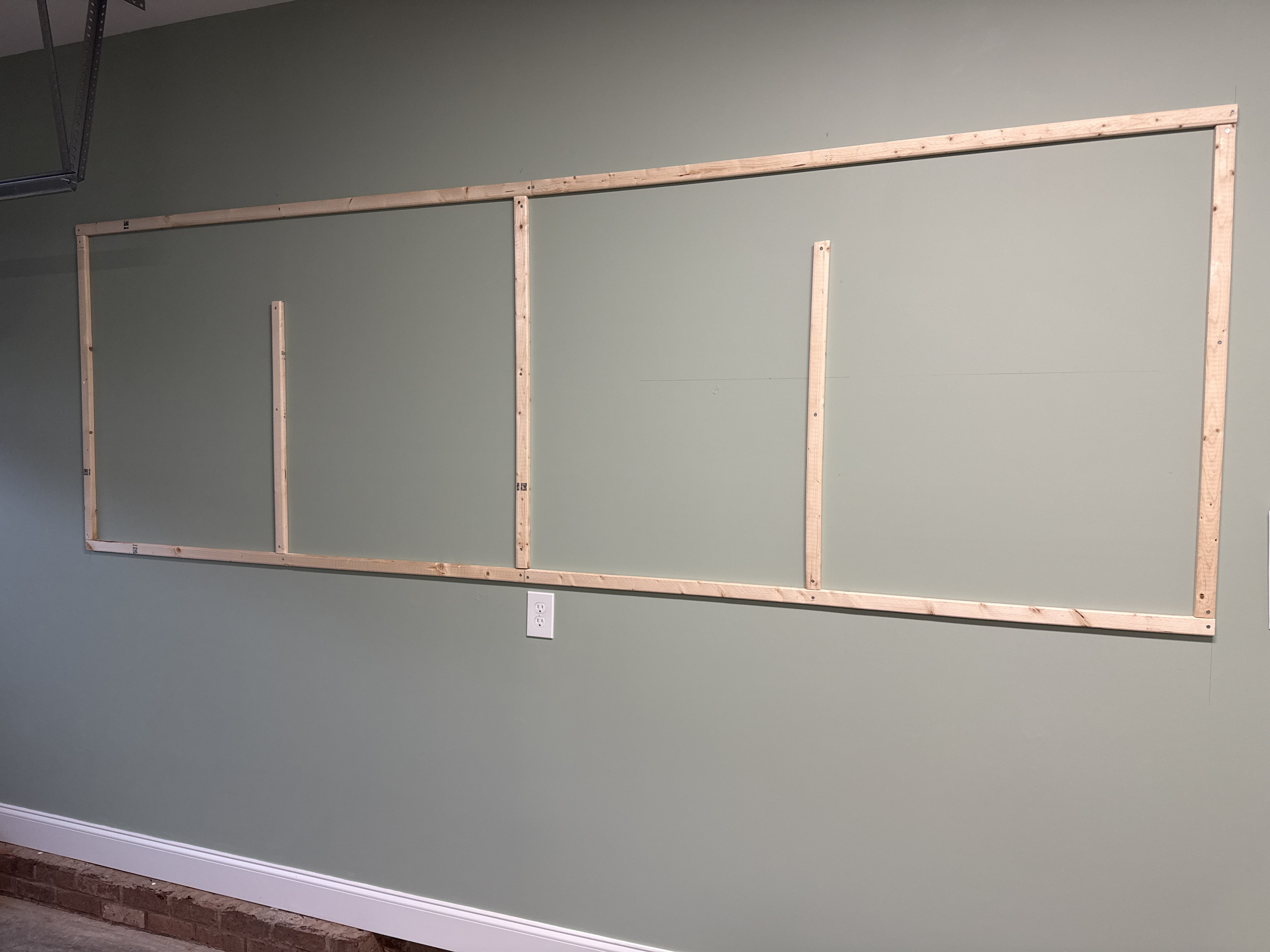
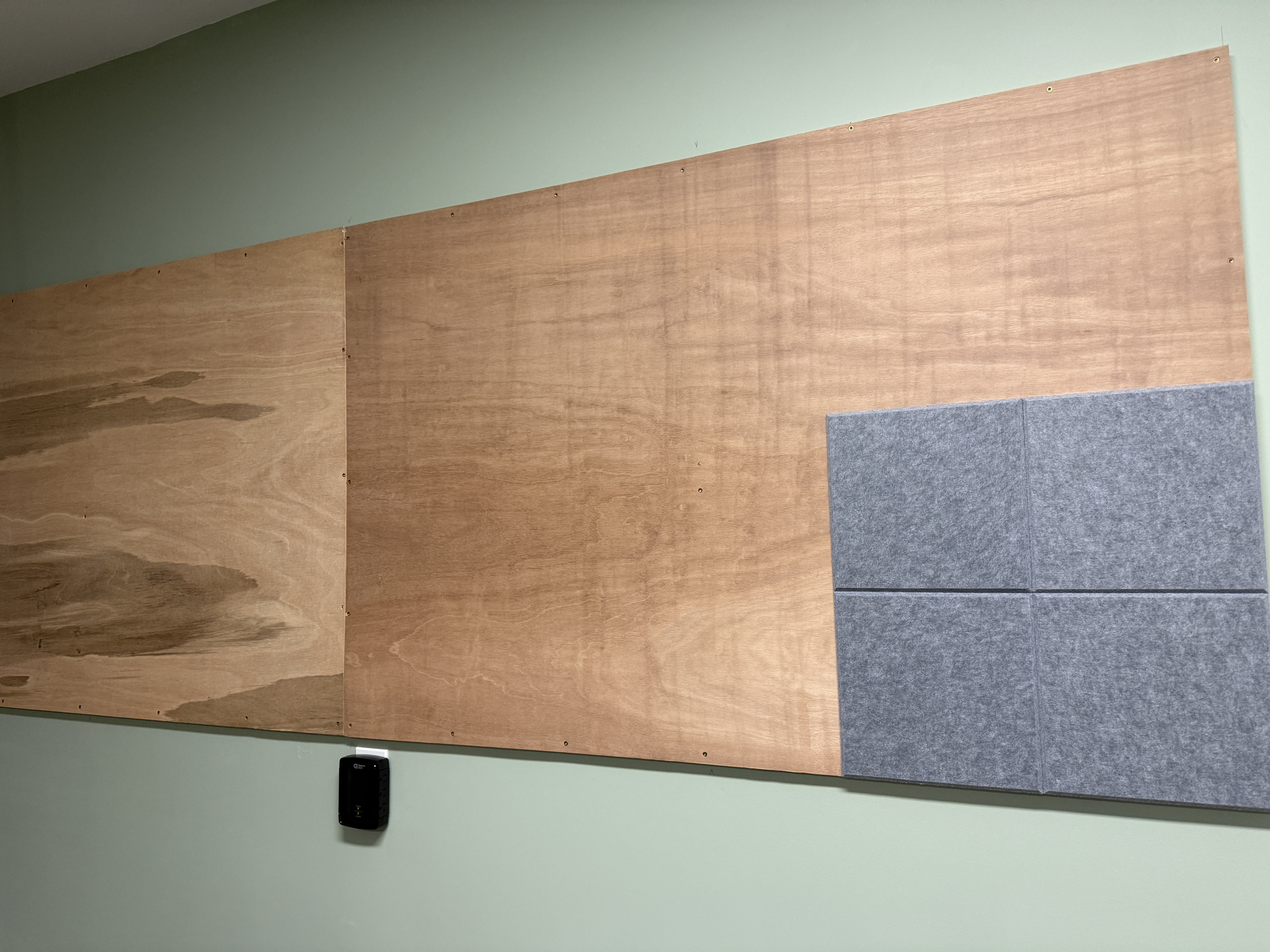
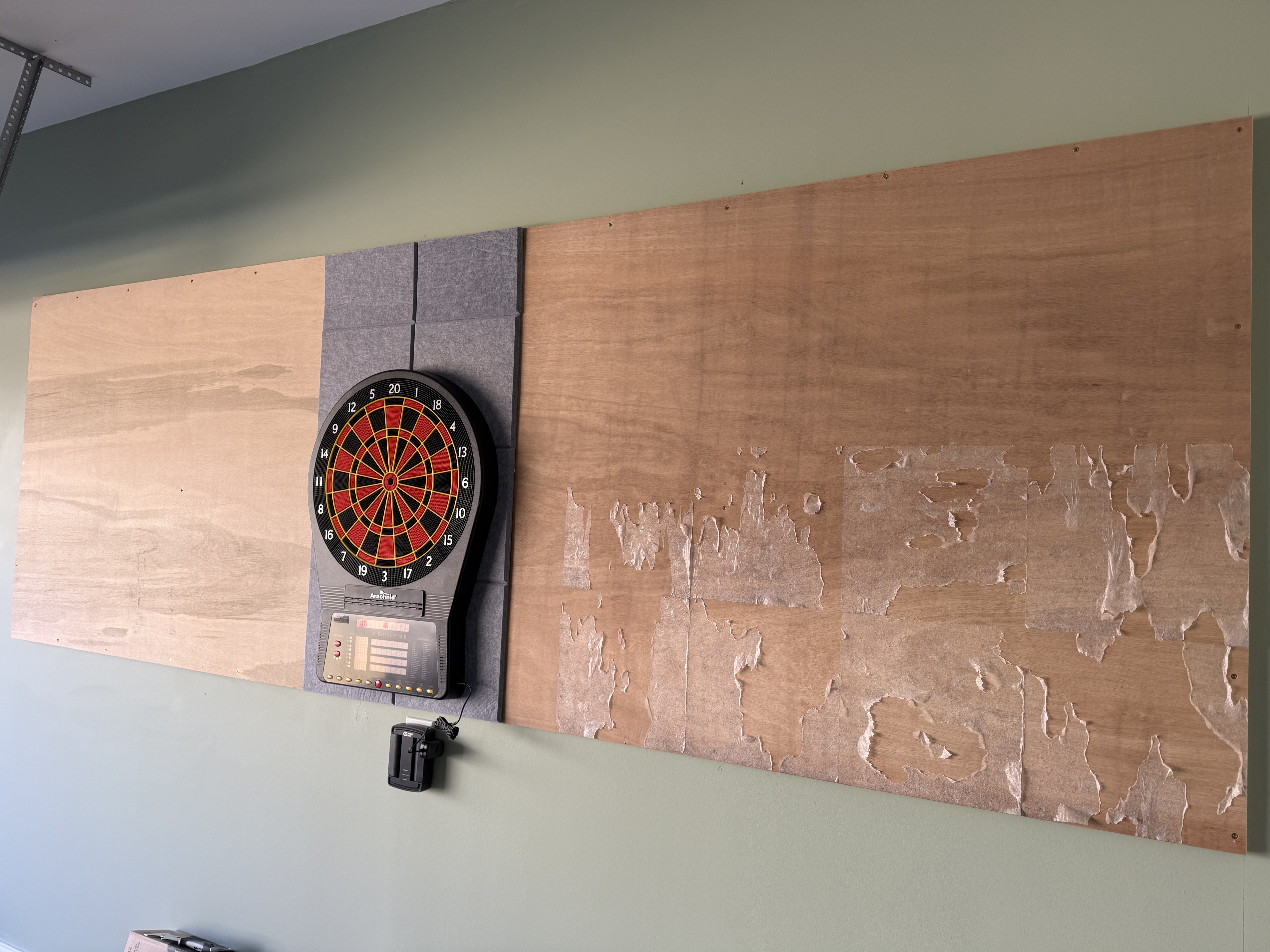
    OK, so, it’s a work in progress, but there is progress. Check out these photos…

    Turns out that grey felt won’t hold a metal tipped dart. Had to take it off.
    The electronic board is just a fun addition.
    Finished! Well, almost. That place on the left is for a training board.

    It turned out pretty good, even after a few missteps. 

    So, now that I have a place to practice, I have no excuse not to get better. But, you how people will make a resolution to lose weight and exercise more, and they spend a lot of money and buy fancy exercise equipment and set it all up, then promptly ignore it? 

    Yeah. 

    Stay tuned.

    Vern

  • Smart House, Dumb House

    I’ve always been fascinated by technology and its innate promise of making our lives easier and more productive. Computers have certainly filled a niche in our collective existence, a niche that, before they became pocketable, we didn’t even know was there. And now artificial intelligence (A.I.) appears to be the next technological frontier humankind is exploring. 

    Back when computers were infiltrating every nuance of our daily lives, many feared them, and for good reason. Computers have replaced humans in many ways, from calculating rocket trajectories, once the exclusive job of human calculators (see the movie, Hidden Figures), to digitally checking out and back in library books. 

    There was a period where no one really knew or fully understood the impact computers would have on us . Many industry pundits lamented the loss of the handwritten letter, books with paper pages, even artistic creativity. We would become plugged-in, tuned-out drones enslaved to our digital overlords.

    Well, some of that has happened. Walk down any street in the world, and you’re bound to see someone staring, zombie-like, at the screen of a mobile phone. In many households, kids trash-talk while they annihilate their digital adversaries/friends on 65-inch high-resolution displays. And a paper roadmap is about as hard to find these days as telephone booths.

    And now it’s AI that has everyone pearl-clutching. It’s too soon to know if artificial intelligence will be the prophesied savior of mankind or our doom. Right now, I just want it to turn on my kitchen light when I tell it to.

    As I’ve said, I’m all about technology, so when I moved into my new house, I wanted to imbue it with some smarts. I have all the core pieces to make it so; I just needed to get the smart accessories: smart doorbell, dimmers, fan controllers, and such. I figured that once I installed all of these smart devices, my house would respond to my simplest request, and all would be right with the world. Or so I thought.

    I’m an Apple fan, so it would only follow that my smart system of choice would be Apple-based. Apple’s smart environment is based on HomeKit, Apple’s version of Alexa, but somewhat more limited. HomeKit-compatible devices are not as plentiful as those for Alexa or Google Home. That’s changing, however, as more smart accessory makers adopt the MATTER standard, which attempts to make accessories usable regardless of whether you rock HomeKit, Alexa, or Google Home. 

    Still, the promise of smart devices and smart systems all working in digital harmony is not quite fulfilled. I believed that even without MATTER, there should be a way to connect any smart device to any smart system, and in theory, there is a way: a device called a bridge. What the bridge is supposed to do is span the gap between a device meant for one smart system, Alexa, for example, and the system you have that is not what the device is compatible with. After all, compatibility is really a software issue. The bridge understands and translates the protocols between the device and the system to achieve the desired action. 

    Again, that’s the theory. In practice, it becomes hit or miss. Let me give you an example.

    I wanted to have some shades in my bedroom windows that opened at sunrise, closed at sunset, and responded to me telling them to open, say, 50%. I found MATTER compatible shades that might have worked, but they were rather pricey, and I am a man of meager means. So, I found a less costly solution that promised MATTER compatibility through an app called TUYA and a device called a WiFi bridge.

    I bought the shades and the bridge. Installation and setup of the shades was easy. They come with remote controllers which allow you to define the upper and lower limits of the shades. Once set, you then connect the shades to the WiFi bridge through the TUYA app. Again, this worked flawlessly. The app lets you raise and lower the shade from your phone, eliminating the need to use the physical controllers (one for each shade). 

    The first clue that something was amiss came when I realized that the included, and rather limited, documentation did not have any reference to HomeKit. Both Alexa and Google Home were mentioned, but that’s it. Through the TUYA app, there was no way for me to complete the integration of the shades into my HomeKit Home system.

    Bummer!

    I explored other apps and options, but nothing was either fully compatible, easy, or cheap. The best option was to buy a device called a HomeBridge, which, while not exorbitantly expensive, added a level of complexity I was hoping to avoid.

    So, I decided that, while I further investigated my options for compatibility, I would at least set the TUYA app so that my shades opened and closed at sunrise and sunset, respectively. As you may have guessed by now, even that didn’t work as I had hoped.

    My shades opening like my house is waking from sleep.

    It’s a hit or miss whether the TUYA app or WiFi bridge, maybe both, will open or close the shades. This morning, the shade both rose like they were supposed to.

    Last night, however, only the left shade closed at sunset. I imagine my neighbors are thinking that my house is winking at them. Definitely not the effect I was aiming for.

    My house winking at my neighbors.

    Another incident had me at wits’ end. HomeKit uses Siri to initiate voiced actions. I could say, “Siri, turn on the kitchen ceiling lights at 50%,” and HomeKit would activate the smart dimmer I had controlling my kitchen lights; they would blink on at half power. Perfect!

    I have a similar setup in what the developers called my dining room, but I’m going to set it up as a small library. I have one of Apple’s HomePod Minis in that room; it provides music and Siri voice control. However, when I said, “Siri, turn on the library lights at 50%,” Siri would ask, “Do you mean lights?”

    I’d say, “Yes,” and Siri would say, “That’s what I thought you meant.” Then nothing happened. The room would remain dark. I’d ask Siri to do it again, and I’d get the same response and the same inaction. 

    What the heck?!?!?

    I’d do it again, and it would work like it was supposed to, but the next time I’d ask it to turn on the lights, it would give me that same stupid response. I got so aggravated that I started cursing at it. Siri would calmly say, “I won’t respond to that,” and go smugly silent. 

    It’s a sad state of affairs when your computer is apparently more emotionally intelligent than you are.

    After mumbling a few more choice words, I made a few changes in how Siri understands commands, and now we get along just fine. 

    As to making my house smarter, the promise is there. I can get up at 2 a.m. with a desire for some tea and tell Siri to turn on the kitchen lights to 25%, and it does so, thankfully, without complaining. My doorbell tells me when a delivery has been made regardless of where I am. The MATTER compatible lamp in the family room turns on at sunset without fail, but my shades still wink at my neighbors sometimes, as though my house is letting them in on a joke.

    Maybe my house is not so dumb after all.

    Stay tuned.

    Vern

  • (Note: This was a blog post I had forgotten to publish while I was in Namibia. The recipe still works though and it’s still pretty cheap. The ingredients may cost you about US$10 now, but it’s a quick and tasty lunch or light dinner.)

    Someone once said that necessity was the mother of invention. I think that person got it wrong. It’s laziness that, more often than not, gives birth to invention. I should know. Me and Laziness are so close you can expect wedding invitations any time now.

    Be that as it may, when it comes to food here in Namibia, I hook up with Laziness and find a way to feed myself with the least amount of effort and cash. I wish I could say that all of my culinary inventions were fit for five-star restaurants, but the reality is that I’ve had to force myself to eat my creations, hoping that the peculiar smell, taste, and appearance justified my adherence to my ‘waste not, want not’ ethic, even over severe gastrointestinal protest. So far, I’ve survived.

    After a year’s worth of experimentation, you’d think I’d have at least one recipe that’s worth sharing, and you’d be right. I’m going to pass this along to other Peace Corps Volunteers here in Namibia and beyond, but why should we have all the fun? 

    What follows in an extremely simple, yet very tasty recipe that hits all the high points:

    ✓ Inexpensive? Yes! You should be able to buy all the ingredients for under N$50 (about US$4.00) and you can likely get 1-3 meals out of it. Also note that you’ll spend for bulk items which can be used later for other meals.

    ✓ Healthy? Yup! It’s lettuce and tuna, for goodness sakes! 

    ✓ Easy? Oh geez, yes! If you can open a can of tuna then you’re halfway done.

    ✓ Tasty? I realize taste varies, but if you can stomach canned tuna and don’t mind lettuce, you’ll probably like this. Of course, if you’re Poseidon, you’d drop-kick canned for fresh tuna, and even your mother-in-law can’t find fault with fresh lettuce.

    So, what is this amazing recipe for producing ambrosia suitable for gods and in-laws?

    Behold! The PCV Tuna Wrap!!!

    PCV_Tuna_Wrap.jpg


    Looks tasty, right?

    Ok, here’s how to make it…

    Ingredients:

    1 can of chunky tuna ( you can use the cheaper shredder variety, it won’t look as good, but tastes the same).

    1 small block of peppered feta cheese (feta comes in many forms. I buy a 200 gram pkg that has three blocks of cheese. I use 1 block, about 60 grams, but more is not a bad thing)

    10 or more halved grape tomatoes ( you can used dices tomatoes too, should equal about 1/3 cup)

    2 tablespoons of Greek salad dressing (this is to taste)

    Dash of kapana seasoning ( can substitute Old Bay of other spicy seasoning)

    1/2 teaspoon of crushed garlic (I buy a container of finely diced garlic and chili pepper. Works great.)

    1 head of lettuce

    Mix together everything but the lettuce. Taste and add other seasoning as you like (diced onions, diced green pepper, salt, ginger, whatever floats your boat).

    Peel off a leaf of lettuce. Scoop about 2 tablespoons of mix into the leaf and wrap like a burrito. Should make about 6-8 wraps.

    Enjoy!

    Stay tuned

    Vern

  • A Lot Going On:

    It’s been a while since I’ve updated this blog. It isn’t just that I’ve ignored it, I have, but it’s also because I’ve had other pressing issues on my mind. I’m not one to turn to social media for opinions about what I consider to be personal issues. I’m used to keeping very exclusive counsel, which tends to be none other than myself. 

    So, though I’m still dealing with my private issues, I’ve found enough mental capacity to talk about stuff I can air publicly. And I’ve got a lot to talk about.

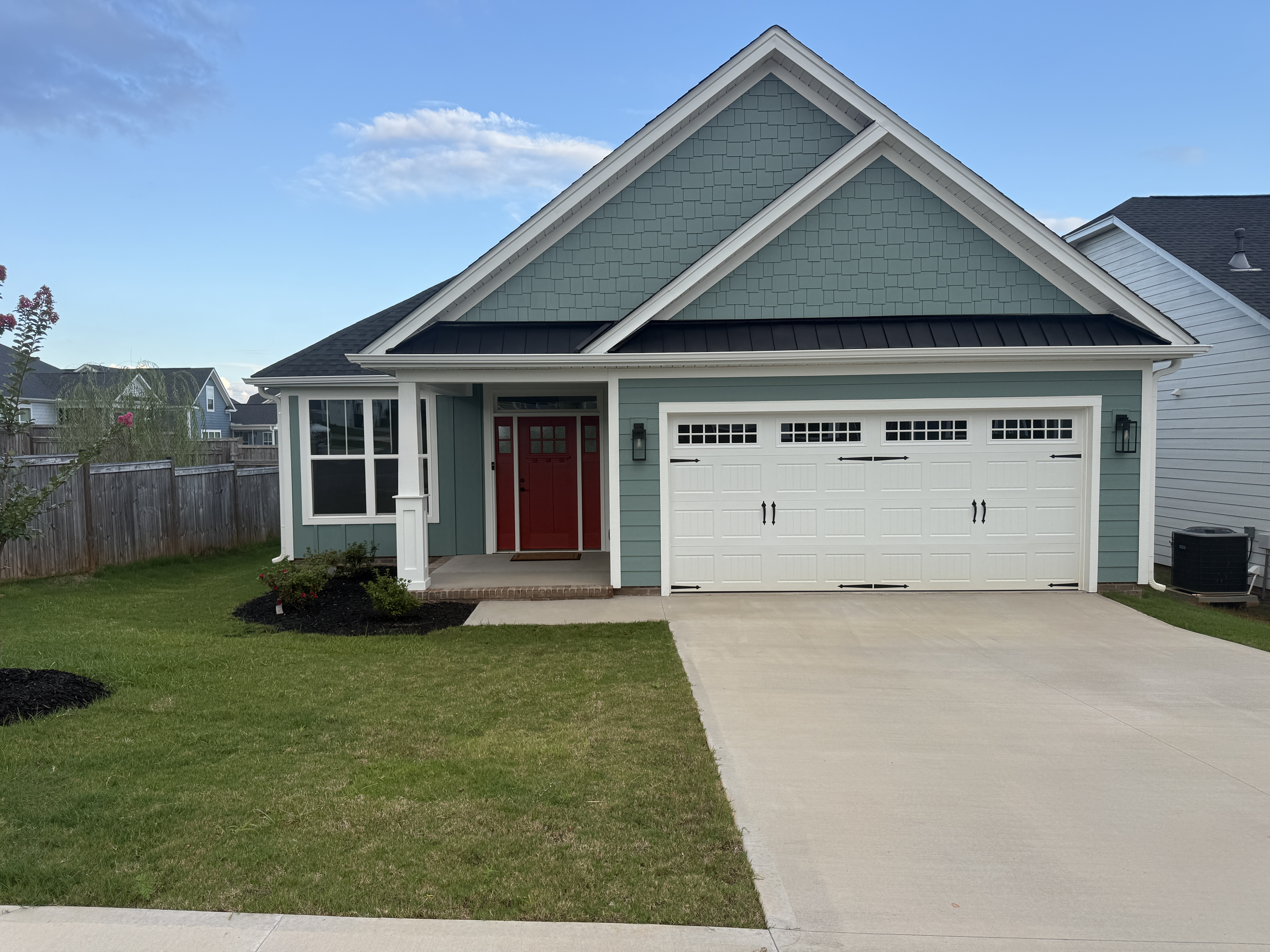
    First and foremost, after a year of waiting, I’m finally in my new house! I’ve been in it about a month now, and I’ve got a lot to do. But here it is.

    Casa de Vern

    It’s nothing grand, just a small 3-bedroom, 2-bath home that’s a tad under 1500 square feet. Perfect size for a guy looking to keep life simple. 

    The problem with moving into a new house (or any house that’s new to you) is that you have to somehow make that space your own. That’s what I’m up against. I gotta figure out what furniture to buy, what colors to paint the walls, what bed and mattress to get, and on and on. Of course, me being me, I want my new house to have some smarts, but I don’t want my private life a hackable password away from being on the Internet. So, I have to pay closer attention to the smart devices I intend to put in my house.

    Giving My House Some Brains:

    Today’s builders, in an attempt to offer buyers “smart home” options, really don’t give buyers much choice. At least that’s true for us on the cheaper end of the buying spectrum. That tends to mean that the devices they offer aren’t privacy-oriented. For instance, my supposedly smart thermostat from Honeywell will only function in a smart way if I connect it to the Internet and create an account on some server. I can do things manually, of course, and that’s how I’ve set it up, but the damned thing keeps popping up an alert screen begging me to connect it to the Internet and an account so that I may enjoy the benefits of controlling the temperature in my house while I’m not in it. 

    Again, I’m all about a smart home, but why do I have to create an account for every device I install? My garage door opener wants an account, my doorbell wants an account. Heck, even stuff that’s not smart begs me to create an account so that I can activate my 60-day warranty. As you may well have guessed by now, all of these accounts are just ways for these companies to gather information about you and your buying habits. It’s not like I have anything worth hiding, and I’m not a conspiracy theorist who believes some dark and nefarious entity is using my data to mind-control me into buying more Chinese-made stuff. (I don’t need mind control, I just need a free afternoon, my Amazon account, and a credit card.) It’s just that it’s MY data, my privacy. It’s not something I want to just throw around the web and hope no bad player takes notice of it. 

    So, to minimize my exposure as much as possible, I minimize the number of accounts I create and I use Apple products. 

    Before you Android and Windows fanboys start yelling, let me say that, while Apple products can and do fall prey to hacking and other such nefarious activities, it’s been shown time and again that Apple’s focus on security and privacy exceeds what is available on Windows and Android systems. 

    The problem, however, is that, because Windows and Android systems try to put gee-whiz technology in the hands of the general public quickly while being less concerned about privacy (see Alexa’s ability to do far more than what the current implementation of Apple’s Siri can do, but also note that Siri tries to keep your requests and data local and in your control), there are more smart devices available for those systems than for Apple’s HomeKit smart system. Luckily, that’s changing.

    A new standard for smart systems, called MATTER, looks to unify smart systems and the devices they support. Apple has wisely started supporting the MATTER standard. Now, instead of having to download an app and create an account to install and set up a smart device, you simply scan a QR code on the MATTER-compatible device. HomeKit, Alexa, Google Home, or other smart systems that support MATTER will recognize the device and integrate it into your system automagically. You can then interact with that system to set up the device’s features and functions. Truth is, currently some features and functions are only accessible through the device-exclusive apps, but that’s changing as the MATTER standard evolves.

    A MATTER Smart Plug. Couldn’t be easier.

    For example, smart camera doorbells offer advanced features like face recognition, activity zone alerts, and more. Those advanced features that are currently not accessible through HomeKit, Google Home, or Alexa, which only offer access to basic functions, like an alert when someone rings the doorbell. If you want to use the more advanced features, then you must download the device’s app and create an account. As I’ve said, MATTER fixes that, or will fix it. The MATTER standard for camera doorbells will be in the next release. With all of the more advanced features, it is a bit harder to work up a standard for more complicated smart equipment.

    Anyway, it’s happening.

    BTW: Reach out if you’re thinking about giving your house some brains. I may have a few suggestions for you that might help make that move easier.

    Projects, Projects, More Projects:

    Back to my new house.

    Another task one must complete to make a house a home is to decorate. I’ll be the first to admit that I’m no good at decorating. The décor in my last house might be called ‘Modern Man-Cave’. I painted the walls colors that I liked and put in furniture that appealed to me. The place was clean, spartan, yet comfortable, at least to me it was. And I guess that’s what’s important. Now, however, I want a bit more than clean and comfortable. 

    If you’ve read some of my earlier posts, then you may remember me talking about following the Mid-Century Modern design ethic, and while I was tucked away in that tiny apartment waiting for this house to be built, I bought a few items that I thought would work well once I moved into my newly completed house. 

    It turns out that the pieces I bought, a credenza and two chairs, do indeed follow the Mid-Century Modern design, but the chairs are a bit too big for the space they were intended for. Even so, it’s starting to come together, albeit slowly. That’s okay; I’m in no rush.

    Since moving in, I’ve bought a nice dark brown leather couch, a small black coffee table, and a cool, small, black swivel chair. I had only bought one chair because I wasn’t sure I’d like it. Now that it’s here and definitely fits the space, I want to buy another, but the price has increased by about $200. I suppose I have the current administration’s tariff policy to thank for that. Now I need to wait to see if it will ever go on sale. 

    Every day I try to check an item off the very long list of things I need to do. One project I recently completed turned out great. 

    At 14 feet by 16 feet, the large bedroom is easily the largest room in the house. With a nice-sized walk-in closet and a large bathroom with a large bathtub, tiled shower, and a closeted toilet, the bedroom is more like a suite. 

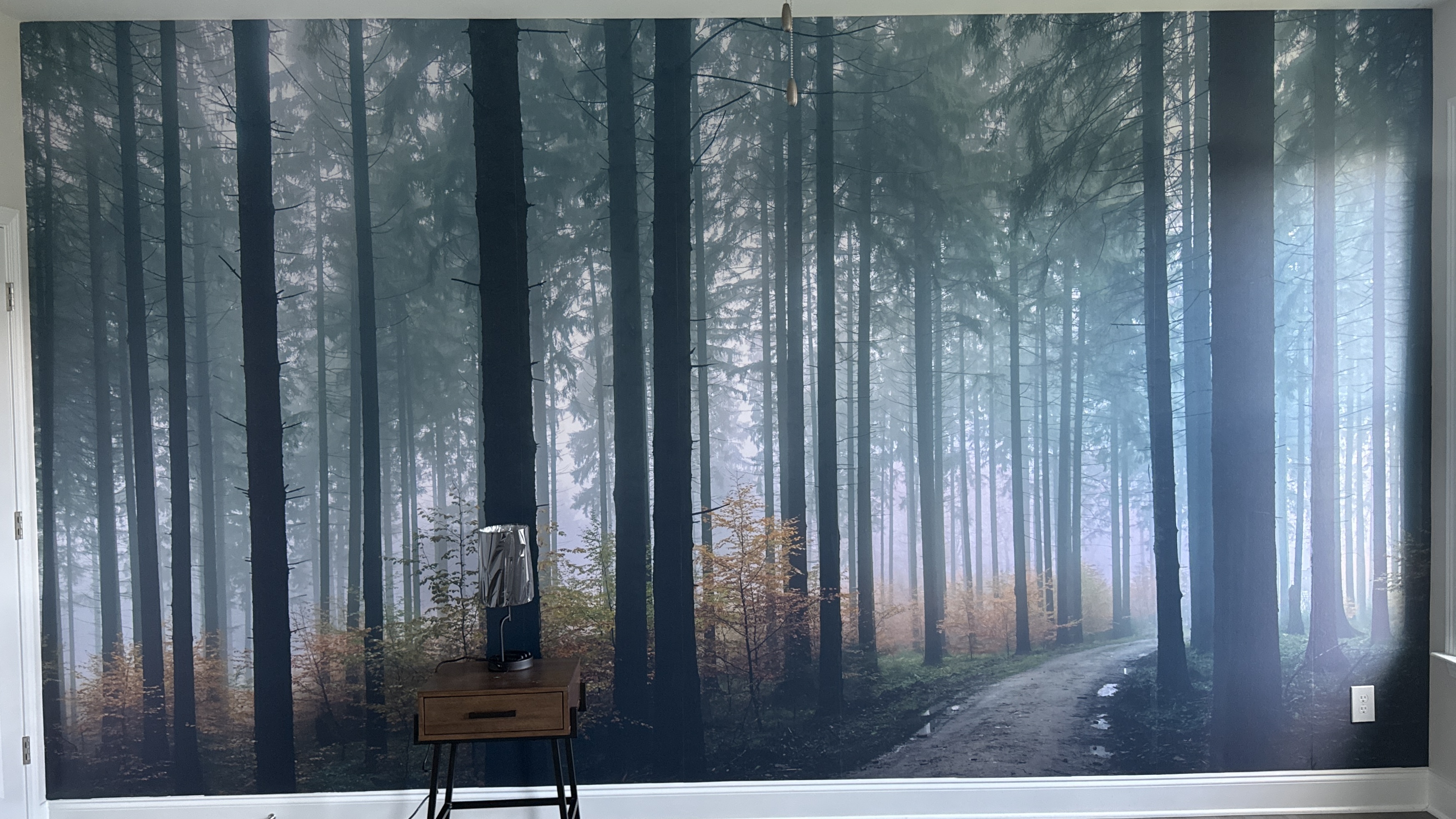
    I wanted to do something interesting for this bedroom, to elevate it to a sanctuary yet remain in keeping with my minimalist Mid-Century Modern ideology. While browsing design articles and sites, I saw a dining room that had a floral mural on one of its walls. The wallpaper mural set the tone for the whole room, and that gave me the idea to try to find something like it that might work in my bedroom. It took a while, but I settled on a foggy early morning forest scene. It took me, and it took a friend, and me an afternoon to put it up. I’m quite happy with the results.

    Wallpaper mural looks like I can walk into my wall.

    Now I’ve got to paint the other walls, put up window treatment, find a suitable area rug, set up the bed, and so on. It may never be completely finished, but it has a great start. Once I get the room further along, I’ll post more photos.

    More on my new house adventures in a bit.

    Stay tuned.

    Vern

  • I left Baltimore when I was 17, leaving behind everyone and everything I had known up to that point. Since then, I’ve never truly felt settled. No matter how far I’ve traveled, how breathtaking the vistas I’ve seen, or how fascinating the people I’ve met, there was always this persistent attraction, like gravity’s pull of a massive star on a small, wayward rock in space, towards the mid-Atlantic region of the U.S. 

    I’d joined the Air Force and, like many others in the military regardless of the branch of service they’re in, I moved from place to place when ordered to do so. But military life, while vastly different and far more interesting than my life on the streets of Baltimore, was too restrictive for me. I was honorably discharged after 9 years of service. My wife wanted me to remain in the military for a full two decades and retire. In retrospect, I likely should have, but at the time, staying in was becoming increasingly difficult for me. I felt like I was missing out on a technological revolution, something I believed I needed to be a part of. This was the early 1980s, when computers were just beginning to permeate every aspect of people’s lives. I firmly believed that my career, my future, was intimately dependent on that blossoming technology. So, I left the military, dragging my pregnant wife, my son, and a miniature Schnauzer from North Carolina to California in a tiny Honda, and in search of a new life. 

    From that point on, I went wherever an opportunity to advance my career presented itself, and often those opportunities were in places I’d never imagined I’d be. Places with names like Redondo Beach, California; Winooski, Vermont; East Fishkill, New York; Ashdod, Israel; and Oviedo, Florida. Ultimately I wound up in Florida, but regardless of where I landed, there was always that familiar, subtle, but insistent pull, an unfulfilled yearning that, at times, I couldn’t quite articulate and I could never adequately satisfy.

    After my children grew up and started their own families, and after my marriage ended, I found myself in a position where I could, if I truly wanted to, allow myself to be drawn by that subtle attraction. I suppose, at that time, I didn’t want to. I had built a life in Florida. I had close relationships and places where I could simply be myself. Yet that yearning persisted, refusing to be suppressed or ignored. 

    In 2017, after weathering an emotional storm, I found that I needed to travel and make a positive impact on some cause, to focus on something beyond my personal interests. So, I joined the Peace Corps. That was an incredible and fulfilling adventure, but in 2020, COVID abruptly ended it, leaving me back in Florida with that ever-present yearning, persistently beckoning.

    Deciding to leave a place that has been your home for over three decades isn’t easy. I grappled with that question for a very long time. I was aware that, just as when I left Baltimore many years ago, I would be leaving behind so much that had become an integral part of who I am. It takes time to adapt to a new environment, even one that was once familiar to me. I would be trading cherished relationships, familiar places where I’ve always felt welcome, and the comforting warmth that comes with familiarity for strangers, new places, and periods of loneliness. If my decision had been solely based on emotions, I probably would have chosen to stay. However, other factors influenced my choice, and yes, that persistent yearning weighed heavily in my ultimate decision to leave.

    Click to see the video.

    Now, several months after moving to a place just north of Greenville, S.C., I’ve begun to settle. I don’t need Apple Maps to find my way around anymore. There’s a bar in a restaurant that I stop in from time to time. The barkeep knows me well enough to have a Modelo Negra with lime on the counter by the time I pull up a stool. I’ve met some interesting people in that restaurant too; a retired lawyer who’s lived in the area since 1995, another Florida transplant who shuffles between a tiny house in the hills of Tennessee with an amazing view to D.C. with Greenville as his way station, a comedian who’s promoting a show to support The American Cancer Society, and so many more.

    There are real seasons here too; the luminous mating dance of fireflies in the summer, a kaleidoscope of colors in the  autumn, biting cold winds in winter.  

    And snow!

    Click to see the video.

    I hadn’t been in a significant snowfall in more than 20 years and it was wonderful to see. I had a silly grin plastered on my face to whole day while it snowed. I was so inspired by it that I produced a short video. You can see it by clicking on the photos..

    As I look forward to spring, I’ve noticed that the yearning that has been my constant companion for so very long is quieter now. While it still lingers, its influence has diminished. Instead of dominating my quiet moments, it now coexists with a more reserved presence. I interpret this as a positive sign, indicating that I’m on the right path, that being here where the trees dress and undress to fit the seasons, and where the landscape undulates like frozen mountainous waves towards the horizon, feels like it’s where I need to be. The yearning’s continued presence, however, suggests that there is still more I need to do.

    My sister recently texted me about an event that might finally satisfy that yearning. In May of this year, my paternal family members will gather in southern Virginia for a reunion. I believe the southern Virginia border, westward towards West Virginia, is the epicenter of the attractive force that has been tugging at me for most of my life.

    I don’t know much about my father’s family or its history. I do know that both my mother and father originally came from the southwestern region of Virginia, and that there are many who bear the Seward family name who still call that area home. In fact, I had seriously considered settling there myself. 

    I intend to go to this reunion in hopes that I can learn more about why I’m so drawn to that place. 

    There’s a memory I have, a recollection so old it’s like a faded photograph, that might hold some clues.

    When I was very young, maybe 3 or 4 years old, I remember a long trip that my father took me on. I recall seeing lots of trees as he drove for what seemed like hours and hours. When we finally stopped we had pulled into a long dirt driveway, each side was walled by tall green corn stalks. At the end of the driveway stood a modest house. A huge tree stood next to the house.

    During one of my visits to Baltimore as an adult my sister told me that the house with the tree exists. The house and the farmland around it belongs to a relative on my father’s side. The memory has left me wondering, and hoping, that that place is what has been pulling at me all these years, that my returning to it will finally sate that yearning and I can find some peace.

    I look forward to May.

    Stay tuned,

    Vern

  • I read an article recently which described the term ‘hypernormalization’ as the feeling that everything around us is not right somehow, but we keep going through our daily routines as if all is right with the world.

    In other words: we instinctively know we’re in a hand basket heading to Hell, but instead of figuring out a way to either brake our descent or get out of the basket, we carry on by ignoring the increasing heat and cramped accommodations. 

    Though we may not be directly affected by natural or man-made disasters, we are inundated by them via our media of choice to the point where what, at one time, is seen as horrific, such as the California fires, is now a media moment, soon to be forgotten when the next headline vies for our attention. Meanwhile, little if anything is done to address the overriding situations and underlying causes because, well, shit happens, and we can expect shit to continue to happen. So, unless there’s a fire in our backyards, or a blizzard-dumped snow pile in our driveways, or cold-busted pipes in our basements, we  glance up from our phones and computers long enough to shake our heads in recognition of what others are dealing with, then doom-scroll to the next disastrous headline.

    And we wonder why we feel discordant, out of sorts, deep in our feels while the cause of our blues seems to have escaped us. 

    Hypernormalization.

    Reading the news is like reading a script for an upcoming disaster movie. (Except Hollywood can’t produce it because it got toasted too!) Watching the news can be a recipe for engendering suicidal thoughts. People who believe such things see these catastrophes as signs declaring that, “The End is Nigh!!”

    Well, maybe.

    Or maybe it’s Mother Nature letting us know who really is in charge. Or maybe all of this has happened before, but the toll on human lives and our endeavors were much less when there were fewer of us. And, of course, all of it is sensationalized to the extreme by whatever media you choose so that a bad situation appears to be far worse than it is and right around the corner.

    Don’t get me wrong, the Cali-fires, wayward blizzards, and hurricanes, and rollercoaster temperatures are all tragic and newsworthy, but the populace not directly affected by them are badgered by them in excruciating detail. It’s as if the media wants us to believe that, for instance, the fires in L.A. are so much more tragic because a favorite movie star’s home burned to the ground.

    Yes, I know that we need to know what’s going on and where, but there is such a thing as information overload, and this winter, I think many of us who are not directly affected by a disaster are suffering from it. And thanks to our innate ability to get used to just about anything, our sensitivity to disasters, in general, has diminished. And with that diminished sensitivity, we tend to accept it while believing there’s little to be done to fix the problems we face, and we move on.

    A friend of mine recently asked me to talk her off a virtual cliff as the news she’d been watching was so overwhelming that she felt lost and anxious. ( Actually, it wasn’t just the weather catastrophes that had her on edge, but I won’t go there, and these are my words, not hers.) To my mind, this is a normal human response. We should be concerned about the disastrous events in our world, and yes, we can and will be overwhelmed by them. 

    I responded by trying to make light of it, stating that I was following the ostrich’s approach to a bad situation by burying my head in virtual sand. I refused to consume the news in any form for a day or two and advised her to do the same, and to seek out anything and anyone that could put a more positive spin on the world. 

    (BTW: Ostriches don’t actually hide their heads in the sand when faced with danger. A full-grown ostrich can run away from danger at speeds of up to 70km/h (about 43 mph) and can defend themselves with large claw-like talons and powerful legs.

    I saw a group of wild ostriches run up a mountainside while I was in Namibia, and I was left in awe at how fast the group ascended, even the little ones. I was also left wondering: since ostriches are land-bound birds, are a group of them called a flock or a herd?) 

    I wasn’t trying to make little of her distress or appear flippant in light of her anxiety, but there was actually some truth in what I offered her. Often, when I’m feeling wired or merely out of sorts, I will find something that will cheer me up or at least divert my attention from the current calamity. For instance, I will watch Looney Tunes and Popeye cartoons. I also dabble in video production, writing, and thinking about my next major move.

    These distractions seldom fail to get my mind off the negatives, at least for a moment, and often that’s all I need to do an emotional level set. I can then focus on what, if anything, I can do about the problem at hand.

    (You can find my latest video releases here: https://www.youtube.com/@vernseward5323)

    No, I’m not suggesting that those folks in the midst of a disaster can find solace in watching Roadrunner outsmart Wiley Coyote or to wait for Popeye to down a can of spinach to open a can of whip-ass on Brutus. What I am saying is that those of us for whom the minute-by-minute stream of wreck, ruin, and heartbreak is affecting our well-being or numbing us to the point where we don’t feel the way we should about the ruinations of others, can and should give ourselves a break and find something more positive for our brains to ingest, at least for a little while. Hit the reset button on our feelings so that we can focus on solutions.

    Otherwise, we’ll just keep dappling away the sweat caused by the increasing heat while marveling at how well the hand basket we’re in can handle the weight of the crowd.

    (A group of ostriches is called a herd.)

    Stay tuned.

    Vern

  • Mo vs Helene

    Anyone in the Mid-Atlantic Region looking to capture scrapbook memories of Autumn can pick up I-81 south out of Roanoke, Virginia and be rewarded with an explosion of reds, yellows, and browns as the lust verdant landscapes of Summer make way for Winter’s starkness. The more adventurous might decided to take a detour and explore the many boroughs nestled between the ancient peaks of the Appalachians. Perhaps those who are hardier still may fall in love with the natural beauty and the small town atmosphere prevalent throughout the region. 

    Mo is one such an individual. Born and raised in Cleveland, Ohio, Mo hiked the Appalachian Trail and fell in love with the what he saw. He decided to put down roots back in 2003. “So I live, as a crow flies, just on the Tennessee side of the Tri-State corner, that’s between Tennessee, North Carolina and Virginia. Just a few miles south of Damascus, Virginia.”

    Here there are four distinct seasons, each can be breathtaking one moment and deadly the next. 4×4 trucks are the vehicles of choice and even sedans will sport all-wheel-drive drivetrains. One never knows what you’ll encounter around the next mountainous bend in the road.

    A construction worker and handyman by trade, Mo’s jobs have taken him into the many nooks and crannies of the area. He knows this region well enough that GPS aided maps on phones are an afterthought, but he always keeps a wary eye on the weather. 

    “I was trying to find a 3-day window because my van was in desperate need of a paint job.” 

    After checking the ten day forecast for his area on Friday, September 20, 2024, Mo thought he had found the window in the weather he needed to get the paint job done. But by Monday the forecast had changed and it started raining. At that time the system that was forming thousands of miles to the south in the Gulf of Mexico still didn’t seem like much of a threat to those living so far inland and in the mountains. But that system had started pumping moisture out of the Gulf that pipelined rain from the the Big Bend region of Florida, up through Georgia and South Carolina and into the Tri-State region where Mo now calls home. 

    The creek behind Mo’s house quickly became a raging river.

    Then, late in the evening on September, 26, 2024,  Hurricane Helene made landfall.

    The storm struck the Big Bend area of north Florida with the full force of a devastating Category 4 (sustained winds: 130-156mph) hurricane, laying waste to entire towns with 5 to 10 foot storm surges, torrential rains and tornadoes. While the storm’s strength quickly diminished as it tracked further inland, it was still pumping moisture from the Gulf inundating the already moisture ladened regions of western Georgia and North Carolina with still more water. Coupled with wind gusts of over 60mph, the southern Appalachians had been lined up for a deadly 1-2 punch.

    Mo woke to still more rain and increasing winds on Thursday, September 27. The branch of Beaver Dam Creek, normally a lazy trickle of water that flows about 20 feet from Mo’s back door, had become a fast moving stream. The wind had picked up a bit, but power and other utilities were still functioning, but conditions were worsening. Mo’s concern was heightening.

    That creek now flows under Mo’s house.

    “Everything was maxed, the ground was entirely saturated,” Mo said. “I’ve watched this creek behind my house for 20 years and it’s only been this high maybe one time before.”

    By Thursday afternoon the creek behind Mo’s house had overflowed its banks. Water now rushed by within a few feet of his back steps, and it was still raining. News reports spoke of the devastation in areas well south of the Virginia-Tennessee border. But with the branch behind his home was of a more immediate concern as it was rapidly becoming a river. Mo began to wonder if he should have been better prepared. He’s lived in the area long enough to have seen all sorts of other nasty weather, but he had never been as concerned about the weather as he was at that moment. By Friday evening the still powerful remnants of Hurricane Helene had devastated the western regions of Georgia, North Carolina and South Carolina. By evening the once lazy creek behind Mo’s home was now a fast moving torrent mere inches from his back door. It was still raining and storm force winds were beginning to blow when Mo finally fell into an uneasy sleep.

    By Friday morning the situation in Mo’s corner of the world had started to become desperate. He still had water, but he’d lost power sometime during the night. “I went to sleep Thursday night, but it was not very restful. I woke up Friday morning around four o’clock, the smoke detectors were beeping because the power was out.”

    Mo was surprised to find that he still had phone service through an all but obsolete landline. The situation outside, however, was becoming a hellscape as trees behind Mo’s house began to topple.

    “I watched a pretty substantial tree fall out of the creek,” Mo said. “It almost hit my neighbor’s house. I knew this was gonna get really hairy really quick.”

    Mo’s neighbor, Joss, whose wife, Cass, was pregnant and was due to deliver soon, was concerned about how long the power would stay out and if the storm would cut off access in and, more importantly, out of their small community. He needed to make sure that, when the time came, he could get his wife to the hospital. After witnessing the tree fall Mo decided to make his way to Abingdon, VA to pick up a gas powered generator, but that venture came to a halt a line of stopped cars foretold road problems ahead. 

    Roads become rivers.

    “I got stopped in a small line of traffic because a limb or a small tree was in the road. I should have grabbed my own chainsaw before I left, but in my hastiness, I didn’t even think to do that,” Mo recalls. 

    Further down the road he got stopped again. “I got less than a half mile down the road when I got stuck in traffic again, another tree had fallen across the road.”

    The road he was on ran along side another creek and it was rising rapidly. “I watched two more trees fall out of the creek across the road. I don’t know if they hit vehicles in front of me or not. But at that point I thought, “No, I’m done. I’m done!””

    He decided to turn around and go back home to wait out the storm. As he was doing so he watched trees along the roadside fall, narrowly missing cars stuck in traffic. As he drove he saw more trees fall. By then, the wind blowing harder and still more rain fell. 

    In his van, Mo picked his way around downed trees, power lines lying across the road and rockslides only to find the path ahead unpassable. Avenues he had traverse only moments before were now under a foot or more of water. He came upon a pickup that had stalled in the middle of a river that was once a road. After attempting to help he and the driver were forced to abandon the pickup. Mo knew his own vehicle wouldn’t make it across those fast moving waters, so parked it on a bit of high ground and decided to make his way home on foot.

    Mo had to leave his van and walk home.

    By the time he got home the waters that was rushing past his back step were now rushing under those steps. And still it rained. 

    Mo checked in on Joss and Cass. Cass had started having contractions. Mo and other neighbors decided it would be prudent to try to clear a path to State Route 91, the main highway that would get the expectant family to a hospital in Mountain City. With chainsaws and heavy tackle in hand, the makeshift crew started cutting up and clearing downed  trees along the most expedient route, but a washed out area forced them to choose an alternative route to clear.

    And it continued to rain. 

    The contractions where coming at regular intervals by the time Mo and his neighbors had finished opening the road on Friday evening and the family was able to get to the hospital. A good thing too, because there were complications and the mother and father were airlifted to a better equipped facility in Johnson City.

    In the aftermath, Mo and his neighbors began picking up after the storm. At its height the rushing waters from the creek behind his house had risen high enough to clean out the crawl space under his home before receding. Downed trees were everywhere, taking out power and communication lines. Once flooded roads are now passable if you drive a 4×4 or AWD vehicle. Some roads remain closed, the damage being too extensive even for 4x4s. Mo was able to retrieve his undamaged van. The pickup Mo tried to help was nearly washed away, but was saved and hauled away for repairs. Joss and Cass welcomed a new addition to their family, a healthy baby girl they named Hillie Ann. Mother and daughter are fine.

    Hillie Ann!

    Mo’s experiences pale in comparison to other stories from that area. “An elderly couple, in their 80s, was swept away in their house during the storm. Somehow they got separated. Miraculously they both survived and were eventually reunited.”

    Many in the area have lost everything. No words can adequately describe the complete chaos and damage the storm wrought. This video is just a small glimpse of what Mo and his neighbors are facing in the aftermath of Helene. 

    Aftermath

    Power and other services are slowly being restored to the area. There has been a lot of misinformation about the federal and state response to the storm ravaged areas including where Mo lives. What outsiders don’t understand is that, even in the best of times, the mountainous regions of western Georgia, North Carolina, South Carolina and eastern Tennessee are not easily navigated. People living in tiny boroughs tucked deep in the hills and valleys of Southern Appalachia are there because they are of a hardier cut, and they gladly trade some conveniences for calloused hands, a 4WD truck, a more natural environment, and neighbors one can count on. In the rare occasions when disasters of the magnitude of Hurricane Helene strikes they rely on each other to get through. It’s how it’s always been. It’s how it is. It’s how it will be.

    Stay tuned.

    Vern