Back when I was a kid, growing up in the heart of Baltimore, there were fireflies.
Though they no longer herald summer evenings with flashes of green and gold in the gardens and backyards of west Baltimore, they had continued to exist right at the edge of my memory, fading like all memories do as we age. But I can still recall how seeing fireflies made me feel. Back then, to my young mind, they were the personification of magic. Their tiny cold flashes proved to me that mystery and wonder were real, that just beyond my very human eyes was a world where fantastic creatures lived. A world where unicorns and fairies might yet be real, and if they could be real, so could magic. How, my young mind would ask, could a creature make its body glow at will, turning the light on and off as if to signal each other that all was right in the world, if not by magic?
I’ve grown and have leaned a lot since then. I know that the light fireflies produce is the product of a chemical reaction, that they use the light to attract a mate, and that there are other creatures that use a similar light producing method, called bioluminescence, to warn off predators or to catch a meal. While that is all very fascinating, the explanation only proved that there isn’t any magic in the world. Not really. And while there is still much to evoke wonder, the loss of magic makes the world a bit less wonderful, even to my adult mind.
I’ve traveled a lot and have seen some wonderful things, but I didn’t realize how much I had missed that sense of mystery I experienced when I was a child until recently.
If you’ve been following my blog you’ll know that I’ve recently took a giant leap and moved from my home of 30+ years in central Florida to establish a new life in South Carolina. I talk about the whys in my previous posts, but the change has, thus far, been moving along smoothly. Over the course of the next several months I will complete my transition and situate myself in a completely new, yet somehow familiar environment. I have my very good friends, Brian and Francis, to thank for making the move far easier than it could have been. They’ve given me a place to stay while I wrangle with the logistics of the move, and I can’t thank them enough.
It was while I was staying with Brian and Francis that I rediscovered that sense of mystery and magic.
Brian and Francis’ home is in a quasi-rural area and the property is surrounded by trees and other flora and fauna natural to the area. I was sitting on their porch one evening, enjoying the cool breezes and evening bird calls when I thought I saw a flash of light a wooded area just beyond their front lawn. As I focused my attention to the area I saw another flash that was low to the ground. The light lingered for a bit, then faded as it drifted higher. Another light flashed, then another. Pretty soon the area was dotted with strobing green lights as fireflies rose from the ground to find a mate.
In that moment I was like a kid feeling the wonder of magic again. I had to walk out there and be surrounded by them. Even the thought of that experience still makes me smile.
Watch carefully. Fireflies!
One of the reasons for me moving to western South Carolina is that I wanted to return to a familiar environment, a place that’s a lot like what I knew as a kid. A place where there are four distinct seasons, where proper oaks, maples and walnut trees still hold sway over the landscape. A place where one can still find deep green meadows, rolling hills and babbling brooks.
A place, unbeknownst to me until now, where one can still find fireflies. A place where magic might yet still exist.
I recently read an article by Darnell Mayberry, whose finance focused articles can be found on Cleveland.com and The Plain Dealer, in which he discusses his newfound frugality mindset. Mr. Mayberry recalls how his grandparent’s tightfisted nature was a call for childhood secret missions to the corner store for sweets instead of whatever the grandparents offered that was stored, unappetizingly, in the garage. Now, much older and, apparently, much wiser, Mr. Mayberry is focusing on obtaining and nurturing a mindset similar to his grandparent’s where spending less is forefront. (And, hopefully, does not involve snacks kept in a garage.)
To that end Mr. Mayberry has stopped frivolous spending on unneeded items, has reduced his consumption of alcohol and cigarettes (certainly a good thing), and has even gone so far as to stop carrying cash and will occasionally, and purposefully, leave his credit card at home.
Mr. Mayberry says he’s at the start of his journey, but he is determined to become more frugal while avoiding the stereotype of becoming a stingy old miser.
I feel ya, Darnell.
I firmly believe that our association with money is shaped by our childhood experiences with it, mindsets that sometimes needs readjusting. In my case it was the lack of money and my family’s inability to afford even the basic necessities of life (food, clothing, sometimes water and heat) that has long shaped my spending habits, both for good and ill. To help with my family’s financial situation, I started ‘hustling’ at a young age.
Hustling can mean different things to different people, but basically it means to do whatever you can to earn a buck. Obviously that can mean doing dishonest things, but in my case, my hustles were honest, I bagged groceries at a local market and loaded them into cars for tips. I usually got about 25 cents for the full service. In the early 60’s, 25 cents went a long ways and on good Saturdays I could go home with $15 to $30 dollars! Not bad for a day’s work.
What hustling doesn’t teach you is the true value of money. In my young mind, money was necessary to live and I could get money by hustling. So, whenever I needed extra cash I’d figure out a way to get it. That often meant getting jobs doing whatever. Almost nothing was beneath me. I’ve chauffeured pizzas, flipped burgers, sold electronics, worked on a sod farm, and more to fill the gaps in what I earned versus what I spent. It occurred to me, even back then, that there had to be a better way, that focusing on spending less was also a viable option for minimizing my financial woes. But I was dealing with other issues in life at the time and hustling was often the most expedient way to address my financial needs. It was what I knew and it worked.
Like Darnell Mayberry, I’m older and somewhat wiser now. I know that there are better ways to deal with finances. For instance; if I need to buy a large-ticket item like a TV or couch, I will search endlessly to understand the pros and cons of the item then decide on and purchase the best I can afford. This is something that an astute student of poverty learns. People of meager means will often buy the least expensive item, which are often poorly made. They wind up having to buy the same item again and again and, in the long run, wind up spending more.
Buying something that may cost more initially, but is made well, is actually the best and most frugal solution. To a person of meager means spending more in the short term to avoid spending a lot more in the long term can seem counterintuitive. Other extenuating factors may influence the decision to buy cheaply. Sometimes it just can’t be helped. An immediate need must be addressed so you do what you have to do to address it. Still, the concept of buying better to avoid buying again is a solid one.
The road to a frugal lifestyle is still relatively new to me, and, like Mr. Mayberry, I’m just beginning to walk that road. This path is chosen more out of necessity rather than adhering to advice and lessons learned over the years.
My move to South Carolina, for instance, was prompted by the fact that my limited and very fixed income could not sustain my current lifestyle in Florida. It’s not that I live extravagantly, far from it. But what I do enjoy doing, being around friends, eating out on occasion, traveling, and maintaining my home was becoming cost prohibitive. Taxes and insurance have and to continue to increased to the point where even living the life of a miser would eventually be unsustainable. I needed to do something. Moving to a more financially friendly environment is the first step. I also need to adopt a more realistic approach to how I handle what income I do have. So, I’ve started looking around for ideas, which is how I stumbled upon Mr. Mayberry’s article, and how his perspective and mine seemed to sync.
So, what is my current view of frugality and how will it affect my life moving forward?
I’m glad you asked.
As I mentioned earlier, and as Mr. Mayberry has said, living like a miser should not be the goal. Clutching every penny is not a mindset that is even remotely appealing to me. I just need to see money as a very limited resource, one that, if carefully monitored and used, can keep me going until the road I’m on ends. To carry the road analogy further; I need to travel in “economy mode” not “sport mode”. That doesn’t mean I can’t enjoy the journey, it just means I need to waste less while moving along. Or, as Mr. Mayberry puts it, “Rather than buying any old thing based on emotion and price, I’m now letting utility and value be my guiding principles.”
But it isn’t just “utility and value” that should guide me because they, by themeselves, are boring. I believe that there also needs to be a sense of purpose, or maybe style, something that makes the journey interesting, even fun. Neither style or purpose fully relates what I think is needed, but it points me in the right direction.
A good opportunity to explore this will be when I find a house to buy after my move to South Carolina. Currently I have no furniture. There’s a reason for that which I won’t go into, but the lack of furniture was on purpose, it allows me to really look at what style I want to be surrounded by. After doing a lot of research I’ve found that I’m most attracted to a style called Mid Century Modern, which is typified by functional furnishings with clean lines, natural materials and solid colors.
Mid Century Modern Living Room. (Photo courtesy of home-designing.com)
While focusing on utility and value, but with an eye on style and comfort, I intend to turn my future abode into a Mid Century Modern home. I also intend to document the process here, but all that is a bit premature. There’s a lot that needs to happen before I get to that stage. I just thought it would be a good idea to explore this here, to set the stage, as it were.
I left home when I was 17. It seems I’ve been traveling ever since.
The truth is that, while I am prone to moving around, I’ve been in one place for the largest portion of my life. That place is Orlando, Florida. I’ve been here close to 30 years! As I think about it, I find that it’s hard for me to reconcile the fact that so much time has passed, and so much has changed.
When I came to Orlando I was married, working on building my career in IT, and saw being here as another adventure. Things pretty much worked out along those lines. Fast forward 25+ years and I am now divorced, retired, and getting ready for another adventure. I’m moving to South Carolina.
Some may see this new chapter as an ill-considered decision, but a lot of thought went into it. I knew I would leave Florida eventually, well before I knew where I would wind up. I was born and raised in Baltimore, Maryland. To paraphrase a lyric from Simon and Garfunkel’s ‘The Boxer’; four seasons, deciduous trees, hilly landscapes, and cooler weather are a breed in me, a need in me. There are other factors that pushed me into deciding to move, but, if I’m honest with myself, I knew it was always going to happen.
When I first started looking around for places I might land my first consideration was in the Appalachians, specifically south-western Virginia. My parents and my grandparents came from that area and I thought it might not be a bad idea to get back to my roots, learn more about my family’s history. While in the Peace Corps I had thought that maybe I should expand my search. While I love nature and being outdoors, I am an urban kid at heart and there are only small to medium sized towns in that part of the country.
I then considered Johnson City, Tennessee. It’s certainly big enough with a nice size university in town, guaranteeing a level of diversity and urban flavor that I like while being close to many state and national parks. And that area has a thriving music scene fed by its proximity to Bristol, Tennessee and Nashville.
But I had a chance to stay with some friends who live near Greenville, South Carolina. Each time I visited my friends showed me more of what Greenville had to offer, which turns out to be quite a lot. Like Johnson City, Greenville is close to one of our country’s original music generating cities. The area chock full of talented artists and musicians. It’s near many state and national parks and only a few hours from beaches, for when I feel the need to see the ocean. The weather is mild, varied and, most of all, the area has four distinct seasons. And I can afford to live there. What’s not to like?
Even though Orlando has never felt like home to me it is a place that I’ve come to love. If you spend 25+ years in a place there’s bound to be something about it that becomes a part of who you are. That’s really what happened to me. I’ve enjoyed the beaches here, and the storms. When the weather is nice it can be really nice. Most of all, I’ve enjoyed the people I’ve met while here. Most of them I knew from my job, but lately, many are people I’ve met who share a common love of music, among other things. These are people I can truly call my friends. As I pack up my belongings and prepare to leave the house I’ve owned for 10 years, my heart aches as the many, many memories drift through my mind.
One of my friends wrote a poem to commemorate my leaving. It so inspired me to write one too. So, to my many wonderful friends, a poem:
Pieces By Vern Seward
I like to think that I’m a wandering man Never satisfied to stay To leave my footprints in foreign sands And relish foreign days.
But truth be told, where ever I go, Whatever sights I behold I leave behind a part of me, A little bit of my soul.
And yet my soul is not undone, It’s bigger than before For each bit that I leave behind Is replaced by even more.
For in whatever place I be It’s the people whom I meet That makes each place a memory, That makes my soul complete.
And when I leave for other sights, For places yet to discover, I take the bits of soul they gave, Which helps mine to recover.
Now, to those I leave behind Please know that I take with me The bits of you that are so fine, Pieces that will sustain me.
I was never one for team sports. When I was a kid I was too short for basketball, too small for football, and baseballs seem to hit me more than I hit them. Oh, I tried, you’d have to give me an ‘A’ for effort, but my lack of speed, agility, and mass relegated me to always being the last one to get picked for teams, if I got picked at all. I didn’t mind so much. I tended to like one on one sports where one person matches his or her skills against those of another, like tennis, boxing or archery. Unfortunately those types of sports were hard to get into in my west Baltimore neighborhood in the late 1950s.
I suppose that, since I was rejected by team sports, I rejected them. I never watched them on TV or followed team statistics. I couldn’t care less what team got into whatever playoffs or what player got traded to which team. I paid enough attention to sports to appreciated the skills involved, so if I happen to be sitting in a bar and football highlights are showing, I’ll watch, not caring what team is playing or the eventual score, but to see the actual plays being skillfully executed by professionals. I appreciate what it takes to get to that level of skill.
So, no team sports for me. That is, until I got to be much older. I now play on a dart team and the team is in a local league. How I wound up on this team is a story in itself.
Back when I was still married I was looking for something that my then wife and I could play together and not wind up killing each other. One Christmas I decided to buy an electronic dartboard. It wasn’t the cheapest board around, but it wasn’t the best either. It was functional enough that it captured our interest on evenings when there wan’t much else to do. It also fit right into my ‘one-on-one’ sports mentality.
My current electronic dartboard. It’s very similar to the one I first started playing on.
My ex and I played often and, while I was decent, my ex got to be really good. She had a very strange throw where she would swing her arms like a baseball pitcher winding up to sling a fast ball. She’d then would hurl the dart and, more often than not, she’d hit her target. It became a point of frustration for me with her winning so much, especially since I had practiced using tips I had picked up on YouTube. Seemed no matter how I tried, the woman would beat me time and again.
Did I mention how frustrating that was?
Yeah.
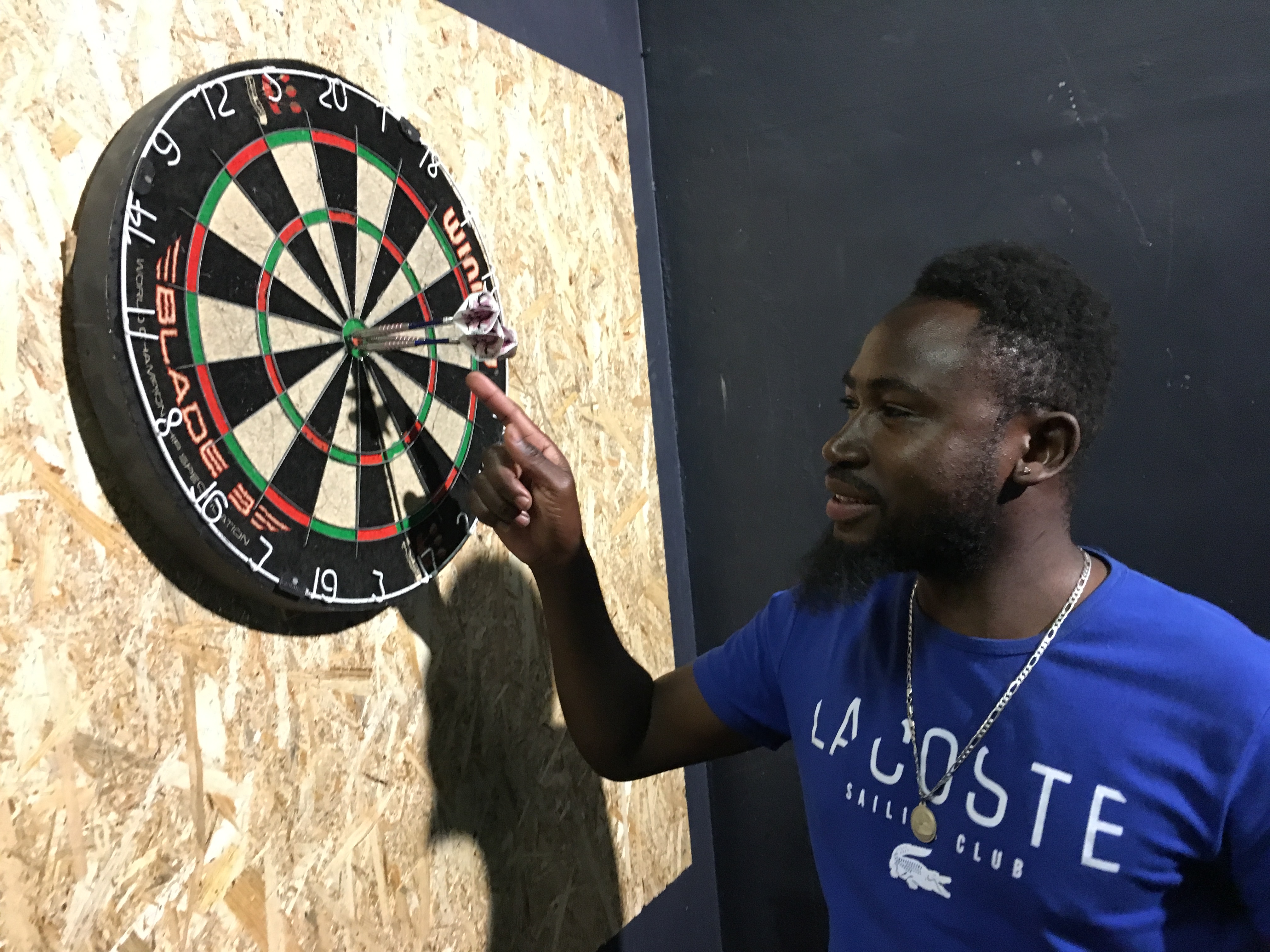
Anyway, after my divorce I decided that I wanted to increase my skills. I bought a real bristle board and metal tipped darts and hung the board in the garage of my new house. I envisioned having neighbors over to throw on warm summer evenings while chit-chatting and downing a cooler full of beer.
The neighbor thing never happened, however. I joined the Peace Corps and rented out my house. But darts wasn’t done with me. There was another Peace Corps volunteer in Arandis, the town I wound up serving in, and he was a darts player and taught some of the locals how to play. He even convinced one of the bar owners to set up a dartboard in an unused room.
One of my Namibian friends kicking my butt.
So, after work, I would head to that bar, order a bottle to Windhoek Lager, the official beer of Namibia, and set about playing against the locals. Once again, I ran into frustration because the local dart players were good, often better than me. Still, it was fun and I got to hone my dart throwing skills a bit.
I actually got fairly decent, good enough to win a trophy and N$200 (about US$10). Not long after that, Covid hit and all Peace Corps volunteers were sent home. When I finally moved back into my house in 2022 I decided to get another electronic dart board. This one is pretty decent with lots of different games and I can play against the builtin computer. It’s been fun to mess around with it, but I found that I really missed throwing metal tipped darts
Me with my friend and colleague, Florian, showing off my trophy.
There’s a difference between soft tip darts used with electronic boards and metal tipped darts used on bristle boards. Soft tip darts tend to be lighter and can bounce off the board if you arch your throws. A good metal tipped dart on a good bristle board is far more forgiving, but the target areas are a bit smaller. Also, throwing a well made metal tipped dart onto a well made bristle dart board gives a satisfying, “thunk!” when dart meets board.
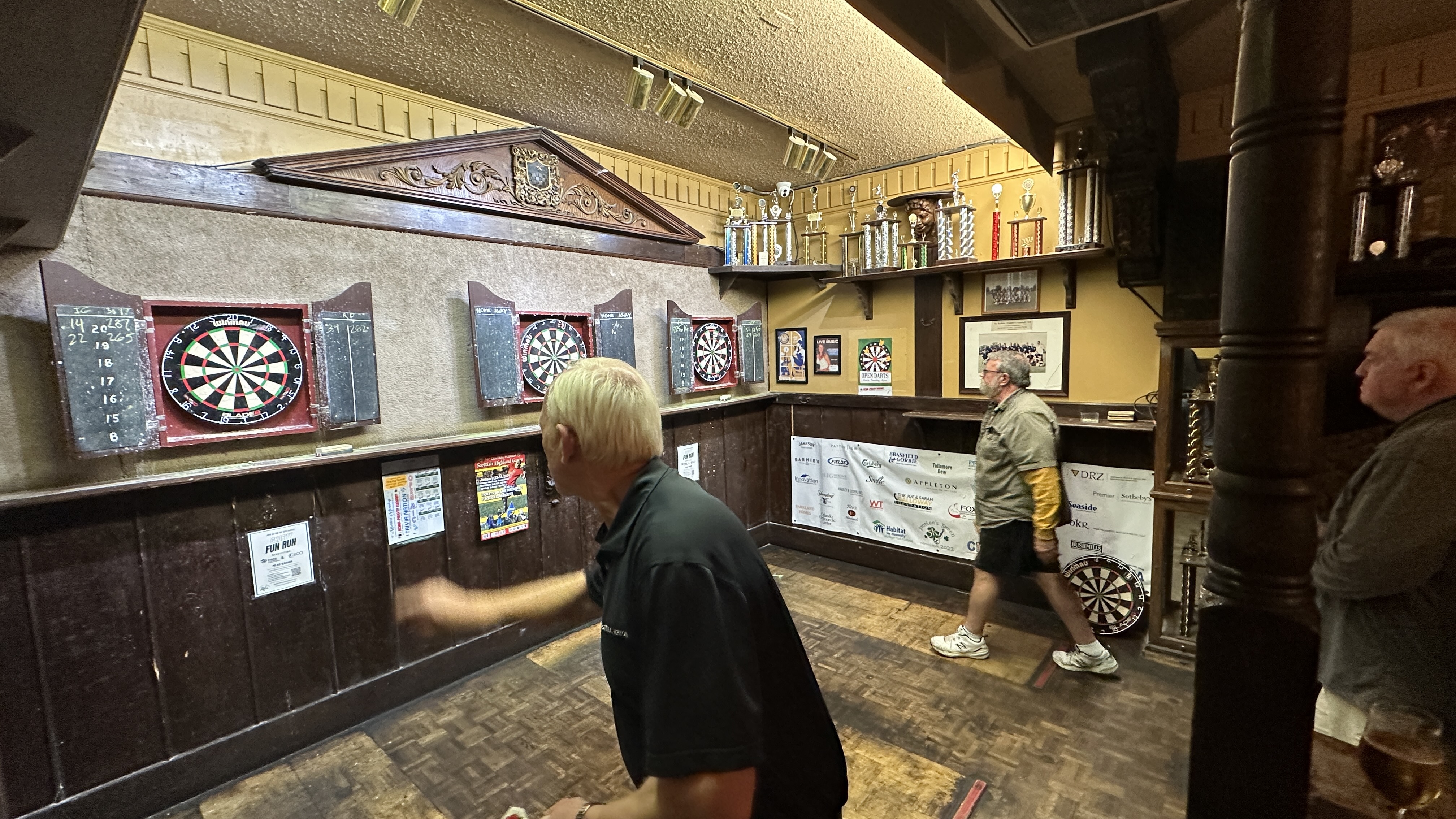
Anyway, back to how I joined a dart team. I was at an Irish pub in Winter Park, Florida called Fiddler’s Green and, lo and behold, they have three bristle dart boards! Many bars and pubs in and around Orlando, if they have dart boards at all, opt for the electronic boards where you have to pay to play. Fiddler’s Green didn’t go that route and their dart boards are often occupied by local kids from Rollins College. The pub even hosts ‘Open Darts’ on Tuesdays where anyone can play and possibly win up to $25 in Fiddler’s Green gift cards.
After seeing those boards I decided to buy a good set of metal tipped darts and started showing up on Tuesdays to try my hand at winning a gift card or two. As it happened, one Tuesday night the captain of Fiddler’s Green’s league team was playing and I guess I made an impression on him, because he asked me to join the team. At that point I was just a so-so player, hardly consistent in my scoring, and I barely understood the rules of the games the league plays. Still, I decided to give it a go.
As far as I can tell, there are two dart leagues in the Orlando area; one for soft tipped darts played on electronic boards, one for metal tipped darts. I don’t know much about the soft tipped dart league, but I do know they appear to be pretty active.
An ongoing match at Fiddler’s Green. We did well that night.
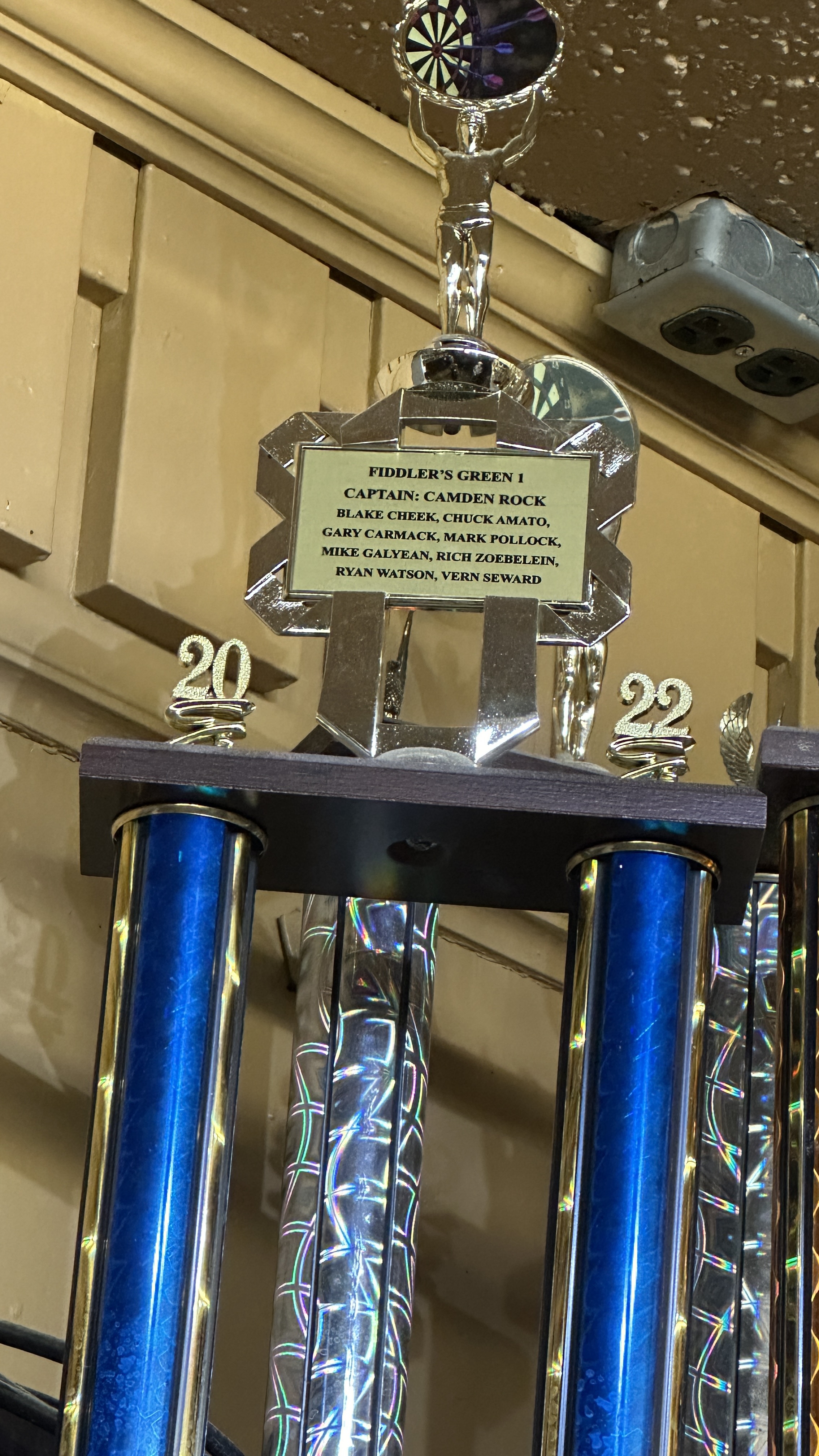
We have 17 teams in the metal tipped dart league, which is divided into 4 tiers. During the season the scores a team achieves by winning matches determines the team’s position in the league standings and what tier that team is in at the end of the season. The playoffs are between the teams in each tier. My team won 1st place in tier 2 both seasons of 2022 and have trophies to show for it. We made it into tier 1 last season, but didn’t do well enough to win a trophy.
The first season I played I won as many as I lost, but I found that I enjoyed hanging out with and cheering on my teammates. This is my third season with the team and it’s been a lot of fun. We’ve just finished the second 2023 season and, once again, we’re in tier two. We are third place in the tier going into the playoffs. I don’t think we’ll win a trophy this season either, but I’m gonna give it my best shot, or throw, which seems more appropriate.
I actually have my name on the team’s trophy!
Like any sports, darts requires skills which are only gained through practice, but you don’t have to be a sharp shooter to have a blast. Almost anyone can play. If you can throw a dart and hit the board, game on!
If you’re new to darts and would like to see how well you might like it, I suggest you start off with soft tipped darts and an electronic board. The board will offer lots of different games with plenty of options. I would avoid the very cheap boards, they are far more trouble than they are worth. Expect to pay between US$50 to US$100 for a decent electronic board. I recommend the Arachnid Cricket Pro 450. It has everything you need to get started playing.
If you’d like more info about metal tipped darts, leave a comment and I’ll get back to you.
I’ll also update this to let you know how my team does in the playoffs, which starts tonight (Jan. 29, 2024). Wish us luck.
Stay tuned.
Update: Last night’s match was fun, but my team didn’t do as well as we’d like. That match was against the top team in our tier. The final score was 3:7.
Several very close games where it could have gone our way, but it was not to be.
I lost my singles cricket match. I just couldn’t get my act together. My doubles cricket match was better. We won that one.
Hopefully we’ll do better next week.
Last Update: We came in third in our tier. Not as good as last season, but better than I had expected. There will be some turnover on the team as well, people leaving to pursue other interests, people joining. In all it was a fun season.
If you’ve followed my blog then you’ll know that my stint in the Peace Corps was cut short when the disease first reared its nasty little head back in 2020. I was a few months into my third year in Namibia when the Corps made the unprecedented decision to recall ALL volunteers worldwide. It was done for our safety, of course. Covid had begun wreaking havoc with airlines and other modes of transportation and it became apparent that the disease was a serious problem.
Since that time I’ve been vigilant about keeping up with my vaccinations, not just for Covid, but for seasonal flus and pneumonia. Still, I’m not overly cautious when I’m out and about. I don’t avoid crowds, though I’m naturally not attracted to them, I don’t mind a handshake or other forms of physical social interaction. I do what I can to minimize germs I might catch or pass on, but I’m not zealous about it.
My philosophy is that our bodies have evolved to keep us healthy while we scurry about this soup of viruses, bacteria, and other forms of biological and non-biological toxicities as we go about our day to day lives. Every so often we do need help to address new dangers, that’s what vaccines do, but for the most part, we get along just fine.
Until we don’t.
As you may have surmised from the title of this post, I have “The Covid”.
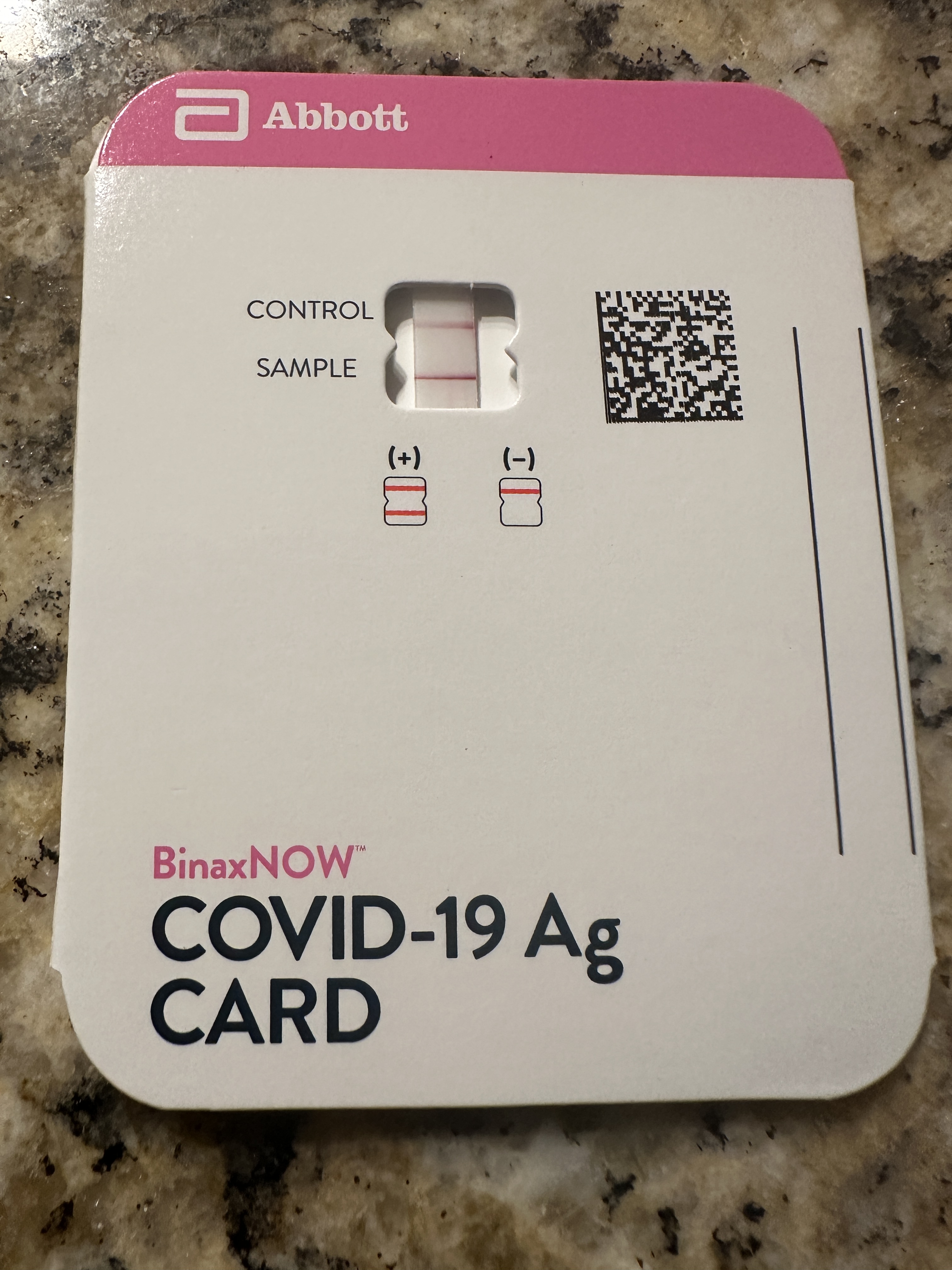
Last Wednesday, after spending time with friends, when I got home I noticed that I was feeling a bit off, not quite myself. I had a mild fever, nothing that would’ve alarmed any health care pro, but it in combination with my general sense that something wasn’t right internally led me to think that I might be coming down with something. Various strains of flu viruses have been going around and I figured that must be what my body was trying to tell me. Still, to be sure, and to make use to the stockpile of Covid test kits I had accumulated since 2021, I decided to test myself.
If you are like me, whenever you learned that our government had Covid test kits to give out for free, you ordered some. And, if you’re like me, you’ve had few opportunities to use said kits on yourself or other members of your family. So, we have a nice little stash.
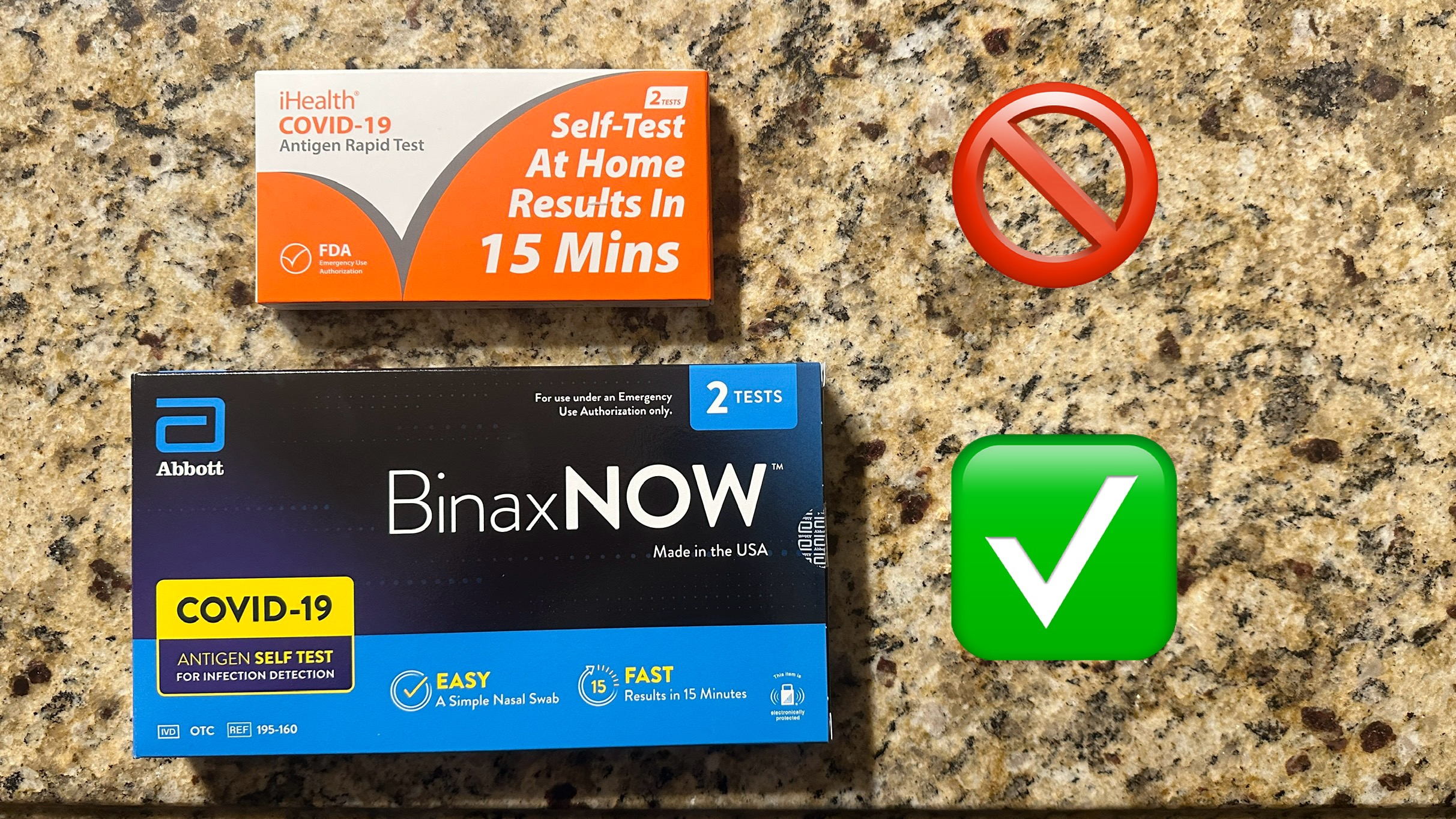
Pubic Service Announcement: if you have the iHealth COVID-19 Antigen Rapid Test kits (these are in orange and white boxes with a dark grey check on the front) and you know they’re older than one and a half years, toss them and order new kits. The fluid use in these kits will likely be dried out or almost so, making them useless. The kits that are now being issued (as of 11/20/2023) are called Binax Now and they come is a black and blue box. These are MUCH easier to use. Get your free test kits here.
Anyway, I tested myself and sure enough, my test showed positive. As I’ve said, at the time I only had a slight fever and an odd feeling, nothing that seemed indicative of the dreaded Covid. So, I tested myself again just to make sure.
Positive!
Damn!
I texted the folks I had hung out with earlier to let them know that I might have infected them then checked my pantry to see if I had enough in store for at least 5 days of isolation. I live in Florida where hurricanes are part of the environment and being prepared is just part of living here. I have several varieties of soups, coffee, several types of teas, canned goods, but most important, a bottle of unopened Maker’s Mark Bourbon, and several bottles of wine.
So, yeah, I was stocked.
That was Wednesday night. By Thursday afternoon I started feeling like I actually had something that wasn’t a flu bug. My fever, while still fairly minor (101 degrees f), was enough to give me chills. My joints started to ache and what was a minor headache the night before had become a major pain.
But Covid was just getting started.
By Friday night my entire body hurt. Even my skin hurt! I was so uncomfortable that I couldn’t sleep more than 2 hours at a time even with medication. I was beginning to think that what I had was a bit more serious than your garden variety virus, and that it might hang on longer than I hoped.
Observation: Why does time seem to slow down when you’re sick? I would take pain meds and go to sleep at, say 10pm. I’d wake thinking that I had slept 4, maybe 5 hours. But the clock beamed 11:30pm back at me. What the heck?? I’d take pain meds and thinking they should start working in maybe a half hour. Thinking at least an hour has passed I check to find it’s been only 10 minutes since the last time I checked.
It’s like being sick puts in some kinda weird time-eddy where you just swirl around, not going anywhere fast.
Anyway, I had other reasons to be concerned about my infection. My plan was to drive out west to see my son, daughter, and my grandson. We were all going to have Thanksgiving together. I had been looking forward to that trip for months. My hope was that if I tested negative by Sunday (11/19/2023) then I would go. But it wasn’t looking good.
By Saturday evening, however, things had changed. My body aches had diminished dramatically. My headache, though still present, was a shadow of the monster it was the night before. I was feeling pretty good, relatively speaking. Even though my fever persisted, I started to hope that I’d get through Covid and make my trip out west.
I tested myself again Sunday morning.
Still positive!
Double Damn!!
All day Sunday my health improved. My headache was all but gone. The fever, though still present, was lower. I didn’t feel quite as tired and I actually slept for more than two hours. I started thinking that maybe I could still make this trip out west. I decided that a test Monday morning would be the deciding factor. If I was still positive, I’d stay quarantined and miss Thanksgiving with my kids. If I tested negative I’d pack up the car, stock up of drugs, masks, and antiseptic wipes and head west.
It’s Monday morning. No body aches. No fever. Minor congestion. I feel good, if not 100%.
I tested.
Postive!!!
Triple Damn!!!
So, my friends, instead of heading west towards family time and turkey, I am stuck in self-imposed isolation. Such is life.
If you’ve read my blog before and wondered why I haven’t posted anything (until now), I will first apologize (so sorry!) and explain.
I got sidetracked and I got lazy. That’s really the gist of it. I’ve been consumed with tackling some much needed maintenance on my house and working on a video (which I had hoped I’d be done with by now) that any sort of writing just took a backseat. I’ll try to keep this blog updated as I anticipate some changes are afoot.
Recently I rediscovered a cache of stories I had written long ago. We’re talking 30+ years ago for some stories. Back then I wanted and tried to write science fiction and speculative fiction in a short story format. I had dreams of getting those stories published in magazines and genre periodicals. I did try and I have a small stack of rejection letters to prove it.
What got me fired up to get published was a chance meeting with a famous science fiction writer, Ben Bova. I was at a sci-fi convention and Dr. Bova was one of the keynote speakers. For those of you not familiar with Ben Bova’s work, one of his best known series focused on human colonization of the our solar system. Likely the best known book in that series is Mars. Dr. Bova wrote over 124 novels, short fiction, and non-fiction works and has won many awards. Dr. Bova died in 2020.
At the convention, between talks, I decided to go have a drink. I was absorbing the vibe of being among like minded people who saw science fiction not as a literary stepchild, but a serious genre. As I sipped at my expensive beer, a guy came up next to me and ordered a beer as well. I looked over and nodded a hello. The man smiled and nodded back, then asked me how I was enjoying the convention. From there we started chatting, just two guys drinking beer and talking about sci-fi stuff.
I didn’t recognize Dr. Bova then and I think he knew I hadn’t recognized him. He asked me my name, I told him. He then introduced himself. I think I said something like, “Ben Bova? THE Ben Bova?”
He might have replied, “Yeah, that guy.”
We shook hands and continued our conversation, but in the back of my mind I was frantically trying to recall the last story of his that I had read, in case he asked me which story of his was my favorite. For the life of me, I couldn’t think of one. And, sure enough, he asked me.
I stammered a bit then decided honesty was best and told him I couldn’t recall a story, but I had read several of his short stories. He asked me if I wrote and I told I did, kind of.
“What does that mean, kind of?” he asked.
I replied that I had written many stories, though I had, up to that point, felt they weren’t ready to be published.
“So, you’ve actually have words on paper?”
“Yes,” replied, and wondered why he was being so specific.
He told me that he goes to these conventions a lot and meet people all the time who claim they are writers, but have never written so much as a sentence. That I actually had written and completed several stories was a lot further along than many so-called writers. He then did two things that I’ll never forget.
First, he paid for our drinks. I was actually intending to pay for them, but he insisted.
Second, he gave me his card and told me to send him a few of my stories. He would read over them and render an opinion.
I was floored.
I promised I would send him some stories and, after gathering what I thought were my best efforts, I sent him four. His reply was tactful, but hard hitting. I knew I had a lot to learn about the craft of writing, and he said as much, but he was also very encouraging, stating, “You really write well.”
He then went on to highlight what I did well in the stories I sent him, and where improvements could be made. One story was well executed, but predictable, another wasn’t engaging enough, while another had a strong plot and characters, but needed to be longer. Ultimately he suggested that I put my current stories aside and start something new, focusing on stronger character and plot development.
I took his advice and started pounding the keys and worked at improving the mechanics of my writing. I am still working towards improving my writing.
One of the stories I wrote before my conversation with Dr. Bova was called Juliettes. It was in that cache of stories I mentioned earlier. I’ve just edited it, expanded it a bit, and posted it on my Stories page. It’s a free download. If you’d like to check it out, please feel free. I’d also like your opinion. Tell me what you liked and didn’t like about the story.
In that cache there are maybe 40 or so short stories. I likely won’t post them all, but I will post others.
Thomas Wolfe wrote a novel titled ‘You Can’t Go Home Again’ which told of an author who wrote about his hometown, and though the novel was a success the people in the town he wrote about took issue with how he portrayed them. The author, then, could never return to the home he knew.
Leaving home, leaving what we’ve grown to know, perhaps love, can be a traumatic experience. When we leave we take with us a snapshot of the place we knew. That snapshot never really changes, but the places we called home does.
I left home on my 18th birthday. Up until that point the furthest I had gone was a field trip to Philadelphia. I knew there was a world and a life beyond the streets of Baltimore, joining the Air Force allowed me to experience it. If I had stayed I likely would have found a way to stay out of jail, maybe get a decent job, but the things I’ve seen and done, the places I’ve been, the people I’ve met would not have happened, and all of that has changed me, made me what I am today for better or ill.
And all while I was seeing, experiencing, and being in foreign places, home was changing too.
My life growing up in B-more was not easy. Juxtaposed to the good memories of summer nights playing with kids on the block while our parents gossiped, drank and laughed are memories of going hungry, stepping over drunks lying in the gutter, and a near constant sense of hopelessness that hung as heavy and dense as a thick morning fog.
Those who never experienced such things often wonder why people stay in situations like that. Seeing it from both sides, I now think I understand why. The fog analogy is a good one. When you’re in a thick fog the only thing you see, the only thing you know for sure is what’s immediately around you. Poverty is like that fog, it restricts your view of the world, limits your options, intimidates you with the unknown and you wind up getting accustomed to those limitations. It becomes your world and it is very hard to leave it.
For me, leaving wasn’t just a choice, it was an imperative. Staying would have drove me to seeking distractions, like so many others do when life isn’t what they believe it should be. So, I am not the man I would have been had I stayed and Baltimore is not the place I left.
The house on Harlem Avenue, where I lived as a young child, is now boarded up. I hear it was a drug den at one point. The neighborhood has also changed. Gone are the stores that used to line Edmondson Avenue; the Five and Dime, clothing shops, even the theater where I spent many Saturday afternoon watching bad sci-fi movies are all gone. So, too, is Public School Number 135, the elementary school I went to. The three story squarish brick building and the adjoining asphalt playground have been replaced by a community center. The other places where I lived, Light Street, Lanvale Street have also changed and not for the better. Gentrification took over the house I lived in on Light Street, while decay claimed the house on Lanvale Street. The people are all gone too.
Had I stayed I may have been able to keep up with a few of my friends. I still have family in Baltimore, a sister, cousins, aunts, nephews, nieces and others, some of whom I’ve not met. They are the only ties I have left to the city where I was born. When I drive through town I recall a few places, but so much has changed that I may as well be visiting a new city in another country.
I was in Baltimore recently to attend a celebration of life service for a family member. While in town I took the opportunity to stop by some of the places where I lived. As I have said, so much has changed and while I have recollections of each place I visited, the house on Harlem Avenue is special, it’s the place where I have my best and the worst memories.
I drove up and parked in front of the house. It was early morning and the street was empty, but I didn’t feel safe enough to get out of the car. Still I sat there a good 10 minutes, looking, thinking, reminiscing. I remember the marble steps I used to have to scrub with Ajax until they seemed to glow. Those steps are now dingy with age and disuse. The front bay windows I used to sit by at 2 AM while everyone else in the house slept are boarded up. Below those windows are the windows to the cellar where I and my brothers played during the day, but I avoided at night. I believed there was a monster lurking in the rear of the cellar and it wasn’t until I was nearly 9 years old before I was brave enough to venture back there. I found that the only things that sat in the dark back there was old furniture and dank, dusty boxes.
1935 Harlem Avenue, Baltimore, MD
I really wanted to find a way in and see the places where I slept, played, ate, and lived. In the end I just snapped a shot of the front of the house and moved on.
That place on Harlem Avenue was home to me and as I drove away I realize how true the adage and Thomas Wolfe’s book title is: you can never go home again. At least, it’s true for me.
I may have mentioned in a previous post that I entered a short movie into several film festivals. The movie, ‘Mosquito Love’, was selected for showing in the monthly Life Screening One Minute Film Festival and will be shown on December 3 at 4:15pm EST.
While this is great news, I’ll have to admit that the movie really isn’t much. It is just 1 minute long and the story is pretty basic, but the reason for creating it has a bit of weight.
Back when I was in Namibia I wanted teach people how to create movies using the technologies they had on hand. Nearly everyone there had a mobile phone, many of those phones could take video. Also, many Namibians had access to a computer even if it meant going to a local library. With these bits of basic tech and free software almost anyone can make movie.
But making a movie, especially one that someone else would want to watch, take more than just capturing video. To tell a story, however rudimentary that story might be, requires planning, scripting, and post processing. I believed I could teach that.
Now that I’m here in the States the thought of teaching a basic movie making class has come back to me. But in order to feel confident enough to teach such a class I needed to go through the steps I would teach, produce a movie and have it accepted in a film festival. I chose the short, 1 minute format to show that a story can be told with as succinctly as possible and still be enjoyable.
Anyway, I did all of that and my little movie got accepted festival that shows 1 minute movies once a month. If you’re interested, here’s the link to the festival. It will occur on December 3, 2022 at 4:1PM EST.
Now that I have some movie making ‘credentials’ the next step is to dust off the syllabus I had put together in Namibia, rework the course for an American audience, and see whee I can offer it as a course.
When I was a kid I dreamt of piloting something, anything that flew. Jets, biplanes, rocket ships, if it provided a means of minimizing the affects of gravity, however temporary, I wanted to do it.
As home computers grew more powerful flight simulators programs (I called them, “Flight Stimulators”) began to appear. When I first loaded up Microsoft’s first flight simulator I was enthralled to be able to take off from LaGuardia and fly over Manhattan where all of the major landmarks were rendered in wireframe and updated every second. State of the art back then.
On my Atari 2600 Game Console I could warp from sector to sector rescuing space stations under attack be a nefarious alien race in Star Raiders. With fairly simple graphics (especially by today’s standards) the game put you in the pilot’s seat and let you dogfight in space. Ahhh, those were the days!
Since that time I have flown on commercial and military transports, hang glided (tandem with the pilot/trainer was ready to take over in case I did something stupid), and took the controls of a Cessna 150 for about 10 minutes. The latter two I did with an enormous grin plastered on my face. I actually ‘flew’.
I’m not so much a thrillseeker, but I don’t back away from the prospect of an adrenaline rush either, and I will likely jump at a chance to take flight, in any manner. I guess I’m still a kid at heart.
Drones can allow one to scratch the flying itch, at least a little bit, so, I bought a drone, a DJI Mini 2. It’s a great little system that’s easy to control and allows me to shoot stellar video while not overtaxing my meager budget. Unfortunately, to keep the Mini under the 249 grams weight limit set by the FCC for drone to fly without being registered (I registered mine anyway), DJI left a lot of features off, like object avoidance.
You can probably guess where I’m going with this, but let me give you the details.
Sample footage from my drone.
Another feature DJI did not include is the ability to automate a flight using waypoints (waypoints are places along a prescribed flight path where changes can be made to altitude, speed, direction, camera usage and so on). Luckily, DJI did open their drone control software to allow other companies to create such things and a company called VC Technologies did just that and created an app called Litchi. With Litchi, my DJI Mini 2 can follow a subject, fly a prescribed course with waypoints, and do all sorts of things the drone couldn’t before. Of course, I grabbed the software as soon as I learned of it.
Now, what comes to mind now is a quote from Spider-Man that goes something like, “with great power comes great responsibility”. Litchi imbued my drone with capabilities once only available on drones costing thousands of dollars. I knew there was great power involved and I read and watch everything I could before deciding to try it out myself.
Alas, there comes a time when reading and watching won’t suffice and one must take the controls. So, I packed up my drone, making sure I had plenty of battery power and storage for the movies I would create as a test, and set off for a local park. I picked a spot where there were few trees, programmed my drone flight with just 2 waypoints at a low altitude, and got everything ready.
Then the moment of truth. I initiated the flight. My drone rose like the obedient automaton it was, turned towards the first waypoint and took off like a banshee, straight into a tree. It was as if the drone knew the tree was there and wanted to commit suicide. It fell into a tangle of tree roots and blinked woefully. I ran to it and picked it up to examine the damage. Propellers were broken, the body was scratched and the drone’s single gimbaled eye dangled as if plucked from its socket by Edgar Allen Poe’s raven.
I gathered up the pieces of my robotic flight avatar and carried it home.
Ahhh, but my ordeal had only begun!
The broken gimbal, removed.
I examined my broken drone and determined that the gimbaled camera was, indeed, the worst of its injuries. DJI wisely provided extra propellers when I bought the device.
I went online to see if I could fix the gimbal myself. There are lots of videos showing how it can be done, but doing so required opening up the drones and mucking around in its electronic innards, stuff I hadn’t done in years. And to add monetary insult to my technological injuries, a replacement gimbal cost $250! That’s half the cost of the drone! The old gimbal was beyond repair so I had little choice. I bought a replacement gimbal and waited for it to arrive.
While I waited I read and watched almost everything I could find on how to replace the gimbal, hoping there might be an easier way. There was no easier way. I would have to take the drone apart, disconnect tiny connectors, handle delicate circuit boards and more all while hoping my hands were still steady enough not to cause further damage.
The part arrived, so did the moment of truth; could I operate on my injured drone and bring it back to life?
The scene was reminiscent of an operating room. I had lights focused on the upturned drone lying listlessly on my table. Miniature screwdrivers, plastic pry tools, hot glue gun, small dishes to hold the screws and other parts I’d remove were all at the ready. I fired up a video the detailed every step then made the first incision, er…, unscrewed the first screw.
Minutes turned to hours as I gently dove deeper into the inner workings on the drone to get to the affected places. Finally, I had removed, disconnected, and detached everything associated with the broken gimbal. Now I had to reverse the process. More hours ticked by, but at last I screwed in the final screw. I installed a battery, pressed the power button and waited for the drone to take it first electronic breath. Lights flashed, beeps sounded, propellers twitched as if it was fresh out of the box. My drone was back!
New gimbal in. On the road to recovery!
It’s still convalescing, I need to run calibration software to get the camera aligned properly, but it will soon be back in the air and once again being my ‘eye in the sky’.
I enjoy writing though I’m not very good at it. My spelling is horrible. My sentence constructions can be bested my many 10 year olds, and my grammar hasn’t improved since junior high school. Yet I continue. Becoming a writer is what I dreamt of becoming when I was a kid. I’ve yet to realize that dream. It doesn’t mean I shouldn’t try.
Kids dream of all sorts of things they’d be when they become adults. While in Namibia, I had put together a series of lectures I would present to secondary and high school kids that exposed them to things I thought they just would not see otherwise. The lecture series was my way of addressing what I saw as a limit to the imagination natural to young minds. Whenever I asked a Namibian child what he or she wanted to be when they grew up I would get invariably the same answers: a nurse, a teacher, an engineer. All admirable careers, but the answers all lacked vision. What kind of nurse? Did they know they could specialize and become an emergency or operating room nurse? Did they know they could teach yoga, programming, or the art of sword making? Did they have any idea that nearly everything in our modern world requires specialized engineering?
They did not.
One of my early attempts at lecturing.
My lectures were supposed to expose these young minds to the vastness of human endeavor. I showed them how medicine and engineering produced prosthetics that allowed people to walk, pick up a can of soda, or see again. I showed them people who taught machines how to dance, open doors, and run on two legs like its creators. I showed them devices engineered to take people into the deepest, darkest, coldest places on earth and view, first hand, creatures never seen before by man.
Did it work?
I don’t know. They were wowed when the watched a Boston Dynamics robot do a backflip and open a door without human assistance. They appeared mesmerized by men and women who seemed to possess comic book-like powers granting them superhuman speed, and strength through engineered prosthetics. They gasped when a diver surprised an octopus that had disguised itself as a rock. The students and teachers applauded loudly an asked for more, but did any of it mean anything?
I like to think that my lectures and presentations were more than hour-long distractions. I earnestly hope that hearing me talk and showing them video snippets of the world beyond their classrooms and auditoriums planted a seed in what I hope were minds still fertile and nourished with imagination and wonder. But I’m a realist, I know I will likely never know if anything I said or showed took root.
I left Namibia is 2020 as COVID became a pandemic. Some of those high schoolers may be freshman now in the University of Namibia or other institutes of higher eduction. Hopefully, by the time they are seniors, they will have decided of a career path and, hopefully, a few may remember the lectures and videos I showed and make a decision based on what they saw and heard.
I suppose what I’m wondering at the moment is what many teachers must wonder at some point in their career: did I make a difference? I am no teacher, but the sentiment is the same and I’ll likely never know if I made a difference, but I believed it was worth the effort.