The Winter of Our Hypernormalization

I read an article recently which described the term ‘hypernormalization’ as the feeling that everything around us is not right somehow, but we keep going through our daily routines as if all is right with the world.

In other words: we instinctively know we’re in a hand basket heading to Hell, but instead of figuring out a way to either brake our descent or get out of the basket, we carry on by ignoring the increasing heat and cramped accommodations. 

Though we may not be directly affected by natural or man-made disasters, we are inundated by them via our media of choice to the point where what, at one time, is seen as horrific, such as the California fires, is now a media moment, soon to be forgotten when the next headline vies for our attention. Meanwhile, little if anything is done to address the overriding situations and underlying causes because, well, shit happens, and we can expect shit to continue to happen. So, unless there’s a fire in our backyards, or a blizzard-dumped snow pile in our driveways, or cold-busted pipes in our basements, we  glance up from our phones and computers long enough to shake our heads in recognition of what others are dealing with, then doom-scroll to the next disastrous headline.

And we wonder why we feel discordant, out of sorts, deep in our feels while the cause of our blues seems to have escaped us. 

Hypernormalization.

Reading the news is like reading a script for an upcoming disaster movie. (Except Hollywood can’t produce it because it got toasted too!) Watching the news can be a recipe for engendering suicidal thoughts. People who believe such things see these catastrophes as signs declaring that, “The End is Nigh!!”

Well, maybe.

Or maybe it’s Mother Nature letting us know who really is in charge. Or maybe all of this has happened before, but the toll on human lives and our endeavors were much less when there were fewer of us. And, of course, all of it is sensationalized to the extreme by whatever media you choose so that a bad situation appears to be far worse than it is and right around the corner.

Don’t get me wrong, the Cali-fires, wayward blizzards, and hurricanes, and rollercoaster temperatures are all tragic and newsworthy, but the populace not directly affected by them are badgered by them in excruciating detail. It’s as if the media wants us to believe that, for instance, the fires in L.A. are so much more tragic because a favorite movie star’s home burned to the ground.

Yes, I know that we need to know what’s going on and where, but there is such a thing as information overload, and this winter, I think many of us who are not directly affected by a disaster are suffering from it. And thanks to our innate ability to get used to just about anything, our sensitivity to disasters, in general, has diminished. And with that diminished sensitivity, we tend to accept it while believing there’s little to be done to fix the problems we face, and we move on.

A friend of mine recently asked me to talk her off a virtual cliff as the news she’d been watching was so overwhelming that she felt lost and anxious. ( Actually, it wasn’t just the weather catastrophes that had her on edge, but I won’t go there, and these are my words, not hers.) To my mind, this is a normal human response. We should be concerned about the disastrous events in our world, and yes, we can and will be overwhelmed by them. 

I responded by trying to make light of it, stating that I was following the ostrich’s approach to a bad situation by burying my head in virtual sand. I refused to consume the news in any form for a day or two and advised her to do the same, and to seek out anything and anyone that could put a more positive spin on the world. 

(BTW: Ostriches don’t actually hide their heads in the sand when faced with danger. A full-grown ostrich can run away from danger at speeds of up to 70km/h (about 43 mph) and can defend themselves with large claw-like talons and powerful legs.

I saw a group of wild ostriches run up a mountainside while I was in Namibia, and I was left in awe at how fast the group ascended, even the little ones. I was also left wondering: since ostriches are land-bound birds, are a group of them called a flock or a herd?

I wasn’t trying to make little of her distress or appear flippant in light of her anxiety, but there was actually some truth in what I offered her. Often, when I’m feeling wired or merely out of sorts, I will find something that will cheer me up or at least divert my attention from the current calamity. For instance, I will watch Looney Tunes and Popeye cartoons. I also dabble in video production, writing, and thinking about my next major move.

These distractions seldom fail to get my mind off the negatives, at least for a moment, and often that’s all I need to do an emotional level set. I can then focus on what, if anything, I can do about the problem at hand.

(You can find my latest video releases here: https://www.youtube.com/@vernseward5323)

No, I’m not suggesting that those folks in the midst of a disaster can find solace in watching Roadrunner outsmart Wiley Coyote or to wait for Popeye to down a can of spinach to open a can of whip-ass on Brutus. What I am saying is that those of us for whom the minute-by-minute stream of wreck, ruin, and heartbreak is affecting our well-being or numbing us to the point where we don’t feel the way we should about the ruinations of others, can and should give ourselves a break and find something more positive for our brains to ingest, at least for a little while. Hit the reset button on our feelings so that we can focus on solutions.

Otherwise, we’ll just keep dappling away the sweat caused by the increasing heat while marveling at how well the hand basket we’re in can handle the weight of the crowd.

(A group of ostriches is called a herd.)

Stay tuned.

Vern
Living in Small Spaces: Part 1

Like many others, I’ve been fascinated by the thought of living in a tiny house. I even considered doing so while I planned my move to South Carolina. But after watching shows like Tiny House Nation, I soon realized that it takes a certain mentality and more than a little will power to confine one’s life into 300 square feet. Bedrooms you have to climb ladders and crawl into, bathrooms where the toilet and shower are in the same space, chairs that are more at home in a camper than a living room, nope! That’s all fine for a short period, but I am neither mentally prepared or have the will power to live in such a small space for the rest of my days.

I’ve done it before and it was not pleasant.

When I arrived in Arandis, Namibia during my stint in the Peace Corps, I fully expected to live in a tiny grass hut. Such was my preconception of Namibia and Africa in general. I knew there were modern cities in Africa. Windhoek, Namibia’s capital, looks like any European metropolis, complete with the traffic and noise. But I didn’t think I’d be working in Windhoek. This was the Peace Corps after all. They go to where the need is most, and that tends to be in rural areas. So, I saw grass huts in my future. 

I was surprised to find that my first home while in country was a three bedroom house built of concrete blocks. It had full plumbing, power, a nice kitchen, and a living room with a 65” TV and sectional sofa, and a small front lawn. Hardly a grass hut.

So much for preconceptions!

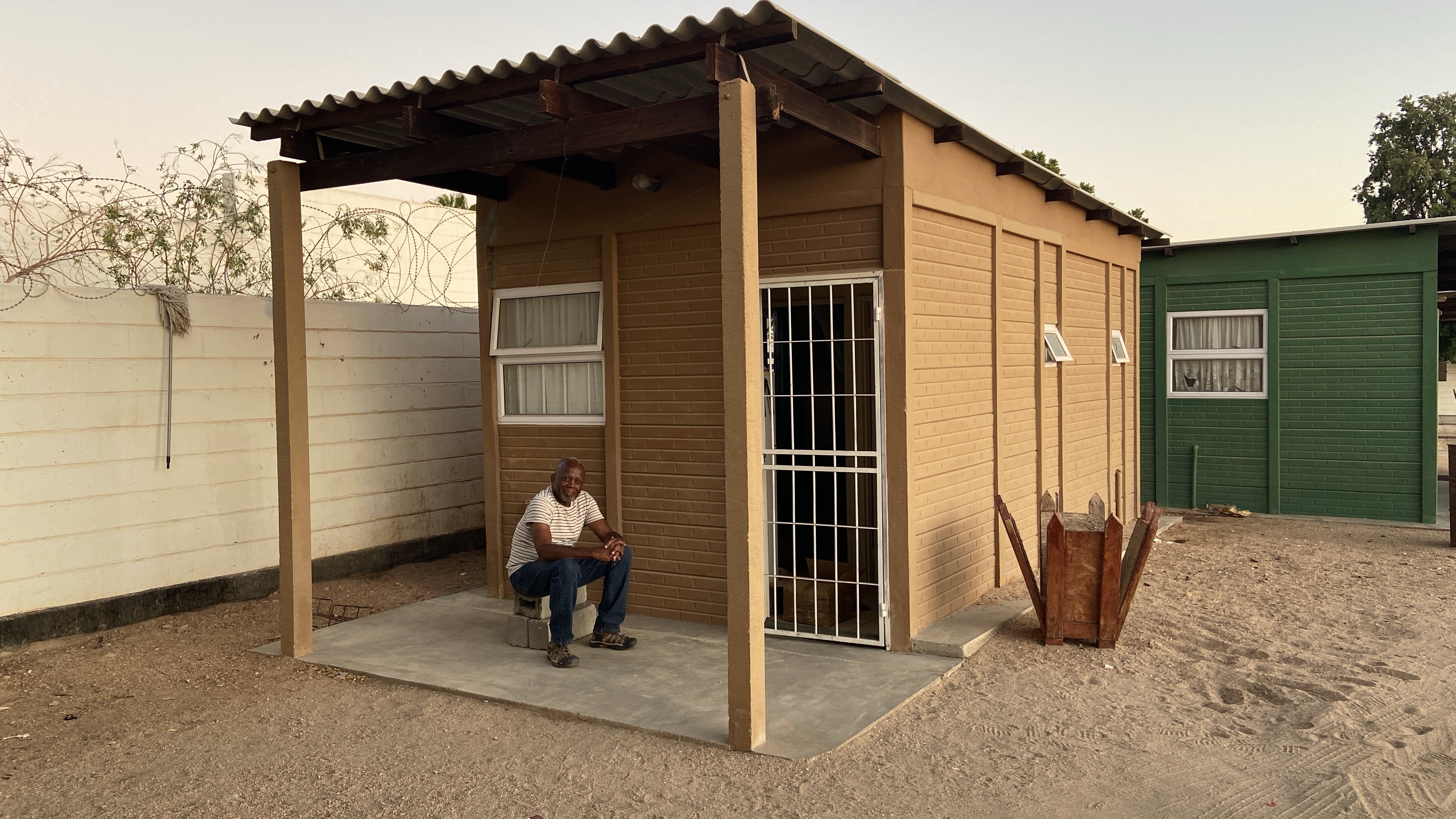
However, by the time I left Namibia, and due to managerial snafus, I was moved to a 500 square foot house, then to a 100 square foot cabin that was originally intended for one person staying overnight. Truthfully, not even one person would want to spend a night in that tiny closet. The place was poorly designed and I barely had enough room for a single bed. Yet I stayed in that cabin for 5 excruciating months. I had an old hot plate for cooking, a fridge the size of a foot stool, and the water from the faucet was not ideal for drinking. I was told that it was temporary, that I was in “transition”. It was hot, smelly and full of mosquitoes. It was not the best 5 months of my life.

Me sitting in front of the tiny hut I spent 5 months in.

When I came back to Florida I rented a 450 square foot cottage. After living in that tiny cabin, 450 square feet felt absolutely palatial! Still, I was in transition; going from my Peace Corps life in Africa to the life I had previously known in Florida. I eventually moved back into my 1450 square foot home and, when I did, I found that I had far more space than I needed. My mind had adjusted to the confining space I was forced to live in.

I had no use for a dining room, one of the smaller bedrooms I used to stage house renovation and repair projects which I could have done in the garage. The other small bedroom remained empty. I pretty much stayed in three room; the kitchen, the living room, and the primary bedroom. Together they were about 800 square feet. I had room to spare!

When I sold my home in Florida my initial intentions were to find a place in South Carolina that was smaller, perhaps around 1000 square feet. I thought that anymore space would be wasted on me. But, sometimes things just don’t pan out like we planned. Instead of downsizing, I’m actually upsizing. The house I intend to buy is a bit more than 1500 square feet. Ah well. It’s still not Buckingham Palace, so there’s that.

Unfortunately, my new home won’t be finished for quite some time. It’ll be at least 10 months before the house is ready. So, I’m in transition once again and, once again, I’m existing in a small space.

I’m renting a studio apartment while my new home gets built. The apartment is 462 square feet. Because space is so limited I find that I need to revisit some of the strategies I used in Namibia and, more so, in the small rental in Florida to optimize storage and make this little spot feel like somewhere I want to be, not escape from. 

With that in mind I’d like to highlight some of those strategies. Maybe you can use some. Maybe you can suggest some. I’m always open to new ideas. So, let’s get crackin!

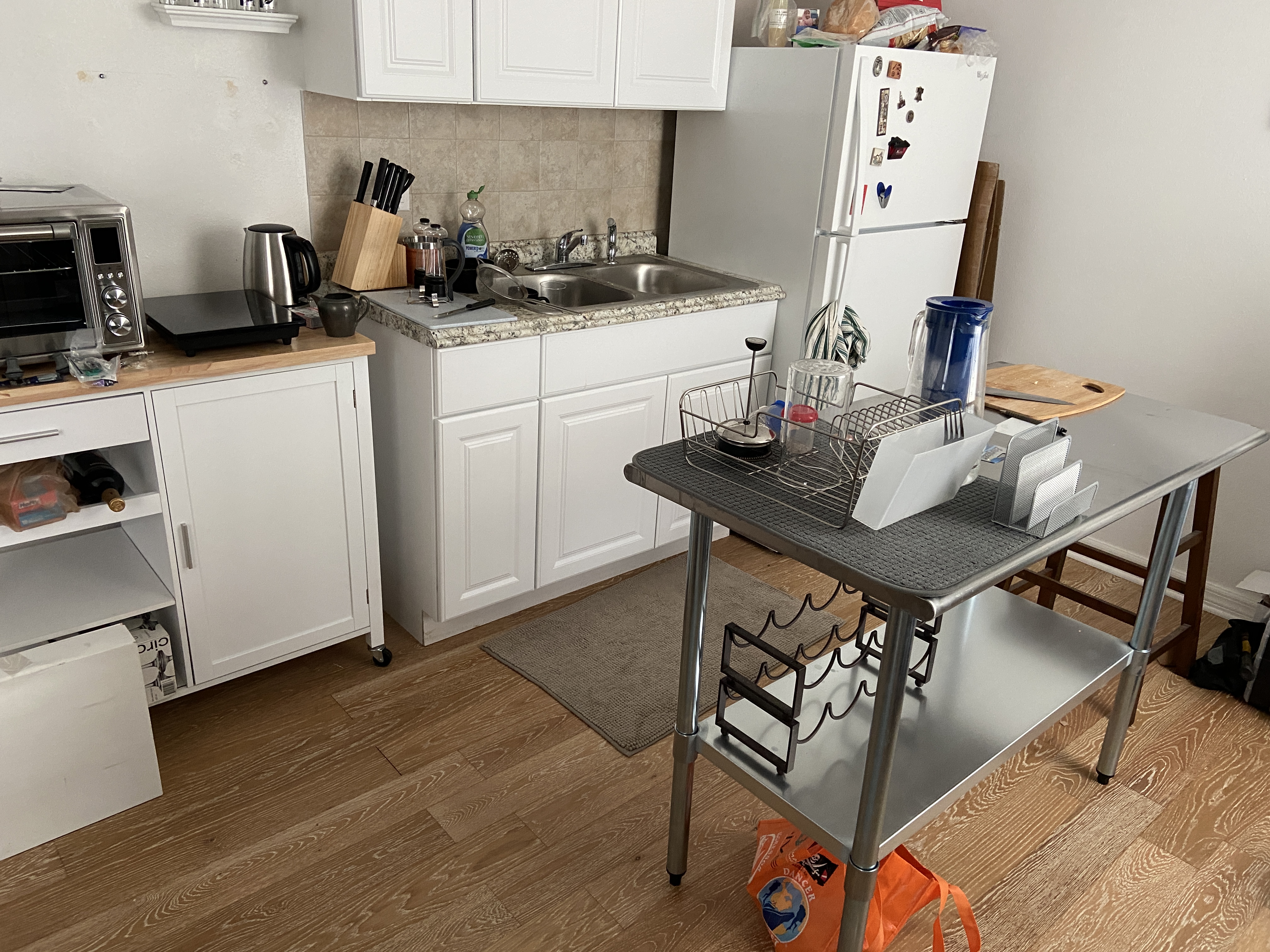
The first thing I want to talk about is a table. Elevated, flat, hard, durable surfaces in a studio apartment is, unsurprisingly, hard to come by. This place has approximately 4 square feet of counter space. It’s nice counter space, made of a composite granite-like material, but it’s barely enough real estate to prep a decent sandwich, much less cook a meal. Obviously a table of some sort is the answer. 

In the small rental back in Florida I had bought and used a very inexpensive stainless steel table. I got the idea from my friend, Sara. She had a nice stainless table she was using as a kitchen island. That table proved to be very versatile. It was easy to clean and maintain. So, I got one too.

While I would highly recommend a stainless steel table, I would strongly suggest that you not get a cheap one like I did. Mine cost about US$100 and it was not very good. The table top was stainless, but barely so, and the rest of the table was of lower grade metal. The lower surface was definitely a poor grade aluminum. The table top was of low grade stainless. Over time I found tiny rust spots on it. Food grade stainless will not rust so the metal in that table was obviously not food grade. 

That cheap steel table did come in handy.

Still, the table served its purpose. I used it for food prep, a workstation desktop, a sound studio station, a dining table, and more. Even so, I was happy to leave it behind. If you decide to get a stainless steel table get one that has food grade stainless as its top surface. It will definitely cost more than a hundred bucks, but it’ll be worth it in the long run.

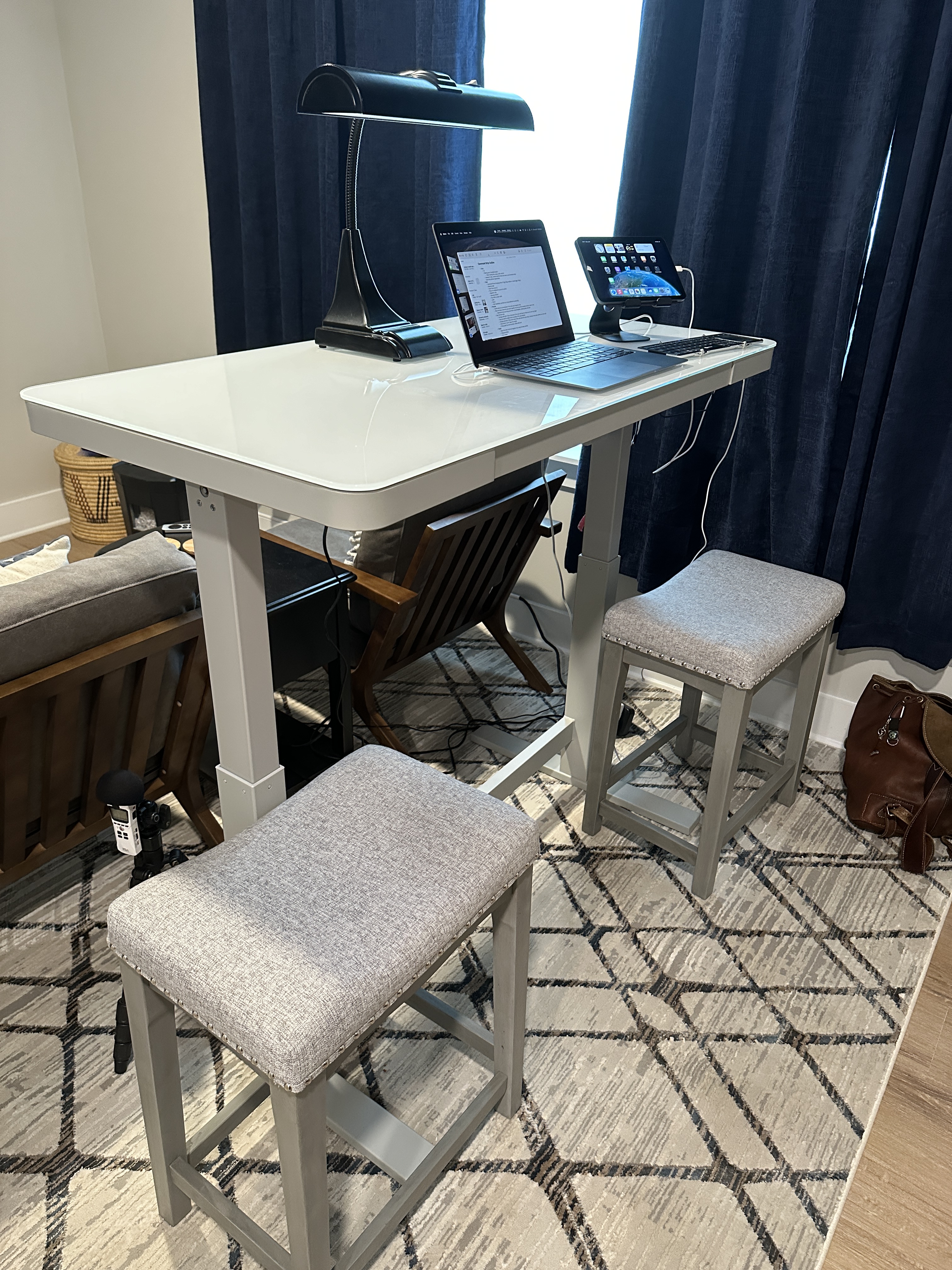
This time around I decided to take a different approach. While shopping in Costco I came upon a robust, adjustable height table with a glass top from a company called Tresanti. Glass is key because it makes the top easy to clean and maintain and it makes the table extremely versatile while looking sharp. 

As I mentioned, the table is height adjustable. Back when I was working I found that standing was a lot better for me than sitting at my computer all day. I had my desk raised and the company I worked for gave me a chair that allowed me to easily sit in a quasi-standing position whenever I needed to. I’ve been standing whenever I’m at my computer ever since. 

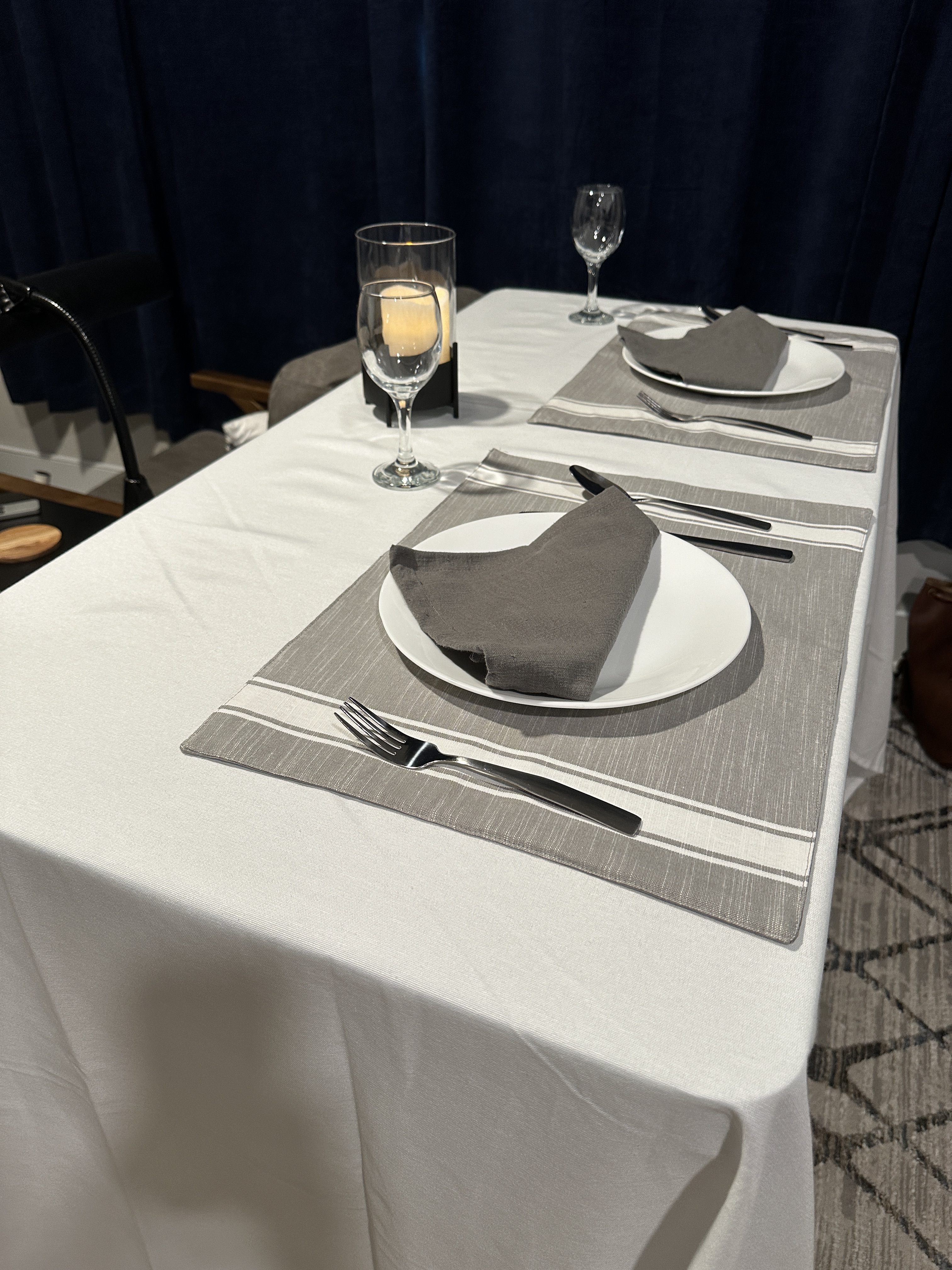
This table, then, is perfect! It’s the right size to sit behind my two comfort chairs, dividing my “living room” from my kitchen/editing studio/whatever else I need the space to be. (More about those chairs in Part 2.) I can dress it up for an intimate, candle lit evening, fit it out to record audio for my next video, or pound out this post for my blog. 

The raised height is great to stand at. And the stools complete it.

The table was a tad spendy, but it will be with me for a long time. 

I bought two fairly inexpensive, decent quality upholstered stools to go with the table. The stools are comfortable and serve as my dining chairs and as extra seating on the rare occasion when I’m entertaining more than two people. Together the table and stools look as if they were made for each other.

From workstation to an intimate table for two.

So, I’ve doubled my elevated surface area, added more seating, and have created a flexible workspace that looks great. And what I’ve bought will find use in the house I’ll eventually move into, so nothing is wasted. 

The second item I’d like to talk briefly about is actually an indulgence of mine that just happened to be useful. 

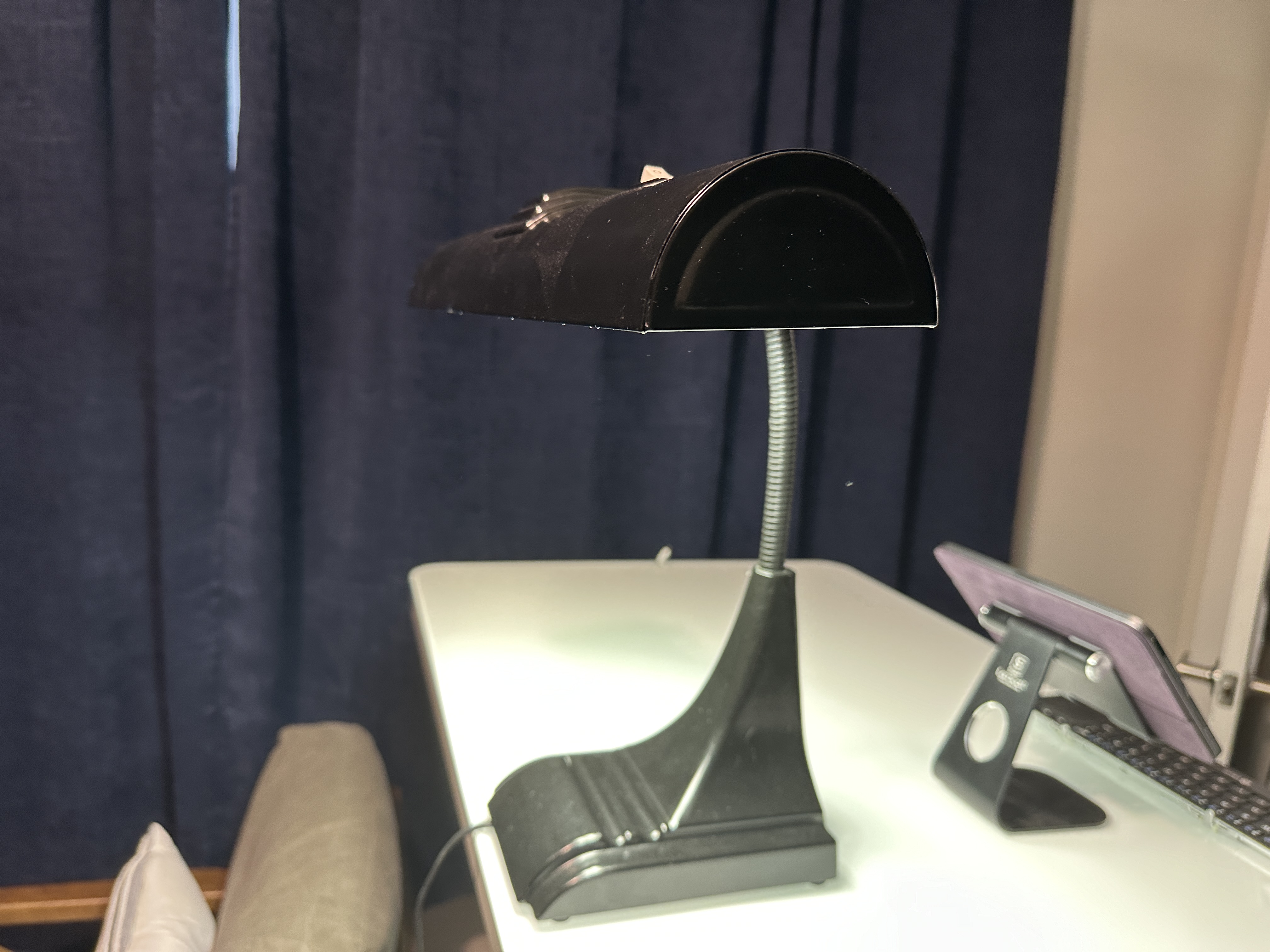
One of the few bits of furniture that I brought with me is a lamp that I found in Goodwill several years ago. I bought it for US$10 not knowing if it would work.

Some of you younger readers won’t recall ever seeing this type of desk lamp. It has a heavy metal base, a bendable snake-like stem, called a goose neck, and a wide, rectangular…, I guess you would call it a globe. It’s the portion of a lamp where the light source, a bulb in most cases, would be. This lamp, however, is fluorescent. It uses two, 16 inch long fluorescent tubes as its light source. These types of lamps were popular years ago, especially in accountants and newspaper editors. 

It may not look it, but this is a great lamp.

What’s special about this lamp, special to me anyway, is its versatility. It’s ideal for reading and any time I need a more focused light source. The thing I like most about the lamp, however, is its looks: clean lines, functional, understated with a hint of Art Nouveau aesthetics. It takes up very little of what precious desktop real estate I do have while providing a much needed function. The cost puts it in line with my new found frugalism and the looks certainly coincide with Mid Century Modern tastes.

A win-win!

More about living in small spaces in part 2. Until then…

Stay tuned.

Vern

Omajowa: The Mushroom King

It’s just the beginning of the rainy season in northern Namibia. Areas that were baked in the unrelenting Namibian sun for most of the year welcome the deluge that starts in late December and continues through March, dumping meters of water and supplying much of the yearly supply of fresh water to the traditional farms and towns that dot this ancient ancestral home to the Herero, Himba, Damara, Ovambo, Kavango, and Nama peoples.

It’s during this time that these subsistence farmers plant their basic food crop, mahangu, a type of millet that is pounded into a meal and eaten as porridge with almost every meal. They will plant maize and other vegetable and feed crops that will rapidly grow to maturity during the life-giving rains. It is also the time of year when once dry lakes and riverbeds come alive with barber fish, a type of catfish that is released from hibernation by the flood waters.

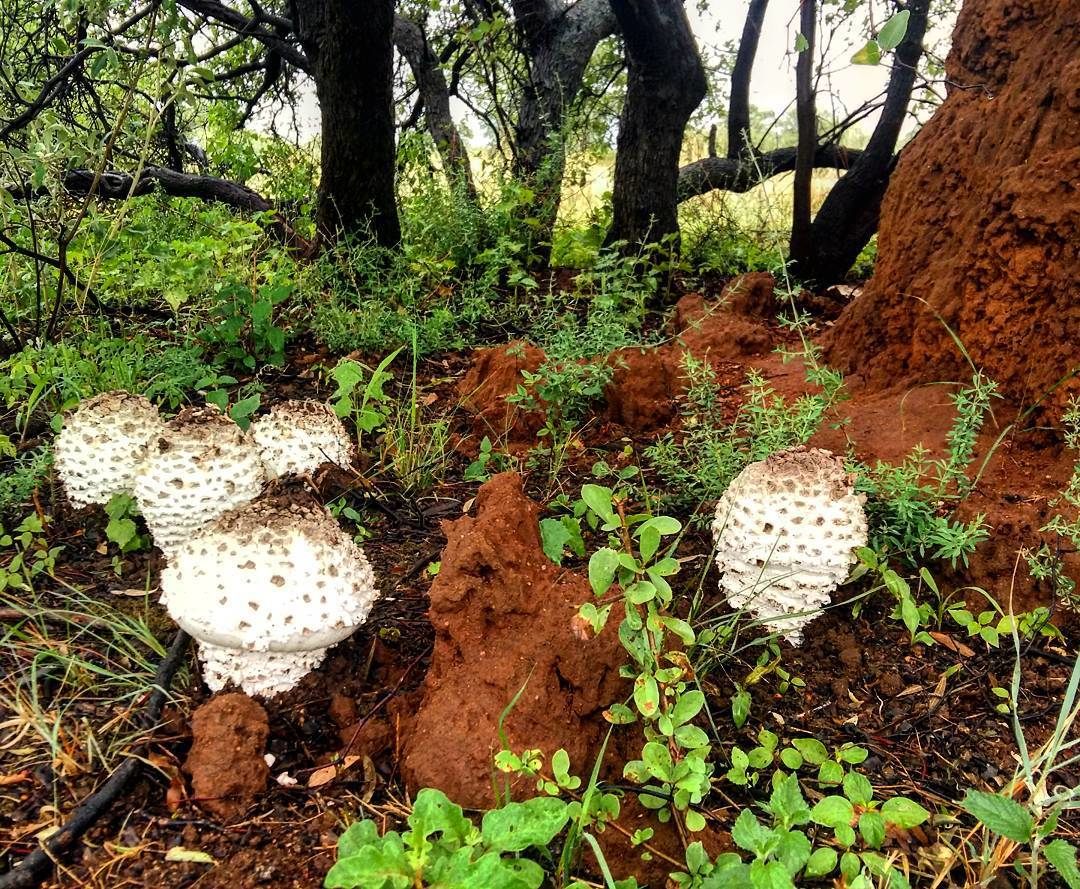
Omajowas sprouting from a termite mound. (Image courtesy of Atlas Obscura)

It is during this time of year that you can find omajowa, a variety of mushroom that sprouts from the many termite mounds that punctuate the northern Namibian landscape. What makes these particular mushrooms interesting is the size. From tip to tip they can grow up to a meter long and a fully developed cap can be the size of a dinner plate! 

Yeah, we’re talking BIG MUSHROOMS!

Not only are they big, they are delicious! My first encounter with these big, tasty beauties was in January, 2020. I was traveling to Ondangwa with my host organization, The Rössing Foundation, when we notice some locals flagging cars and waving what looked large white bones. We pulled over and I was instructed to remain quiet. It seems that the haggled price increases dramatically if the sellers hear an American accent. (I wonder why?)

Haggling for omajowas

After several minutes of intense haggling we came away with several enormous, but slightly immature mushrooms. I was told that getting the mushrooms before the caps fully developed insures a more tender and flavorful experience. 

We stayed at a guest house and one of the staff volunteered to prepare the mushrooms for us. She cooked up 4 for us and kept 2 for herself. The result was a big bowl full of what looked like sautéed diced chicken. The flavor was interesting, falling somewhere between chicken and veal or pork and the texture was like chicken breast.

In March, 2020, not long before I along with all PCVs worldwide were sent home due to the COVID-19 Pandemic, I had another opportunity to experience omajowa. During another trip to the north, where my colleagues and I drove through calf-deep water for kilometers in areas that, just a few months before I saw the desiccated remains of livestock that succumb to the drought in the area, I was lucky enough to buy several of these stupendous mushrooms to try my hand at preparing them.

Keep in mind that I’d only seen these immense mushrooms once before and had never cooked them. But, after talking to several friends about how best to prepare them, I figured I’d give it a go.

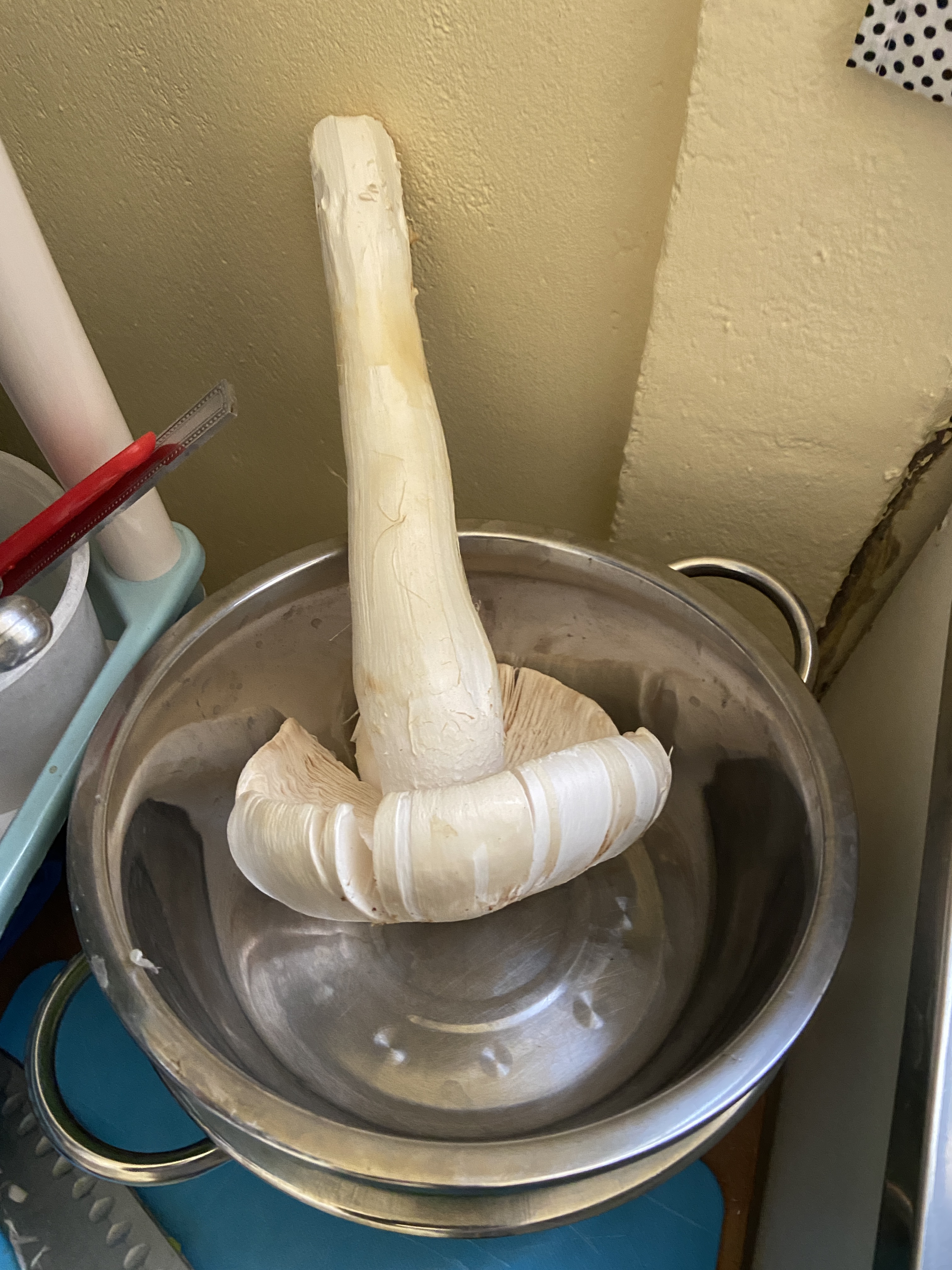
Step 1: Skin it

These giant fungi have a fibrous epidermis that is edible (I’m told), but not desirable. So ya gotta skin them. Luckily they peel fairly easily, like a big white carrot.

Skinned!

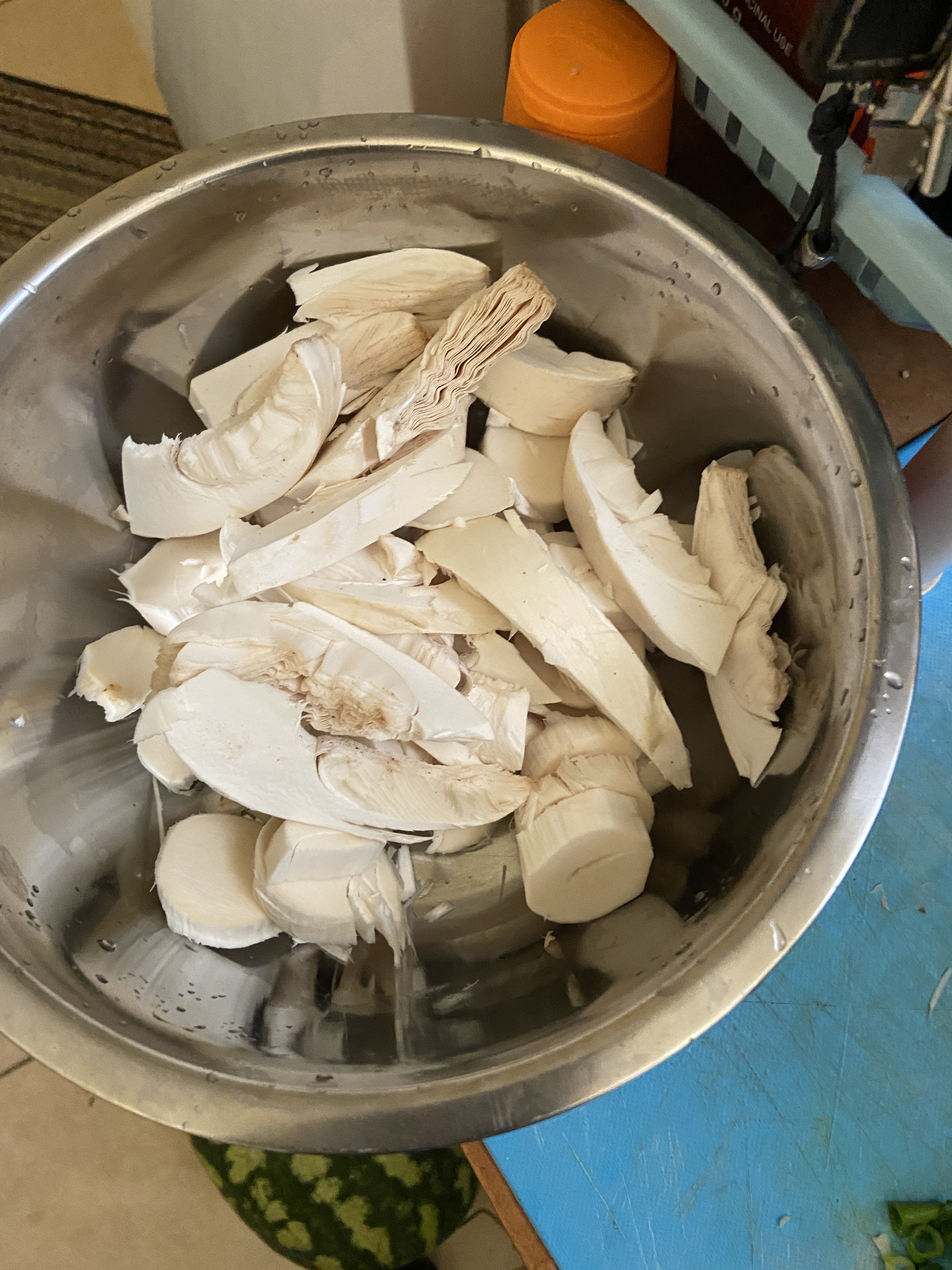
Step 2: Chop It

The stem is round and fibrous and look a lot like scallops. I decided to cut the cap into strips, each about the size of my palm.

Chopped!

Step 3: Season It

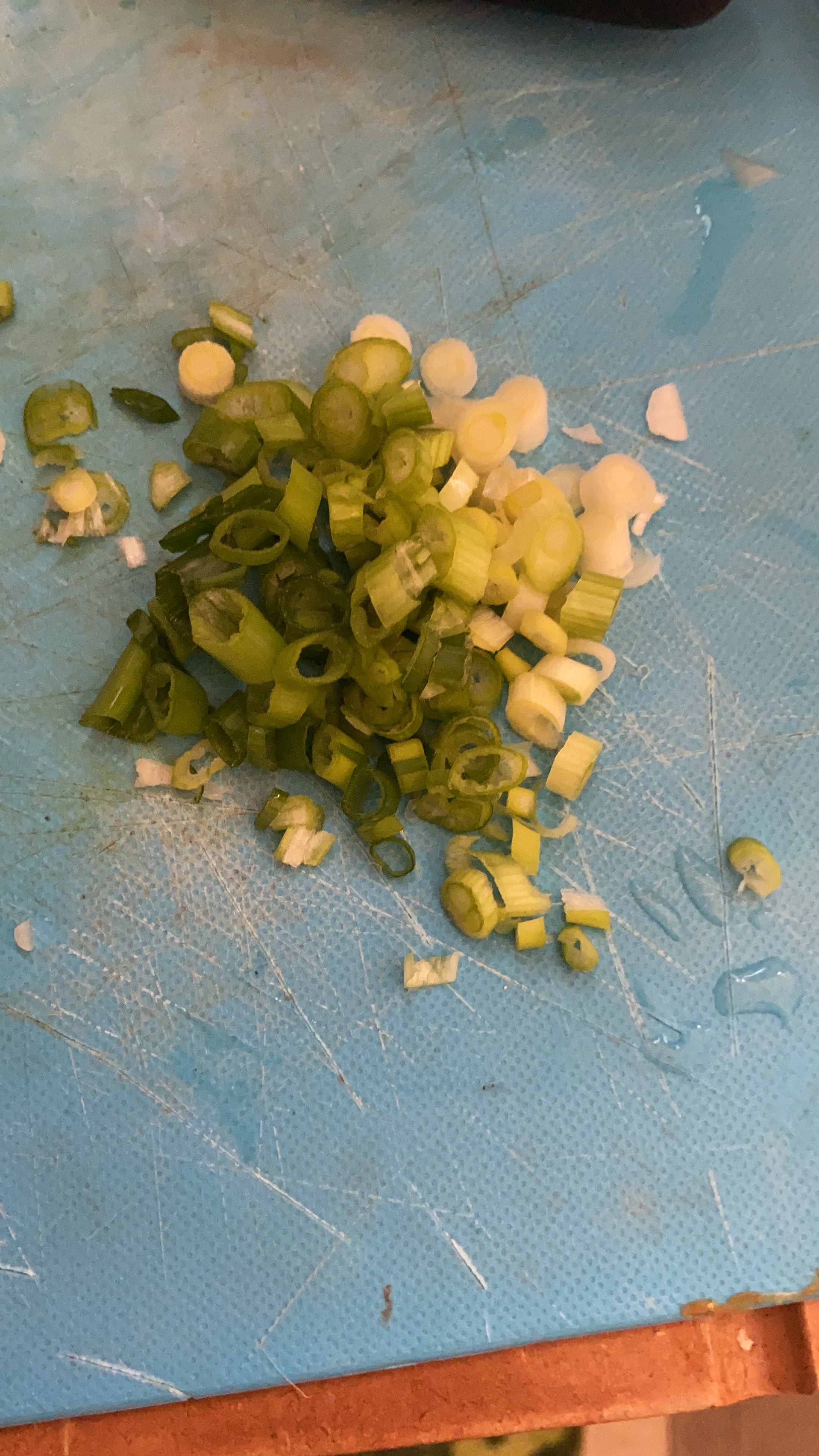
I broke out my small pan, added a dollop of butter, some chopped green onions and garlic, then added the shrooms. Like all mushrooms I’ve prepped in the past, these reduce in size as you cook them. I sautéed until they started to brown on the edges and the meat was tender with a fork. I lightly salted them. That was it!

Seasoned!

Step 4: Enjoy!

One gigantic mushroom was more than enough for me and I had enough to share. It was DELICIOUS! It’s a shame Namibia can’t export these beauties because they would be a huge culinary hit worldwide. 

Enjoyed!!

Portabellas can’t match them. Shitakes are no contest. Whites take a backseat. In fact, every edible mushroom pale in flavor, texture, and most of all, size, compared to Omajowas, The Mushroom King.

Stay tuned.

Vern