Darting Around

I’ve never been one for sports. I don’t religiously follow teams, though I will watch a game recap. I could never properly perform a basketball layup, throw or catch a football with any finesse, or hit a baseball no matter how hard I tried, so I was always the last one to get picked for a team.

I was turned off from tennis when some bozo said he’d coach me for free, but it turned out he just wanted someone he could blast 200mph serves at. I had even bought a tennis racket with the intention of learning the basics. Besides, I figured women might take notice (more like pity) of a strapping young man trying to whack a fuzzy yellow ball across a net and failing miserably. And, sadly, no women took notice. 

A friend of mine tried and failed to teach me the finer points of golf. While I enjoy smacking the hell out of those little white balls on a driving range, I absolutely suck at playing the game on a course. I figured that if I was going to spend that much time in sand traps, I may as well go to a beach instead.

There are really only two activities that may loosely be considered sports that I am any good at: table tennis (ping pong) and darts.

I picked up table tennis during my stint in the military while stationed in Thailand. I was looking for something to do that didn’t cost money and didn’t involve drinking. I started playing in the NCO (Non-Commissioned Officer) rec rooms on the bases wherever I was stationed, and I got to be fairly good, winning more matches than I lost.

During my time at IBM, I had a manager who also enjoyed ping pong and was quite good at it, though he was half again my age at the time. We discovered that IBM had a table tennis setup in one of the lounges on site, and my manager and I would go and play during our lunch breaks. 

We weren’t in the league of those world class players who stand ten feet away from the table and can make the ball move blindingly fast or seem to hover just above the net, but we had a lot of fun. 

I don’t play anymore, though I’m sure I’ll pick it up again given the opportunity.

I started playing darts after looking for something that my then-wife and I could do together after my daughter went off to college. I bought an electronic dart board. It wasn’t very good and broke not long after we started playing regularly. But we played enough that we were hooked, so I bought better one.

While I got fairly decent at it, my ex got really good, beating me 3 out of 5 games almost every time we played. I think she practiced while I was at work, though she never would admit it. 

She had a very unconventional way of throwing. She would swing her arms like a baseball pitcher winding up for a pitch, then throw the dart, not hard, but with uncanny accuracy. My throwing style at the time was copied from players I’d seen on the internet. They all threw basically the same way; using the forearm and wrist to kind of flick the dart. These guys were pros, but my mimicked throw produced mixed results. You can imagine my frustration at losing to a woman who threw darts like a Yankee pitcher trying for a no-hitter.

Since that time, my dart throwing accuracy has improved. Back in 2019, the organization that hosted me while I was in Namibia, the Rössing Foundation, had put on a sporting event for its employees. Darts was among the activities, and I won the first-place trophy! The first time I’d ever won a trophy for anything!
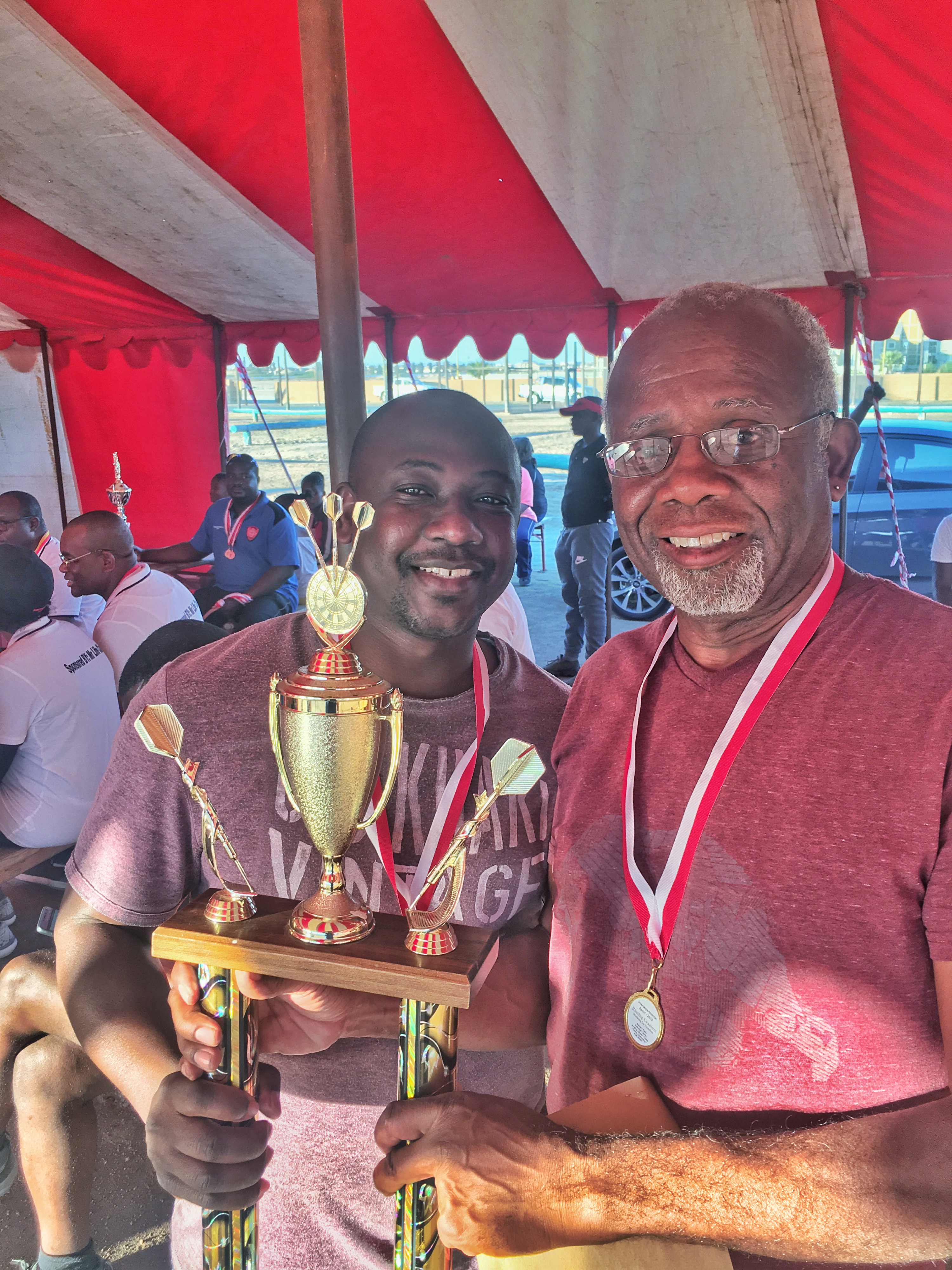
That’s my friend, Florian, on the left.

While I was in Namibia, I found that the locals also enjoyed darts, and I would play them after work at a local bar. It was there, oddly enough, that I learned to associate beer with darts. An association that I enjoy to this day.

My skills had improved since returning from Namibia (so did my beer drinking), enough so that I wound up on a team in the Orlando Darts League. We played out of Fiddler’s Green in Winter Park. I was there for 3 seasons, and the second season I was there, we were first in our division and got a trophy for our efforts!  Every game was enhanced by a pint or two of Guinness. 
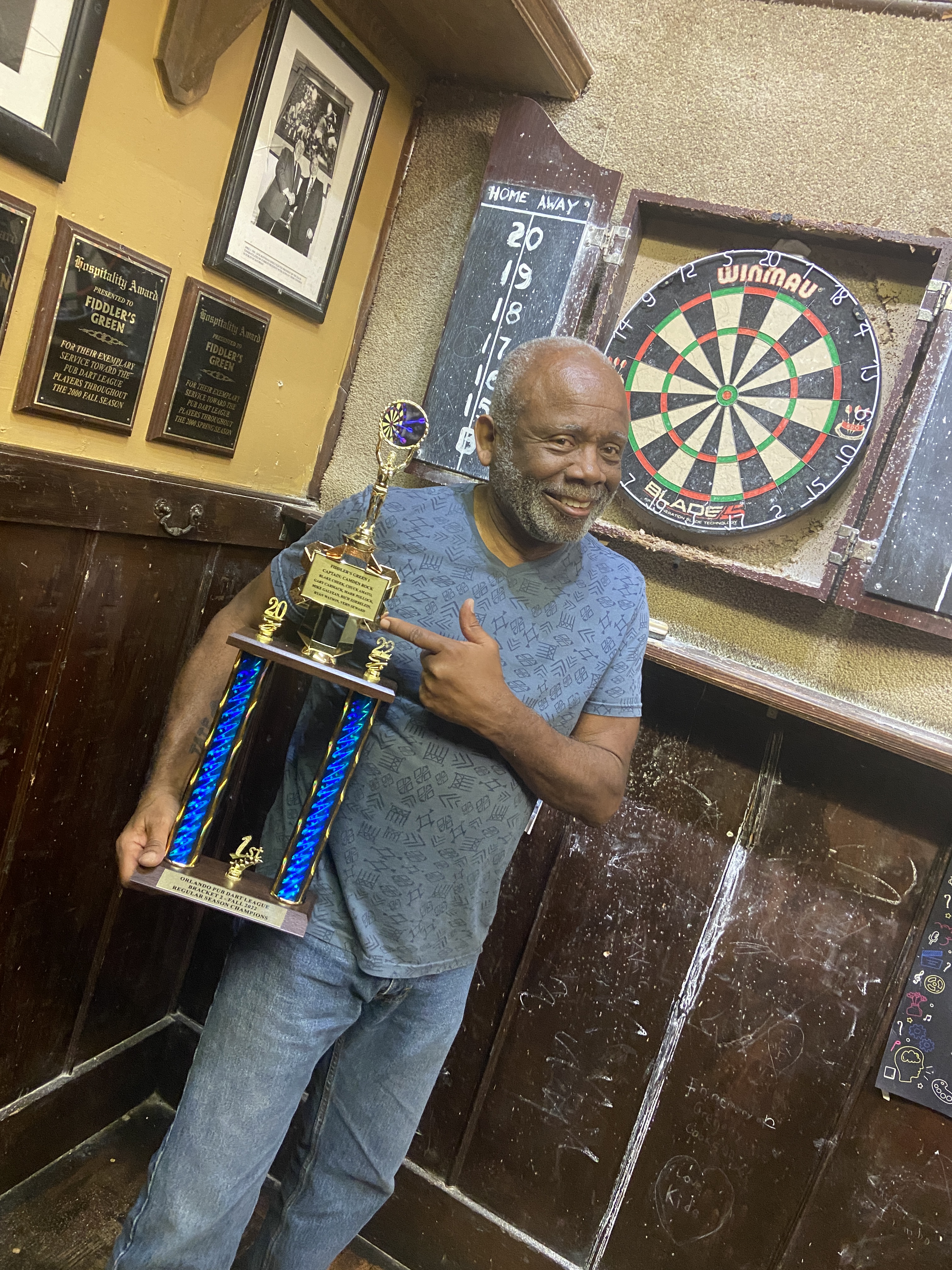
That’s my name I’m pointing to.

Since moving to the Greenville, SC area, however, my dart throwing skills have declined dramatically. I was still good enough to get signed onto a team out of Doc’s Tavern in Greenville, and we actually won first place in our division last season, but we did so without much help from me. This season my team, called ‘No Ton Intended’, moved up to Division 2 and we are getting spanked soundly by nearly every team we’ve played so far. And I don’t think I’ve won a match yet this season, regardless of how many beers I drank.
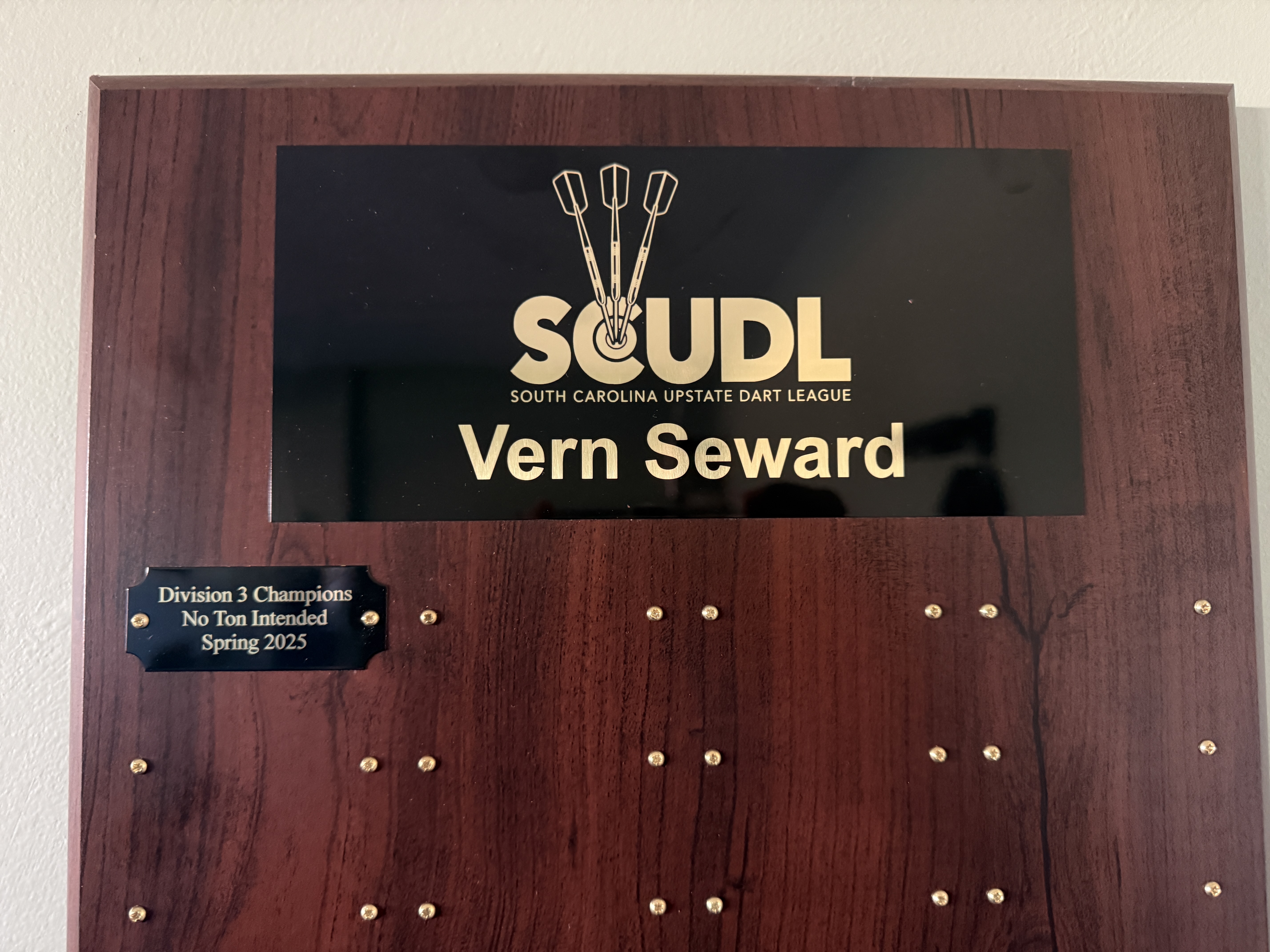
The plaque was a surprise. Not sure how many of those empty spots I’ll fill in.

I know what the problem is: practice, or rather, the lack of it. Like any skill, throwing a pointy bit of metal at a 1-inch diameter target about 8 feet away and hitting it consistently takes practice. Lots and lots of practice. 

A quick search on the internet reveals that professional darters practice anywhere between 1 hour up to an astounding 12 hours a day!! I’m retired and I enjoy throwing, but 12 hours a day?? 

Nope!

Still, after reviewing my league performance so far this season, it’s obvious that I need to practice. A lot. The problem is that I have nothing to practice on. I’ve moved into my house about 4 months ago, and my focus has been on fitting up the house to make it feel like home. The apartment I had the year before I moved in was so small that I had to go outside to change my mind. (Old joke, but still makes me chuckle.) Places where I could go to practice were inconveniently far away for daily throws. What I need is a dart setup here, in my house somewhere. 

Now, I’m on a mission!

Other tasks around the house have been put on hold until I can establish a dart practice space. I can’t just throw a dartboard on a wall and have at it. A dartboard must be hung at a specific height (5 feet, 8 inches from floor to bullseye) and must be a specific distance from the throw line (7 feet, 8 and 3/4 inches). There must be proper lighting. There should be a backboard behind the dartboard that can catch errant throws without causing damage to the wall. And more. 

An engineering challenge that is not outside the scope of my abilities.

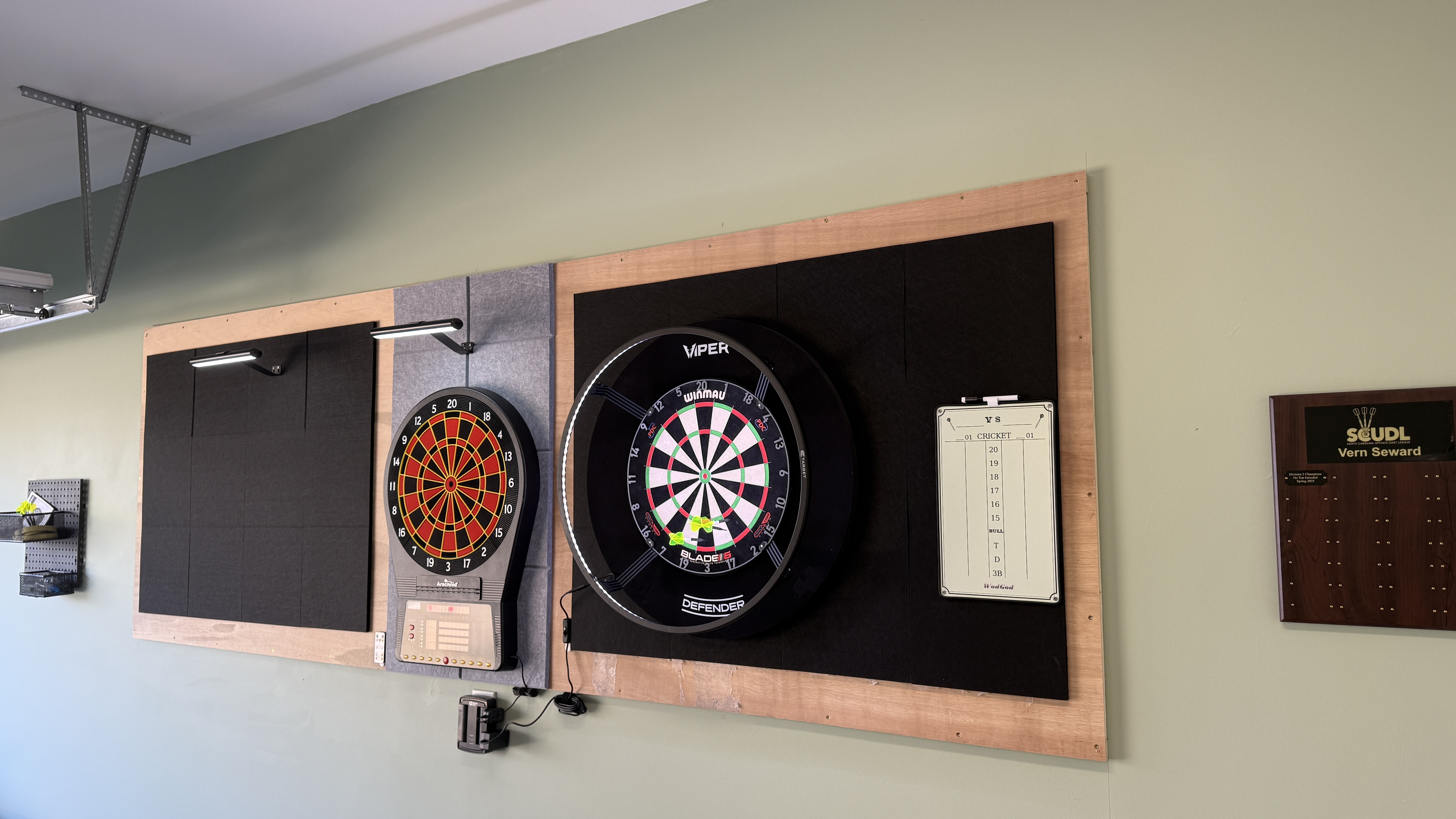
So, after careful consideration ( and a few beers), I’ve decided to build a dart practice setup consisting of, not 1, not 2, but 3 dart boards: a regulation board, a practice board where the high-point target areas are all reduced in size, and an electronic dart board.

I’m going to go all out with this setup. I’m putting it in my garage. The walls will be painted. The floor will be epoxy-coated, and the garage will be kept neat and free of clutter and accumulated stuff. 

That’s the goal anyway. Right now, the floor is bare concrete. The walls are painted, but there’s stuff everywhere. 

I’m working on it!

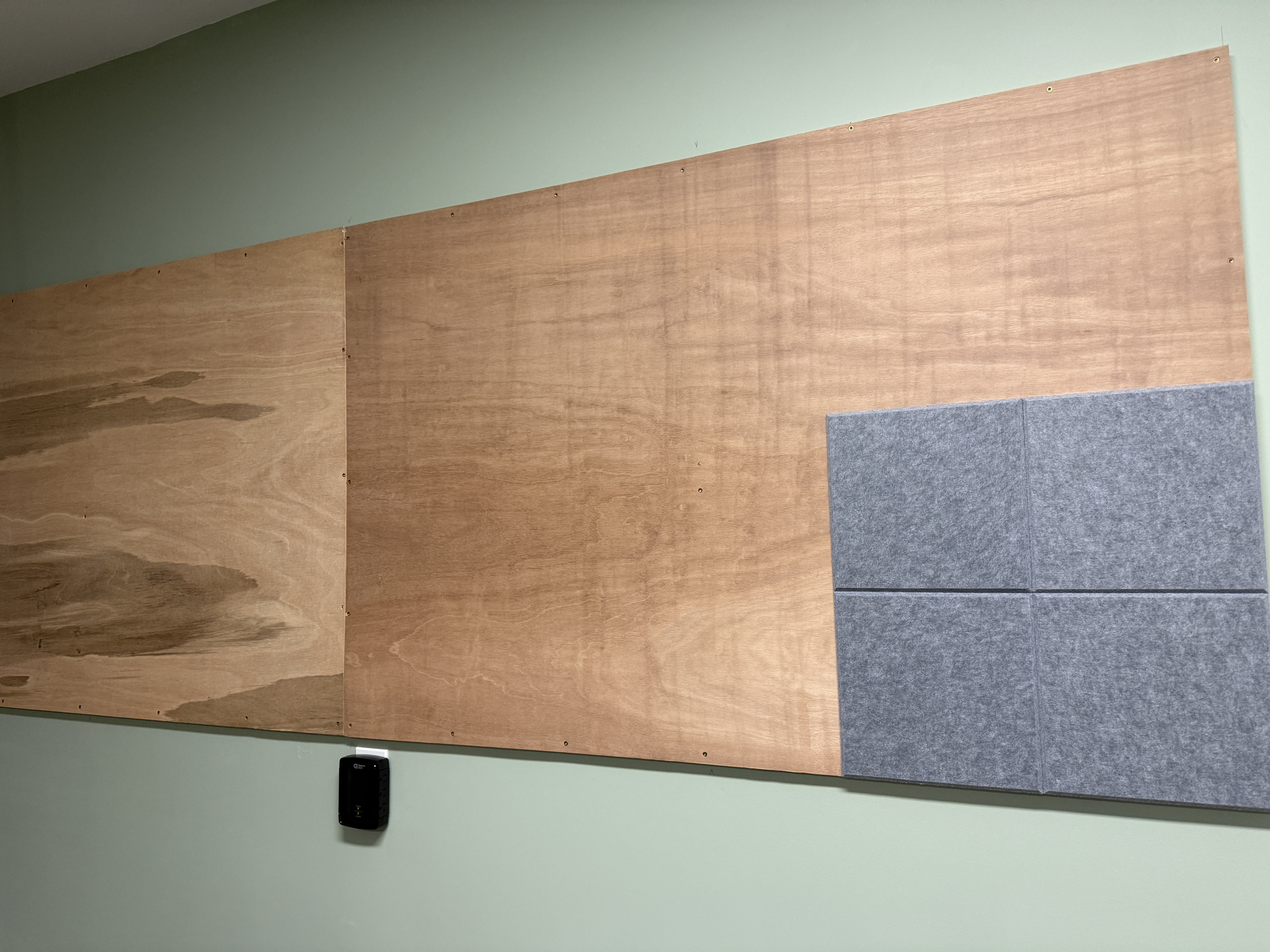
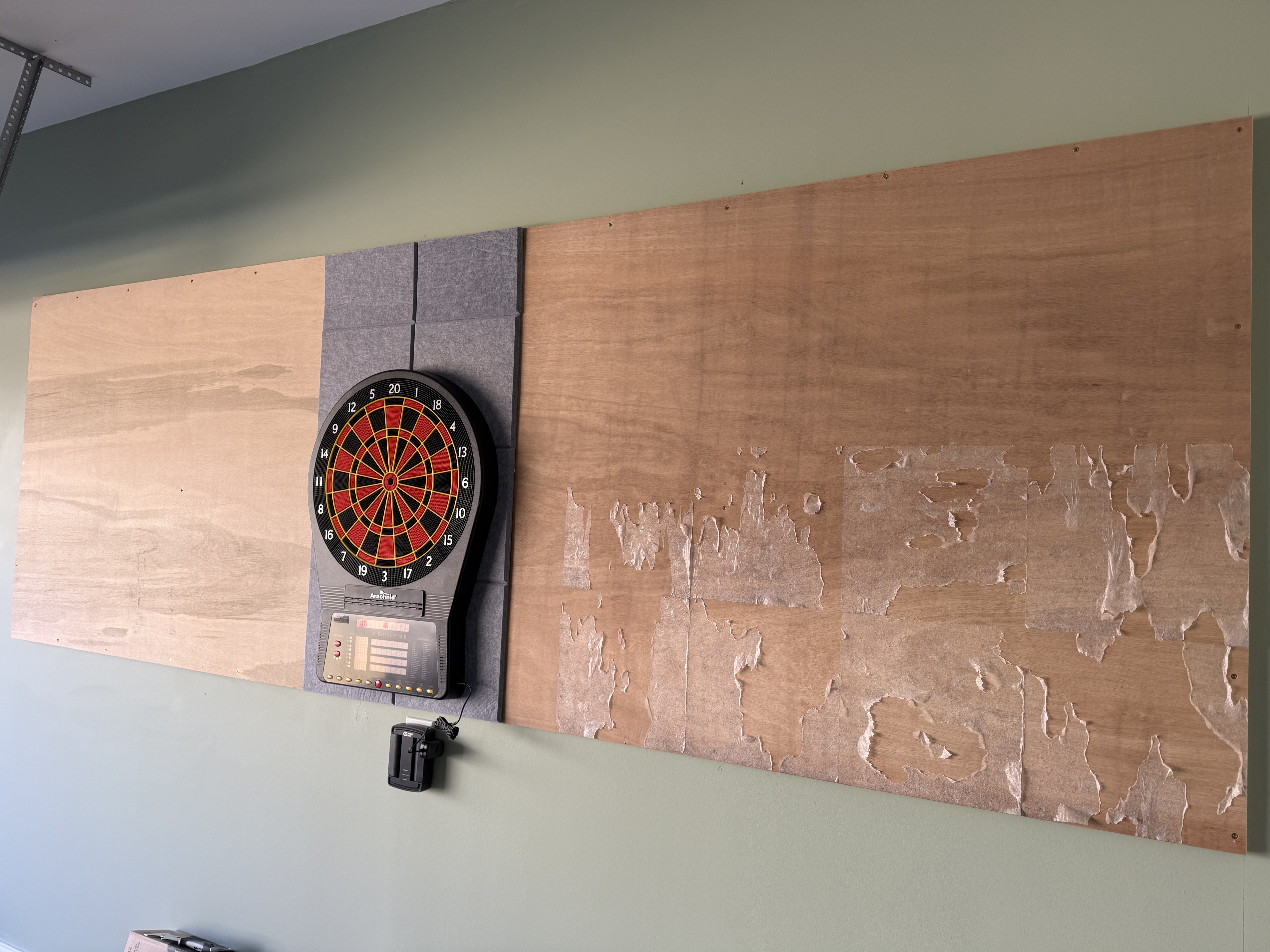
OK, so, it’s a work in progress, but there is progress. Check out these photos…
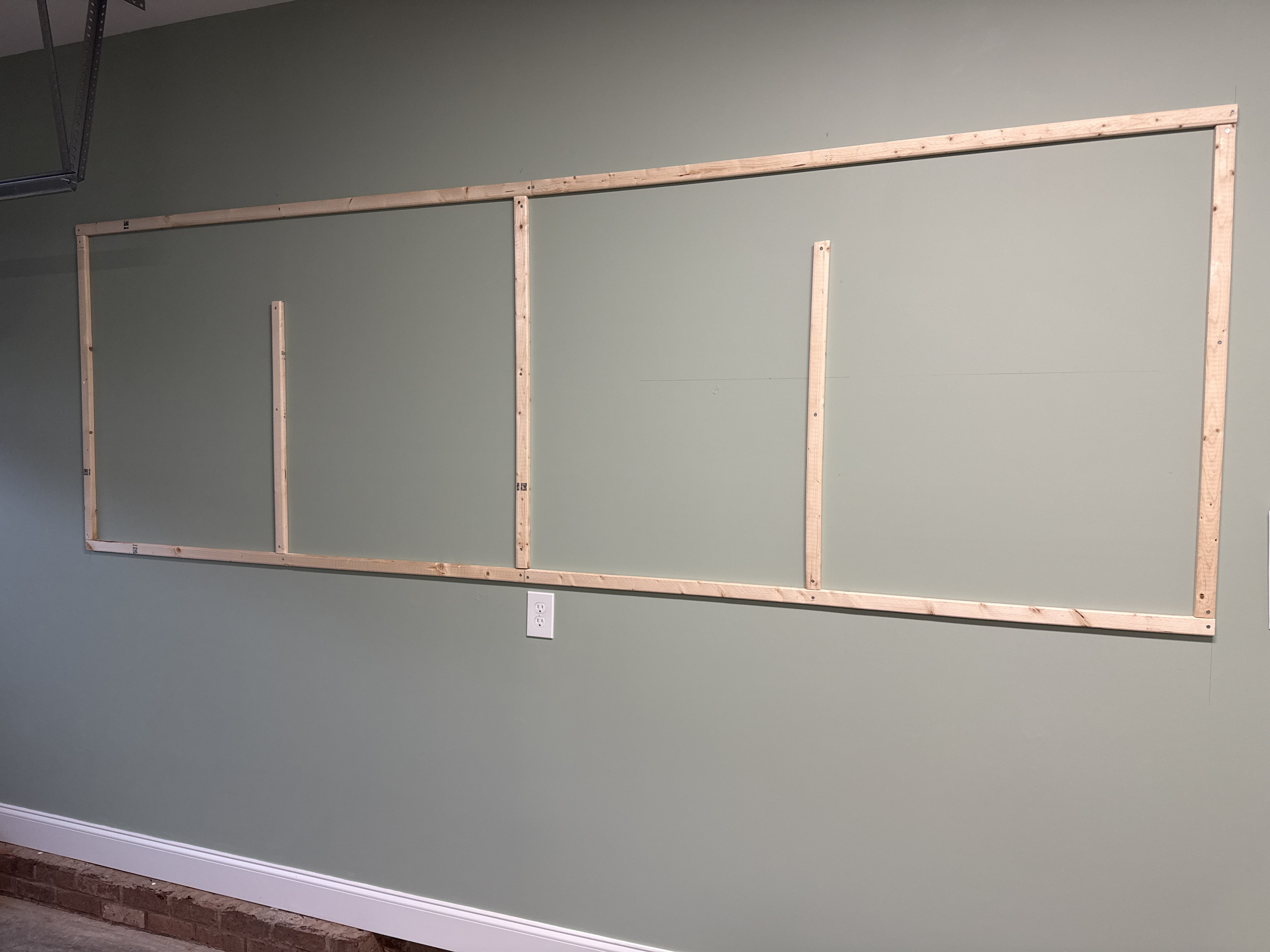
Turns out that grey felt won’t hold a metal tipped dart. Had to take it off.
The electronic board is just a fun addition.
Finished! Well, almost. That place on the left is for a training board.

It turned out pretty good, even after a few missteps. 

So, now that I have a place to practice, I have no excuse not to get better. But, you how people will make a resolution to lose weight and exercise more, and they spend a lot of money and buy fancy exercise equipment and set it all up, then promptly ignore it? 

Yeah. 

Stay tuned.

Vern

Gravity

I left Baltimore when I was 17, leaving behind everyone and everything I had known up to that point. Since then, I’ve never truly felt settled. No matter how far I’ve traveled, how breathtaking the vistas I’ve seen, or how fascinating the people I’ve met, there was always this persistent attraction, like gravity’s pull of a massive star on a small, wayward rock in space, towards the mid-Atlantic region of the U.S. 

I’d joined the Air Force and, like many others in the military regardless of the branch of service they’re in, I moved from place to place when ordered to do so. But military life, while vastly different and far more interesting than my life on the streets of Baltimore, was too restrictive for me. I was honorably discharged after 9 years of service. My wife wanted me to remain in the military for a full two decades and retire. In retrospect, I likely should have, but at the time, staying in was becoming increasingly difficult for me. I felt like I was missing out on a technological revolution, something I believed I needed to be a part of. This was the early 1980s, when computers were just beginning to permeate every aspect of people’s lives. I firmly believed that my career, my future, was intimately dependent on that blossoming technology. So, I left the military, dragging my pregnant wife, my son, and a miniature Schnauzer from North Carolina to California in a tiny Honda, and in search of a new life. 

From that point on, I went wherever an opportunity to advance my career presented itself, and often those opportunities were in places I’d never imagined I’d be. Places with names like Redondo Beach, California; Winooski, Vermont; East Fishkill, New York; Ashdod, Israel; and Oviedo, Florida. Ultimately I wound up in Florida, but regardless of where I landed, there was always that familiar, subtle, but insistent pull, an unfulfilled yearning that, at times, I couldn’t quite articulate and I could never adequately satisfy.

After my children grew up and started their own families, and after my marriage ended, I found myself in a position where I could, if I truly wanted to, allow myself to be drawn by that subtle attraction. I suppose, at that time, I didn’t want to. I had built a life in Florida. I had close relationships and places where I could simply be myself. Yet that yearning persisted, refusing to be suppressed or ignored. 

In 2017, after weathering an emotional storm, I found that I needed to travel and make a positive impact on some cause, to focus on something beyond my personal interests. So, I joined the Peace Corps. That was an incredible and fulfilling adventure, but in 2020, COVID abruptly ended it, leaving me back in Florida with that ever-present yearning, persistently beckoning.

Deciding to leave a place that has been your home for over three decades isn’t easy. I grappled with that question for a very long time. I was aware that, just as when I left Baltimore many years ago, I would be leaving behind so much that had become an integral part of who I am. It takes time to adapt to a new environment, even one that was once familiar to me. I would be trading cherished relationships, familiar places where I’ve always felt welcome, and the comforting warmth that comes with familiarity for strangers, new places, and periods of loneliness. If my decision had been solely based on emotions, I probably would have chosen to stay. However, other factors influenced my choice, and yes, that persistent yearning weighed heavily in my ultimate decision to leave.

Click to see the video.

Now, several months after moving to a place just north of Greenville, S.C., I’ve begun to settle. I don’t need Apple Maps to find my way around anymore. There’s a bar in a restaurant that I stop in from time to time. The barkeep knows me well enough to have a Modelo Negra with lime on the counter by the time I pull up a stool. I’ve met some interesting people in that restaurant too; a retired lawyer who’s lived in the area since 1995, another Florida transplant who shuffles between a tiny house in the hills of Tennessee with an amazing view to D.C. with Greenville as his way station, a comedian who’s promoting a show to support The American Cancer Society, and so many more.

There are real seasons here too; the luminous mating dance of fireflies in the summer, a kaleidoscope of colors in the  autumn, biting cold winds in winter.  

And snow!

Click to see the video.

I hadn’t been in a significant snowfall in more than 20 years and it was wonderful to see. I had a silly grin plastered on my face to whole day while it snowed. I was so inspired by it that I produced a short video. You can see it by clicking on the photos..

As I look forward to spring, I’ve noticed that the yearning that has been my constant companion for so very long is quieter now. While it still lingers, its influence has diminished. Instead of dominating my quiet moments, it now coexists with a more reserved presence. I interpret this as a positive sign, indicating that I’m on the right path, that being here where the trees dress and undress to fit the seasons, and where the landscape undulates like frozen mountainous waves towards the horizon, feels like it’s where I need to be. The yearning’s continued presence, however, suggests that there is still more I need to do.

My sister recently texted me about an event that might finally satisfy that yearning. In May of this year, my paternal family members will gather in southern Virginia for a reunion. I believe the southern Virginia border, westward towards West Virginia, is the epicenter of the attractive force that has been tugging at me for most of my life.

I don’t know much about my father’s family or its history. I do know that both my mother and father originally came from the southwestern region of Virginia, and that there are many who bear the Seward family name who still call that area home. In fact, I had seriously considered settling there myself. 

I intend to go to this reunion in hopes that I can learn more about why I’m so drawn to that place. 

There’s a memory I have, a recollection so old it’s like a faded photograph, that might hold some clues.

When I was very young, maybe 3 or 4 years old, I remember a long trip that my father took me on. I recall seeing lots of trees as he drove for what seemed like hours and hours. When we finally stopped we had pulled into a long dirt driveway, each side was walled by tall green corn stalks. At the end of the driveway stood a modest house. A huge tree stood next to the house.

During one of my visits to Baltimore as an adult my sister told me that the house with the tree exists. The house and the farmland around it belongs to a relative on my father’s side. The memory has left me wondering, and hoping, that that place is what has been pulling at me all these years, that my returning to it will finally sate that yearning and I can find some peace.

I look forward to May.

Stay tuned,

Vern

Living in Small Spaces: Part 1

Like many others, I’ve been fascinated by the thought of living in a tiny house. I even considered doing so while I planned my move to South Carolina. But after watching shows like Tiny House Nation, I soon realized that it takes a certain mentality and more than a little will power to confine one’s life into 300 square feet. Bedrooms you have to climb ladders and crawl into, bathrooms where the toilet and shower are in the same space, chairs that are more at home in a camper than a living room, nope! That’s all fine for a short period, but I am neither mentally prepared or have the will power to live in such a small space for the rest of my days.

I’ve done it before and it was not pleasant.

When I arrived in Arandis, Namibia during my stint in the Peace Corps, I fully expected to live in a tiny grass hut. Such was my preconception of Namibia and Africa in general. I knew there were modern cities in Africa. Windhoek, Namibia’s capital, looks like any European metropolis, complete with the traffic and noise. But I didn’t think I’d be working in Windhoek. This was the Peace Corps after all. They go to where the need is most, and that tends to be in rural areas. So, I saw grass huts in my future. 

I was surprised to find that my first home while in country was a three bedroom house built of concrete blocks. It had full plumbing, power, a nice kitchen, and a living room with a 65” TV and sectional sofa, and a small front lawn. Hardly a grass hut.

So much for preconceptions!

However, by the time I left Namibia, and due to managerial snafus, I was moved to a 500 square foot house, then to a 100 square foot cabin that was originally intended for one person staying overnight. Truthfully, not even one person would want to spend a night in that tiny closet. The place was poorly designed and I barely had enough room for a single bed. Yet I stayed in that cabin for 5 excruciating months. I had an old hot plate for cooking, a fridge the size of a foot stool, and the water from the faucet was not ideal for drinking. I was told that it was temporary, that I was in “transition”. It was hot, smelly and full of mosquitoes. It was not the best 5 months of my life.

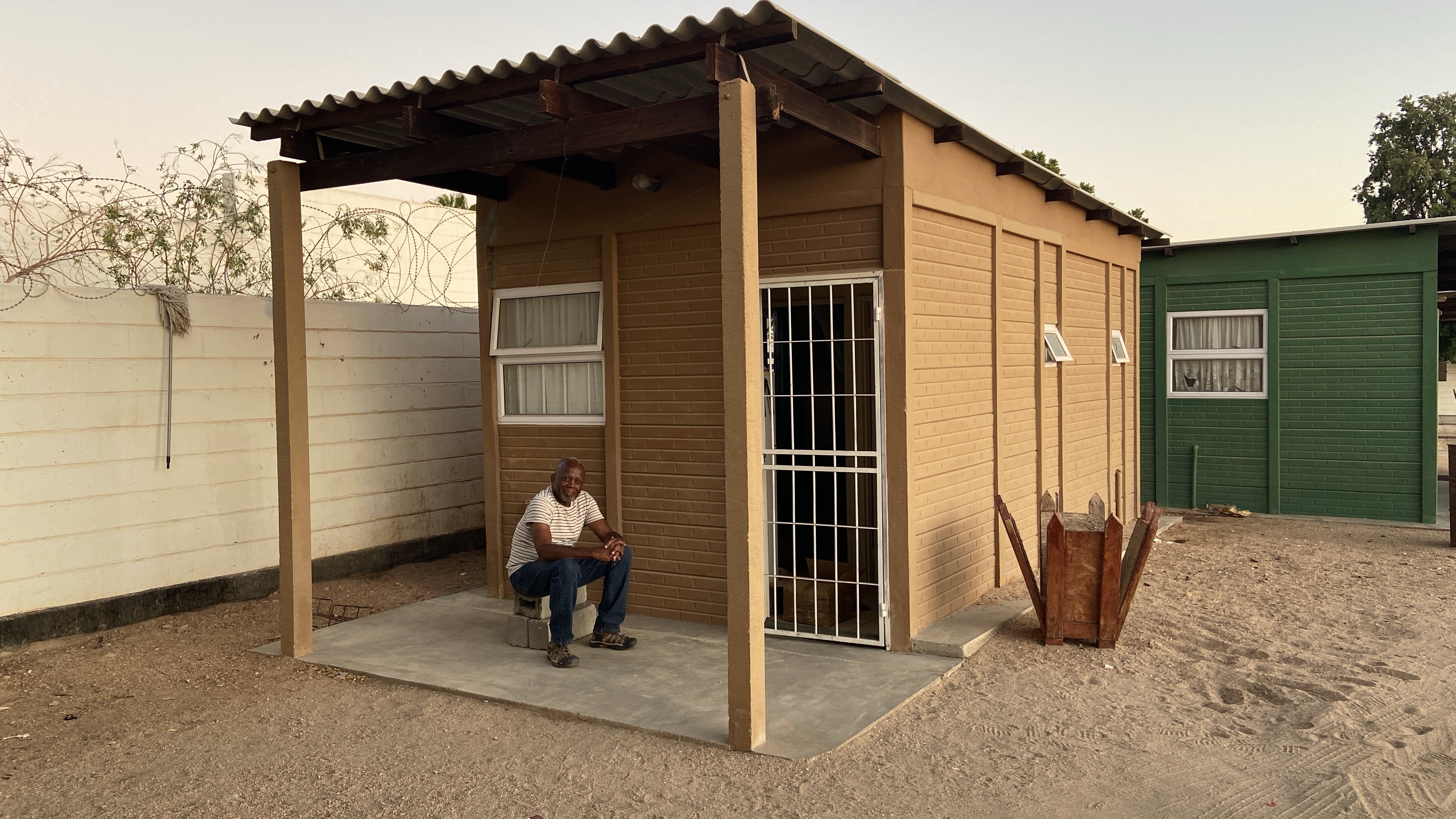
Me sitting in front of the tiny hut I spent 5 months in.

When I came back to Florida I rented a 450 square foot cottage. After living in that tiny cabin, 450 square feet felt absolutely palatial! Still, I was in transition; going from my Peace Corps life in Africa to the life I had previously known in Florida. I eventually moved back into my 1450 square foot home and, when I did, I found that I had far more space than I needed. My mind had adjusted to the confining space I was forced to live in.

I had no use for a dining room, one of the smaller bedrooms I used to stage house renovation and repair projects which I could have done in the garage. The other small bedroom remained empty. I pretty much stayed in three room; the kitchen, the living room, and the primary bedroom. Together they were about 800 square feet. I had room to spare!

When I sold my home in Florida my initial intentions were to find a place in South Carolina that was smaller, perhaps around 1000 square feet. I thought that anymore space would be wasted on me. But, sometimes things just don’t pan out like we planned. Instead of downsizing, I’m actually upsizing. The house I intend to buy is a bit more than 1500 square feet. Ah well. It’s still not Buckingham Palace, so there’s that.

Unfortunately, my new home won’t be finished for quite some time. It’ll be at least 10 months before the house is ready. So, I’m in transition once again and, once again, I’m existing in a small space.

I’m renting a studio apartment while my new home gets built. The apartment is 462 square feet. Because space is so limited I find that I need to revisit some of the strategies I used in Namibia and, more so, in the small rental in Florida to optimize storage and make this little spot feel like somewhere I want to be, not escape from. 

With that in mind I’d like to highlight some of those strategies. Maybe you can use some. Maybe you can suggest some. I’m always open to new ideas. So, let’s get crackin!

The first thing I want to talk about is a table. Elevated, flat, hard, durable surfaces in a studio apartment is, unsurprisingly, hard to come by. This place has approximately 4 square feet of counter space. It’s nice counter space, made of a composite granite-like material, but it’s barely enough real estate to prep a decent sandwich, much less cook a meal. Obviously a table of some sort is the answer. 

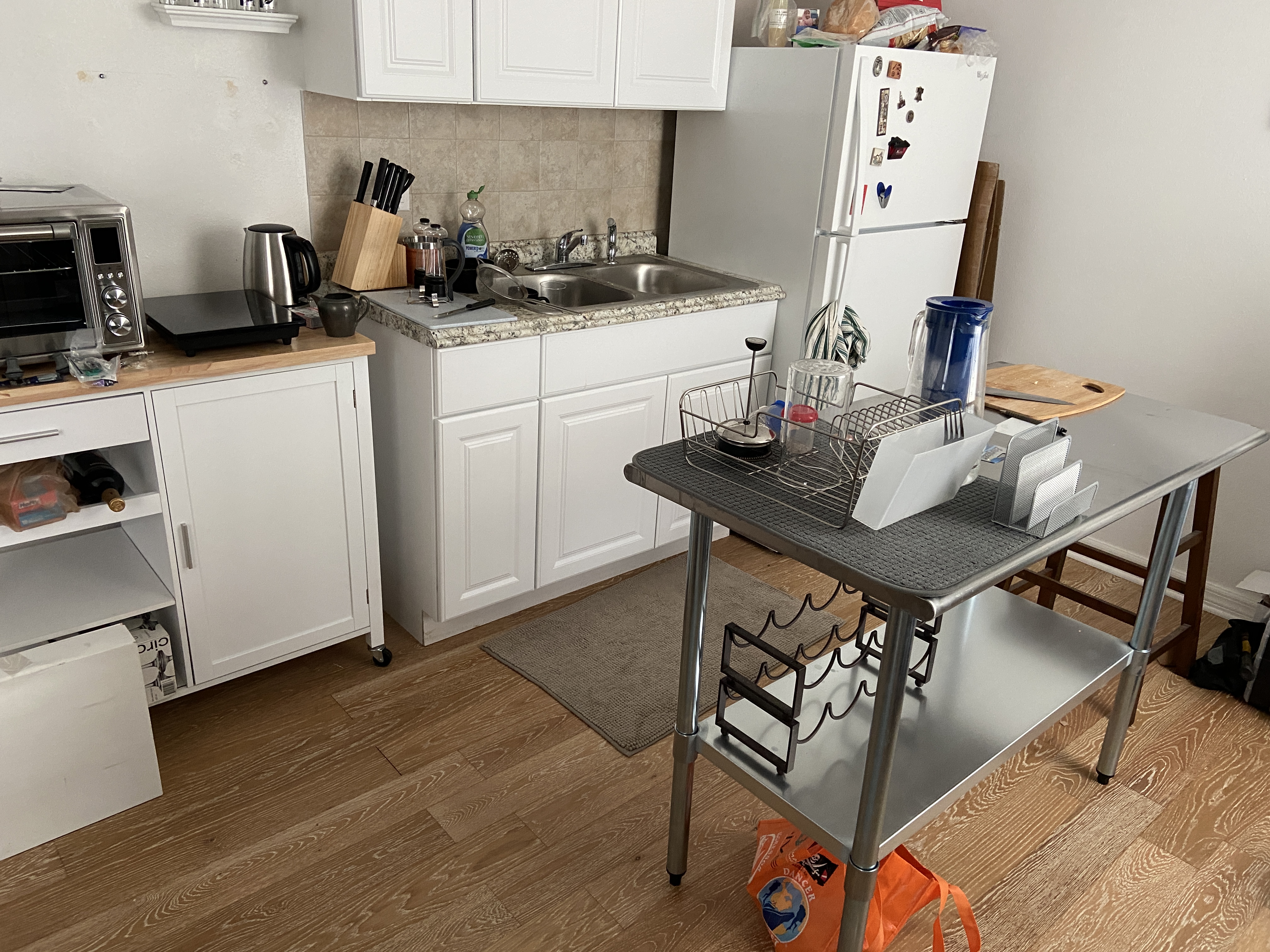
In the small rental back in Florida I had bought and used a very inexpensive stainless steel table. I got the idea from my friend, Sara. She had a nice stainless table she was using as a kitchen island. That table proved to be very versatile. It was easy to clean and maintain. So, I got one too.

While I would highly recommend a stainless steel table, I would strongly suggest that you not get a cheap one like I did. Mine cost about US$100 and it was not very good. The table top was stainless, but barely so, and the rest of the table was of lower grade metal. The lower surface was definitely a poor grade aluminum. The table top was of low grade stainless. Over time I found tiny rust spots on it. Food grade stainless will not rust so the metal in that table was obviously not food grade. 

That cheap steel table did come in handy.

Still, the table served its purpose. I used it for food prep, a workstation desktop, a sound studio station, a dining table, and more. Even so, I was happy to leave it behind. If you decide to get a stainless steel table get one that has food grade stainless as its top surface. It will definitely cost more than a hundred bucks, but it’ll be worth it in the long run.

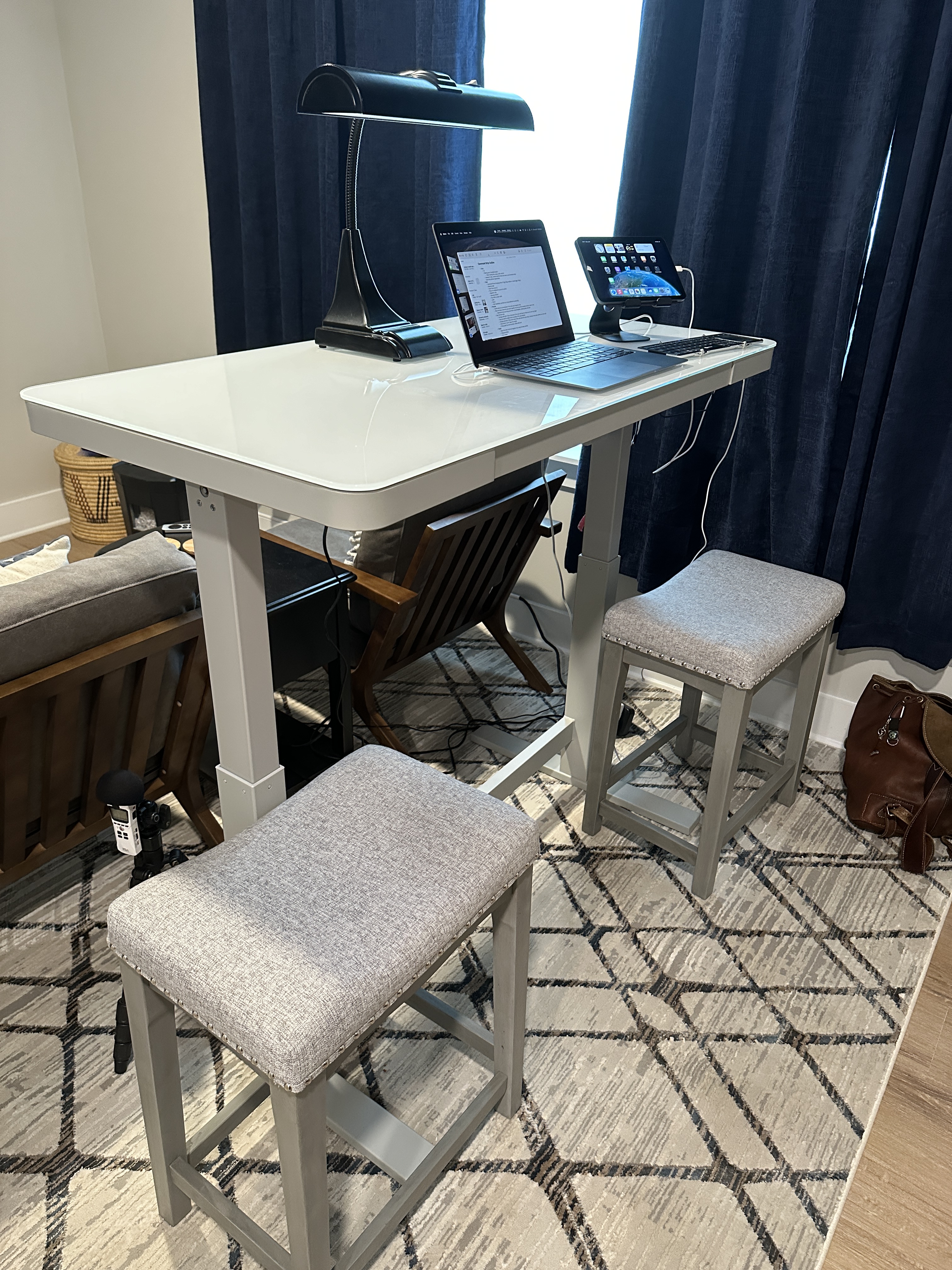
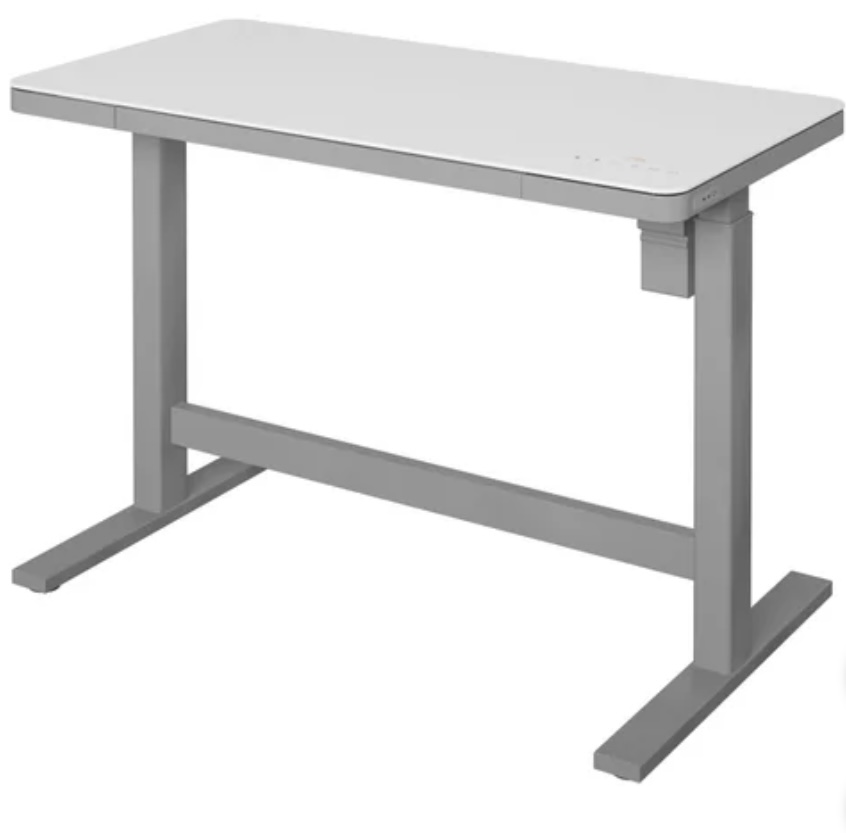
This time around I decided to take a different approach. While shopping in Costco I came upon a robust, adjustable height table with a glass top from a company called Tresanti. Glass is key because it makes the top easy to clean and maintain and it makes the table extremely versatile while looking sharp. 

As I mentioned, the table is height adjustable. Back when I was working I found that standing was a lot better for me than sitting at my computer all day. I had my desk raised and the company I worked for gave me a chair that allowed me to easily sit in a quasi-standing position whenever I needed to. I’ve been standing whenever I’m at my computer ever since. 

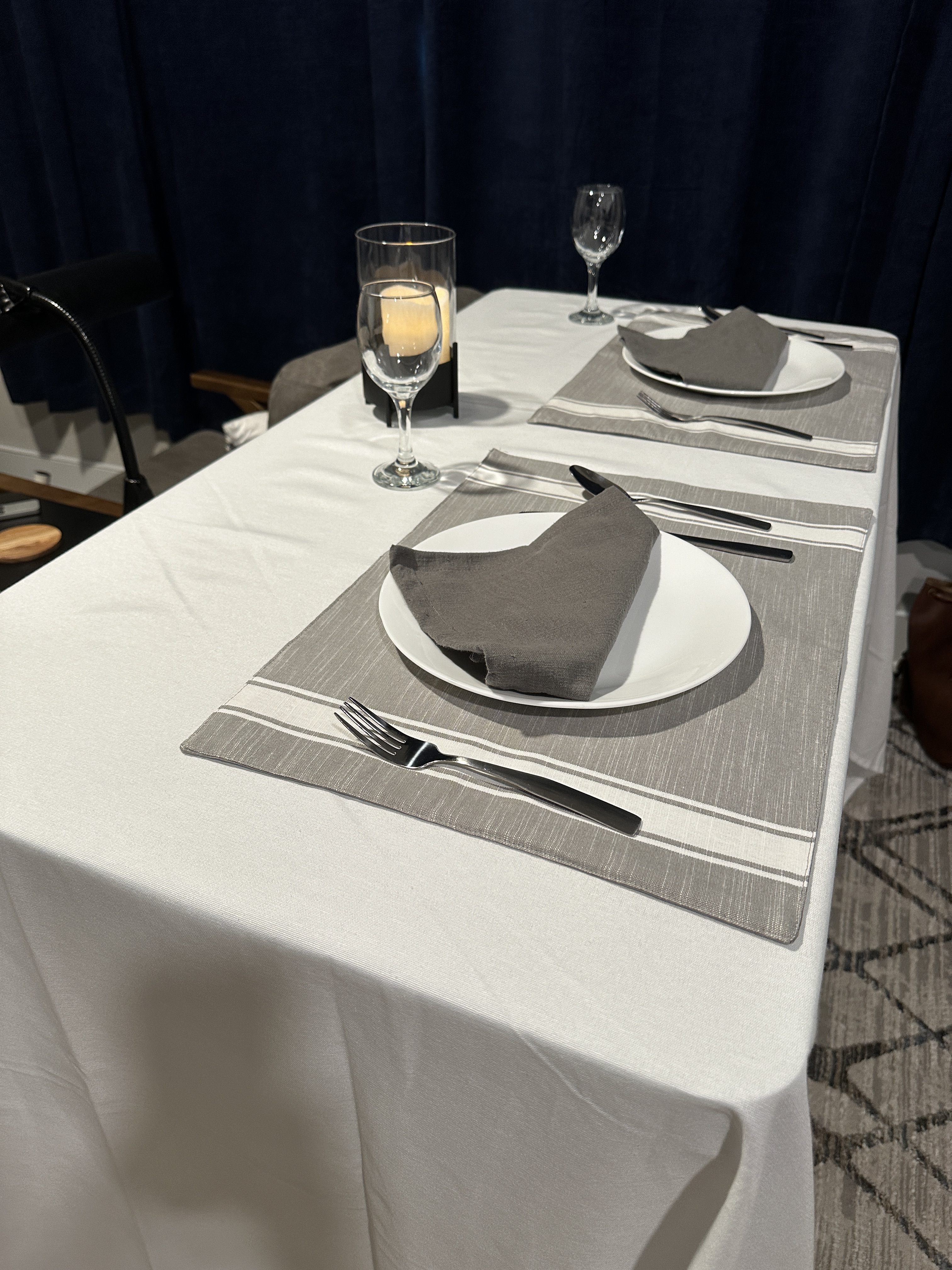
This table, then, is perfect! It’s the right size to sit behind my two comfort chairs, dividing my “living room” from my kitchen/editing studio/whatever else I need the space to be. (More about those chairs in Part 2.) I can dress it up for an intimate, candle lit evening, fit it out to record audio for my next video, or pound out this post for my blog. 

The raised height is great to stand at. And the stools complete it.

The table was a tad spendy, but it will be with me for a long time. 

I bought two fairly inexpensive, decent quality upholstered stools to go with the table. The stools are comfortable and serve as my dining chairs and as extra seating on the rare occasion when I’m entertaining more than two people. Together the table and stools look as if they were made for each other.

From workstation to an intimate table for two.

So, I’ve doubled my elevated surface area, added more seating, and have created a flexible workspace that looks great. And what I’ve bought will find use in the house I’ll eventually move into, so nothing is wasted. 

The second item I’d like to talk briefly about is actually an indulgence of mine that just happened to be useful. 

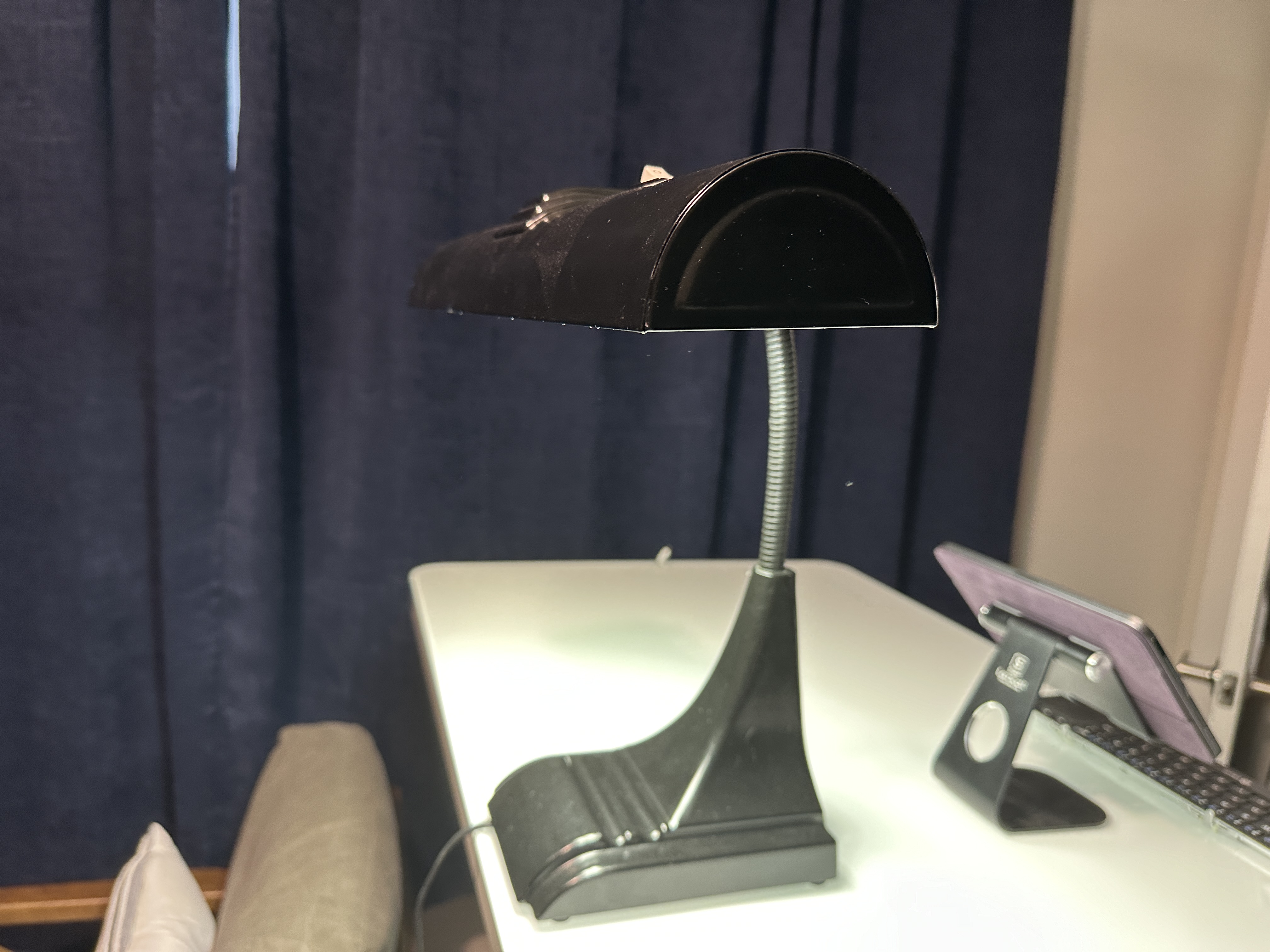
One of the few bits of furniture that I brought with me is a lamp that I found in Goodwill several years ago. I bought it for US$10 not knowing if it would work.

Some of you younger readers won’t recall ever seeing this type of desk lamp. It has a heavy metal base, a bendable snake-like stem, called a goose neck, and a wide, rectangular…, I guess you would call it a globe. It’s the portion of a lamp where the light source, a bulb in most cases, would be. This lamp, however, is fluorescent. It uses two, 16 inch long fluorescent tubes as its light source. These types of lamps were popular years ago, especially in accountants and newspaper editors. 

It may not look it, but this is a great lamp.

What’s special about this lamp, special to me anyway, is its versatility. It’s ideal for reading and any time I need a more focused light source. The thing I like most about the lamp, however, is its looks: clean lines, functional, understated with a hint of Art Nouveau aesthetics. It takes up very little of what precious desktop real estate I do have while providing a much needed function. The cost puts it in line with my new found frugalism and the looks certainly coincide with Mid Century Modern tastes.

A win-win!

More about living in small spaces in part 2. Until then…

Stay tuned.

Vern

The Move So Far…

I’m sitting in an iHop, waiting for my breakfast. It’s 9:32 am on July 4th. I think it’s about time to update my status of my move to South Carolina.

Back when I started this new chapter I knew there would be challenges. I’ve been around the block a few times and change and challenges are not new to me. Events in the past only prepares you for the notion that there will be challenges in the future, however, not what those challenges will be. 

Greenville’s iconic bridge over the Reedy Falls

On the face of it, my move to South Carolina has been largely uneventful. That’s primarily due to my friends, Brian and Francis in South Carolina and Sara in Florida. They have provided lodging for me and storage for my stuff. And the days leading up to my departure was filled with special memories thanks to Marcia. No words can express the depth of my appreciation and gratitude to these my rare and wonderful friends. I hope I can repay their kindness and generosity in kind in the future, once I am settled.

Speaking of getting settled: I now have a studio apartment, have registered my car and changed my driver’s license. For all intents and purposes ( incense and porpoises) I’m now a South Carolina resident. 

(Yay!!)

On the house buying front, I’ve selected a lot, picked out interior and exterior colors and options and I’ll go under contract next week. Unfortunately it’ll take 10 months or more to complete the house, which is why I’ve rented the apartment. 

Knowing that I’ll be in this tiny apartment for a while, I’ve decided to make it as comfortable as I can without breaking the bank. The challenge of fitting out an apartment with an eye on my future house, and my newfound design choices, and frugality mindset have kept me busy. Every major piece of furniture I buy for the apartment will be used in the house. So, careful consideration is a must. 

Oddly, I’m finding my choices for seating and storage to be a bit tougher than one would expect. I’ve visited local furniture shops looking for chairs or small sofas and shelving. Only one store had anything of interest for seating, but the cost was more than I was willing to pay. And I could find no shelves that fit both my sense of style and my budget.

One purchase I’m proud of is a table that I found in Costco, of all places. The table is glass topped and height adjustable, both features are key to maximizing what little space I have in my apartment.

Adjustable height, glass topped table from Tresanti

The glass top makes cleaning a breeze. I can use the table for dining and food prep, and I can seat 4 people comfortably if the need arises. Not that I’m expecting to host intimate soirées in my little studio, but ya neva kno.

When I’m not using it as part of my kitchen I can use the table as it was intended, as a workstation. The height adjustable feature is great because I like to work at my MacBook and iPad while standing. Again, the glass top can be easily cleaned so dinner doesn’t gunk up my keyboards.

The table was a bit pricey at US$250.00, but, in keeping with my frugality mindset, it’s a high quality piece and I’ll own it and use it for a long time.

Another purchase that I’m happy with is my bedding. My house will have a primary bedroom and two smaller bedrooms. I intend to fit out the primary bedroom with a king sized bed, but one of the smaller bedrooms will have a queen sized bed. That is what I bought for use in my apartment. The mattress came from Costco, one of those foam mattresses in a box. I have slept on lower quality foam mattresses before and found them to surprisingly comfortable. This one is from Novaform and it’s so comfortable that I have no trouble falling to sleep on it. 

And my chairs have arrived! 

While shopping around for seating the would fit comfortably in my tiny studio I stopped in a local furniture store that caters to more affluent customers. The sales person, let’s call him Biff, scoffed when I told him I liked Mid Century Modern style of furnishings. “Oh! You mean that 80s looking stuff with the wood and avocado plush pillows?” He asked in a mockingly annoying tone.

No, Biff, I mean clean lines, no overstuffed upholstery, and neutral colors. And no motion furniture! In my world a chair is just a comfortable place to sit, relax, read, think. I don’t want it to be a bed, or vibrate, hold my cup, or heat my back. If I want to put my feet up I’ll grab an ottoman, which can serve as extra seating if needs be.

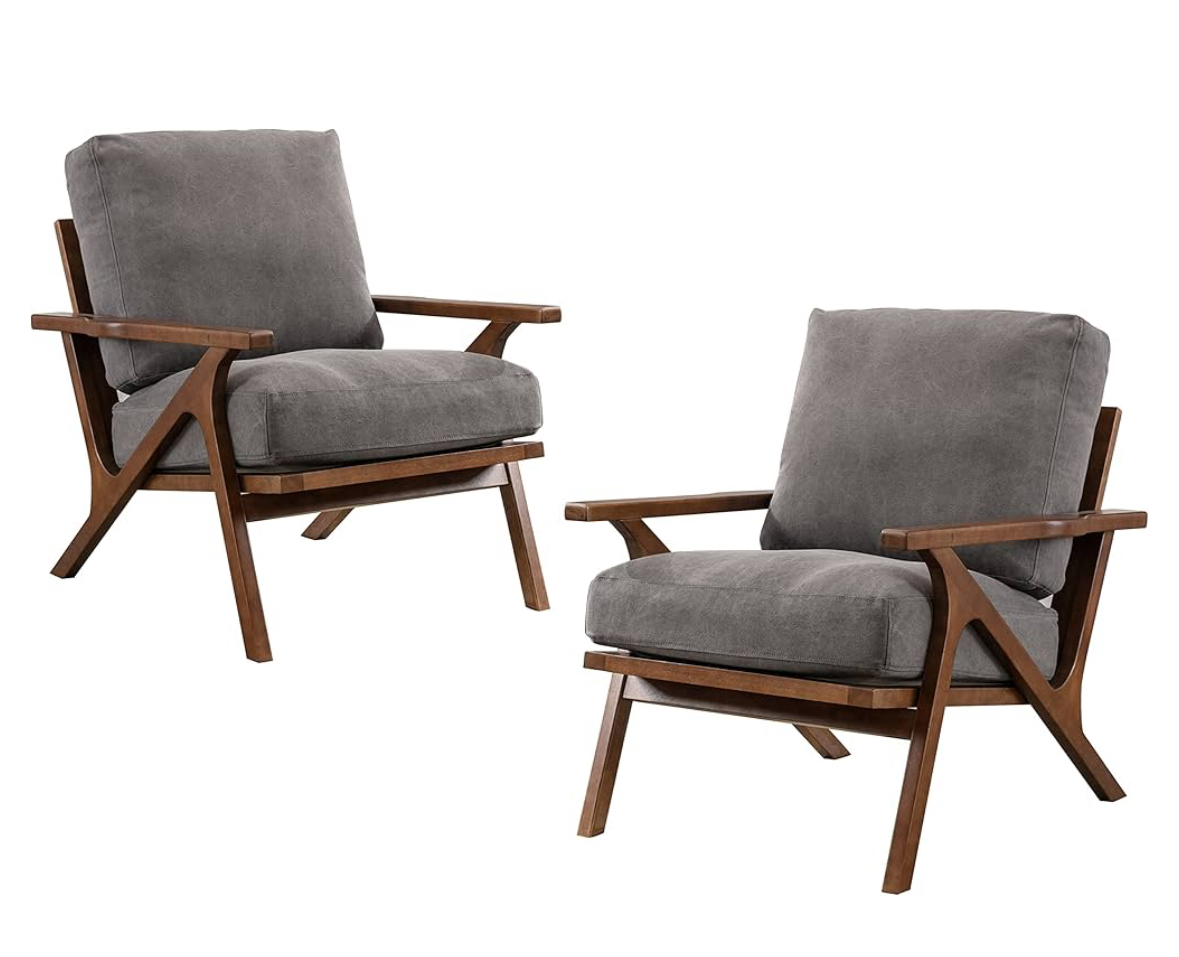
My Mid Century Modern chairs

But that’s me. I’ll confess to enjoying a sofa once that happened to be able to recline. Even so, I still don’t want that type of furniture. The chairs I bought are more inline with my style senses. They are wooden framed with sturdy wooden arms. The upholstery is not overly stuffed and very comfortable. The material is grey denim which can be easily removed and washed. I intend to get the upholstery redone in leather later, but for now, these are perfect. 

I still have a few items yet to get; a decent shelving unit, headboard for my bed, and a credenza. Each item will eventually be used in my house and I have narrowed down my choices for each. Once everything is in place I’ll give you a video tour.

And so, my move to South Carolina continues to unfold. The journey so far has been exciting and challenging in unexpected ways. I’ve also met some nice people. My family has commented on how fast things are developing. In my mind, however, things aren’t moving fast enough. I like to keep it moving because when I stop moving things get quiet. And when things get quiet I start to feel the emotions that are often associated with changes of this magnitude. Those emotions are not always positive. 

For instance, I could do so much and I was surrounded by a great group of people in Florida. One person in particular and I hung out a lot together. I miss that. I miss them. I miss that person. A lot. 

It will take time for me to get immersed in my new environment and those feelings, I’m sure, will diminish, but never disappear. I just need to keep moving forward.

Stay tuned.

Vern

Fireflies

Back when I was a kid, growing up in the heart of Baltimore, there were fireflies.

Though they no longer herald summer evenings with flashes of green and gold in the gardens and backyards of west Baltimore, they had continued to exist right at the edge of my memory, fading like all memories do as we age. But I can still recall how seeing fireflies made me feel. Back then, to my young mind, they were the personification of magic. Their tiny cold flashes proved to me that mystery and wonder were real, that just beyond my very human eyes was a world where fantastic creatures lived. A world where unicorns and fairies might yet be real, and if they could be real, so could magic. How, my young mind would ask, could a creature make its body glow at will, turning the light on and off as if to signal each other that all was right in the world, if not by magic? 

I’ve grown and have leaned a lot since then. I know that the light fireflies produce is the product of a chemical reaction, that they use the light to attract a mate, and that there are other creatures that use a similar light producing method, called bioluminescence, to warn off predators or to catch a meal. While that is all very fascinating, the explanation only proved that there isn’t any magic in the world. Not really. And while there is still much to evoke wonder, the loss of magic makes the world a bit less wonderful, even to my adult mind. 

I’ve traveled a lot and have seen some wonderful things, but I didn’t realize how much I had missed that sense of mystery I experienced when I was a child until recently.

If you’ve been following my blog you’ll know that I’ve recently took a giant leap and moved from my home of 30+ years in central Florida to establish a new life in South Carolina. I talk about the whys in my previous posts, but the change has, thus far, been moving along smoothly. Over the course of the next several months I will complete my transition and situate myself in a completely new, yet somehow familiar environment. I have my very good friends, Brian and Francis, to thank for making the move far easier than it could have been. They’ve given me a place to stay while I wrangle with the logistics of the move, and I can’t thank them enough.

It was while I was staying with Brian and Francis that I rediscovered that sense of mystery and magic.

Brian and Francis’ home is in a quasi-rural area and the property is surrounded by trees and other flora and fauna natural to the area. I was sitting on their porch one evening, enjoying the cool breezes and evening bird calls when I thought I saw a flash of light a wooded area just beyond their front lawn. As I focused my attention to the area I saw another flash that was low to the ground. The light lingered for a bit, then faded as it drifted higher. Another light flashed, then another. Pretty soon the area was dotted with strobing green lights as fireflies rose from the ground to find a mate.

In that moment I was like a kid feeling the wonder of magic again. I had to walk out there and be surrounded by them. Even the thought of that experience still makes me smile. 

Watch carefully. Fireflies!

One of the reasons for me moving to western South Carolina is that I wanted to return to a familiar environment, a place that’s a lot like what I knew as a kid. A place where there are four distinct seasons, where proper oaks, maples and walnut trees still hold sway over the landscape. A place where one can still find deep green meadows, rolling hills and babbling brooks. 

A place, unbeknownst to me until now, where one can still find fireflies. A place where magic might yet still exist.

Stay tune

Vern

Frugality: A Matter of Perspective

I recently read an article by Darnell Mayberry, whose finance focused articles can be found on Cleveland.com and The Plain Dealer, in which he discusses his newfound frugality mindset. Mr. Mayberry recalls how his grandparent’s tightfisted nature was a call for childhood secret missions to the corner store for sweets instead of whatever the grandparents offered that was stored, unappetizingly, in the garage. Now, much older and, apparently, much wiser, Mr. Mayberry is focusing on obtaining and nurturing a mindset similar to his grandparent’s where spending less is forefront. (And, hopefully, does not involve snacks kept in a garage.)

To that end Mr. Mayberry has stopped frivolous spending on unneeded items, has reduced his consumption of alcohol and cigarettes (certainly a good thing), and has even gone so far as to stop carrying cash and will occasionally, and purposefully, leave his credit card at home.

Mr. Mayberry says he’s at the start of his journey, but he is determined to become more frugal while avoiding the stereotype of becoming a stingy old miser.

I feel ya, Darnell.  

I firmly believe that our association with money is shaped by our childhood experiences with it, mindsets that sometimes needs readjusting. In my case it was the lack of money and my family’s inability to afford even the basic necessities of life (food, clothing, sometimes water and heat) that has long shaped my spending habits, both for good and ill. To help with my family’s financial situation, I started ‘hustling’ at a young age. 

Hustling can mean different things to different people, but basically it means to do whatever you can to earn a buck. Obviously that can mean doing dishonest things, but in my case, my hustles were honest, I bagged groceries at a local market and loaded them into cars for tips. I usually got about 25 cents for the full service. In the early 60’s, 25 cents went a long ways and on good Saturdays I could go home with $15 to $30 dollars! Not bad for a day’s work. 

What hustling doesn’t teach you is the true value of money. In my young mind, money was necessary to live and I could get money by hustling. So, whenever I needed extra cash I’d figure out a way to get it. That often meant getting jobs doing whatever. Almost nothing was beneath me. I’ve chauffeured pizzas, flipped burgers, sold electronics, worked on a sod farm, and more to fill the gaps in what I earned versus what I spent. It occurred to me, even back then, that there had to be a better way, that focusing on spending less was also a viable option for minimizing my financial woes. But I was dealing with other issues in life at the time and  hustling was often the most expedient way to address my financial needs. It was what I knew and it worked.

Like Darnell Mayberry, I’m older and somewhat wiser now. I know that there are better ways to deal with finances. For instance; if I need to buy a large-ticket item like a TV or couch, I will search endlessly to understand the pros and cons of the item then decide on and purchase the best I can afford. This is something that an astute student of poverty learns. People of meager means will often buy the least expensive item, which are often poorly made. They wind up having to buy the same item again and again and, in the long run, wind up spending more.

Buying something that may cost more initially, but is made well, is actually the best and most frugal solution. To a person of meager means spending more in the short term to avoid spending a lot more in the long term can seem counterintuitive. Other extenuating factors may influence the decision to buy cheaply. Sometimes it just can’t be helped. An immediate need must be addressed so you do what you have to do to address it. Still, the concept of buying better to avoid buying again is a solid one.

The road to a frugal lifestyle is still relatively new to me, and, like Mr. Mayberry, I’m just beginning to walk that road. This path is chosen more out of necessity rather than adhering to advice and lessons learned over the years. 

My move to South Carolina, for instance, was prompted by the fact that my limited and very fixed income could not sustain my current lifestyle in Florida. It’s not that I live extravagantly, far from it. But what I do enjoy doing, being around friends, eating out on occasion, traveling, and maintaining my home was becoming cost prohibitive. Taxes and insurance have and to continue to increased to the point where even living the life of a miser would eventually be unsustainable. I needed to do something. Moving to a more financially friendly environment is the first step. I also need to adopt a more realistic approach to how I handle what income I do have. So, I’ve started looking around for ideas, which is how I stumbled upon Mr. Mayberry’s article, and how his perspective and mine seemed to sync.

So, what is my current view of frugality and how will it affect my life moving forward?

I’m glad you asked.

As I mentioned earlier, and as Mr. Mayberry has said, living like a miser should not be the goal. Clutching every penny is not a mindset that is even remotely appealing to me. I just need to see money as a very limited resource, one that, if carefully monitored and used, can keep me going until the road I’m on ends. To carry the road analogy further; I need to travel in “economy mode” not “sport mode”. That doesn’t mean I can’t enjoy the journey, it just means I need to waste less while moving along. Or, as Mr. Mayberry puts it, “Rather than buying any old thing based on emotion and price, I’m now letting utility and value be my guiding principles.”

But it isn’t just “utility and value” that should guide me because they, by themeselves, are boring. I believe that there also needs to be a sense of purpose, or maybe style, something that makes the journey interesting, even fun. Neither style or purpose fully relates what I think is needed, but it points me in the right direction.

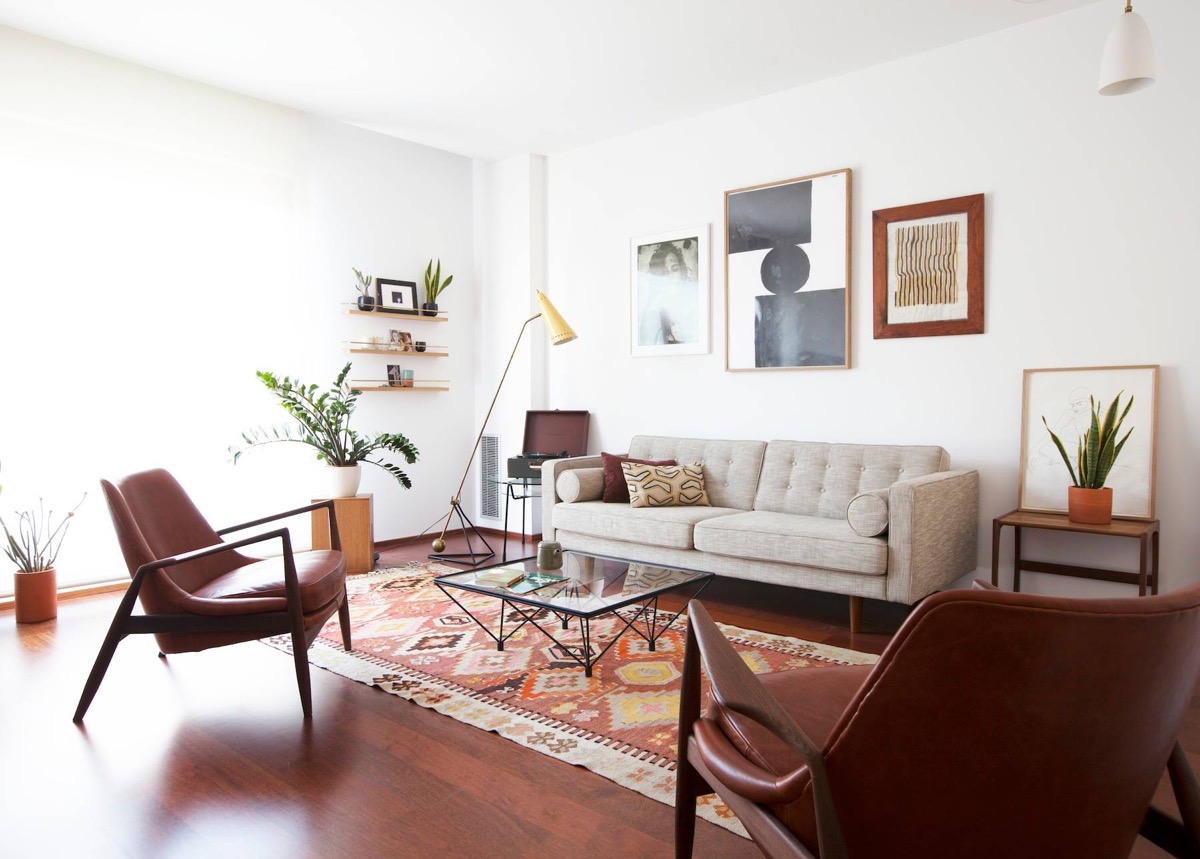
A good opportunity to explore this will be when I find a house to buy after my move to South Carolina. Currently I have no furniture. There’s a reason for that which I won’t go into, but the lack of furniture was on purpose, it allows me to really look at what style I want to be surrounded by. After doing a lot of research I’ve found that I’m most attracted to a style called Mid Century Modern, which is typified by functional furnishings with clean lines, natural materials and solid colors.   

Mid Century Modern Living Room. (Photo courtesy of home-designing.com)

While focusing on utility and value, but with an eye on style and comfort, I intend to turn my future abode into a Mid Century Modern home. I also  intend to document the process here, but all that is a bit premature. There’s a lot that needs to happen before I get to that stage. I just thought it would be a good idea to explore this here, to set the stage, as it were.

More to come. Stay tuned.

Vern

Hurricane Ian

My son lives in Southern California. He loves it there and, when I visit him, I can easily see the attraction. Rolling hills are blanketed by morning fog that melts away as a kind, almost gentle sun rises and warms the land. Most of the year the daytime temperature seldom gets above 87f (30.5c) and nighttime temps hangs around a very comfortable 65f (18c). Beaches to the west, mountains and desert to the east, large urban areas to the north and south and everywhere you turn you feel that iconic California vibe. What’s not to love?

Earthquakes, that’s what.

The ground in SoCal shakes and shimmies so often it doesn’t even register with the locals. I ask my son how is it that he can sleep when the very earth rumbles like the world is siting on one of those hotel vibrating massage beds and someone just put in a quarter. He thinks nothing of it. It’s part of the environment, like the mild temps and the morning fog. The sun shines, the breezes blow, and the earth shakes; that life in Southern California.

Of course, scientists say that ‘The Big One’ is going to happen at some point and a large portion of Southern California, from San Francisco to Baja, will split off from the mainland and become a new island and the destruction and the number of lives lost will be incalculable. My son will counter saying that scientists have been saying that for so long that most folks just don’t care anymore. If it happens, it happens. Que sera sera! 

My son will then point to Central Florida, where I live, where midday summertime temps can easily hit 100f (38c) with humidity hovering near 95%. He points to how often we get drenching, bone shaking thunderstorms, tornadoes, waterspouts, rip tides, and, of course, hurricanes. It’s all true, but I mitigate it all by telling him how much I enjoy the thunderstorms (I actually do enjoy them), that tornadoes are relatively rare (compared to the Midwest, for instance), and waterspouts and riptides can occur anywhere. And because I live near Orlando, which is at least 60 miles or more from any coast, by the time most hurricanes reach us, most of the destructive power has been sapped from them and they become little more than an aggressive tropical storm. Something most Central Floridians sleep through. 

That was a great argument until Hurricane Ian hit this passed week. Ian was born in the Gulf of Mexico where the Gulf’s warm waters are the ideal nursery for such storms. In fact, the Gulf of Mexico is so nurturing that any storm that wanders into the area will find new strength. Hurricane Katrina, that devastated many Gulf States in 2005, was such a storm. It originated in the Atlantic and, after briefly brushing Florida as a weak Category 1 hurricane, it wandered into the Gulf where it was invigorated and became one of the most intense and damaging hurricanes to hit the US.  

A view from my house during the height of the storm

Even though Ian has long since left Florida, the damage it left behind is still being tabulated. That’s because Ian was a super-saturated storm. It pulled so much water out of the Gulf that water levels in Tampa Bay were drained ahead of the storm, leaving boats docked in the bay lying in mud. Ian, in turn, dumped all of that water in a huge swath across Central Florida, from Tampa in the west to Daytona Beach on the eastern coast. On average over a foot (30cm) of rain fell in a 24 hour period. I live in Winter Springs, which is just east of the center of Central FL, and we got more than 15 inches (38cm) of rain. Add to that the damage Category 4 hurricane winds (130-156mph (209-251kph)) can cause and you got a recipe for disaster on a biblical scale.

Another view from my window. Not much damage or debris. Other area were a lot worse.

Florida, especially Central Florida, is a big sand bar and sand can get saturated quickly. All of that rainfall quickly filled the thousands of lakes and ponds that dot the Florida landscape. Creeks became streams. Streams became rivers and rivers overflowed their banks, inundating places that normally are flood-free. 

I’m happy to report that my house and my immediate neighborhood escaped with minimal damage. I was fortunate. Many, many homes suffered damage so severe that rebuilding is questionable. Huge trees, some more than 100 years old, uprooted or had massive limbs sheared off. Some fell on houses and cars. Winds in advance of the storm wreaked havoc in marinas, piling boats on top of each other. Power outages affected hundreds of thousands and water and sewage systems were push far past their ability to cope, leaving residents without potable water or viable waste disposal. I was without power for almost two days, again, I’m lucky because there are still thousands without power. I was also without running water. The water is back on now, but local utilities advise us to minimize use of our sewage systems and boil any water from our spigots before consuming.

And there have been deaths caused, either directly or indirectly, by the storm. Such things one may not be able to prepare for and they are always sad when they occur.

I did prepare in advance of the storm, as many Floridians did. Though flooding is not an issue at my home, I gathered sandbags and positioned them in what I thought were vulnerable places, just in case. I bought water and ice and stocked up of nonperishable foods. I also helped friends prepare as much as I could.

The areas on either side of the road are sod fields. They are still underwater days later.

It turned out that my preparations were not needed. I and my friends all came through the storm ok.

As I sit and reflect on Hurricane Ian and the very real dangers that exist in a place where such storms can and do occur, I think about my son and what I perceived as his somewhat cavalier attitude towards the possibility of a devastating earthquake in SoCal. I realize now that his attitude is not so much cavalier as it is a simple matter of choice. He chooses to live there, understands the dangers, has prepared as much as he can for them, and now he lives his life without worrying about if or when The Big One will strike. If it does, it does and he will do what he can to survive it. 

I guess the same can be said for anyone who chooses to live in places in spite of known dangers. We don’t often get storms like Ian. Most hurricanes that hit Florida tend to be little more than annoyances, like snowfall in the northeast, or dust storms in the southwest deserts. On occasion an anomalous event will happen, such as Ian here, or a Nor’easter in the northeast. They happen, you prep for it then deal with it and the aftermath when they occur, and you move on if you can, however you can. Worrying about it beforehand only degrades the quality of life that is here and now.

And that, my friends, is what really matters.

Stay tuned.

Vern